Science1 distinct publisher3 min readPublished
Stanford and SLAC found the early optical signal they went looking for in common II-VI semiconductors, but the geometry that revealed it has to know when the radiation arrived, which a working detector never does.
The Scientist · Science desk

Compiled by The ScientistSomething wrong?How this is made
A scintillator's light is a second-hand report. Ionizing radiation cannot be measured directly, so detectors read secondary signals: charge is freed, the material relaxes, and visible light comes out [15][6]. That conversion takes time, and the time is the problem. Diana Jeong's question, as she put it, was whether there is "an earlier light signal immediately after ionization that we could observe with ultrafast laser pulses" [7].
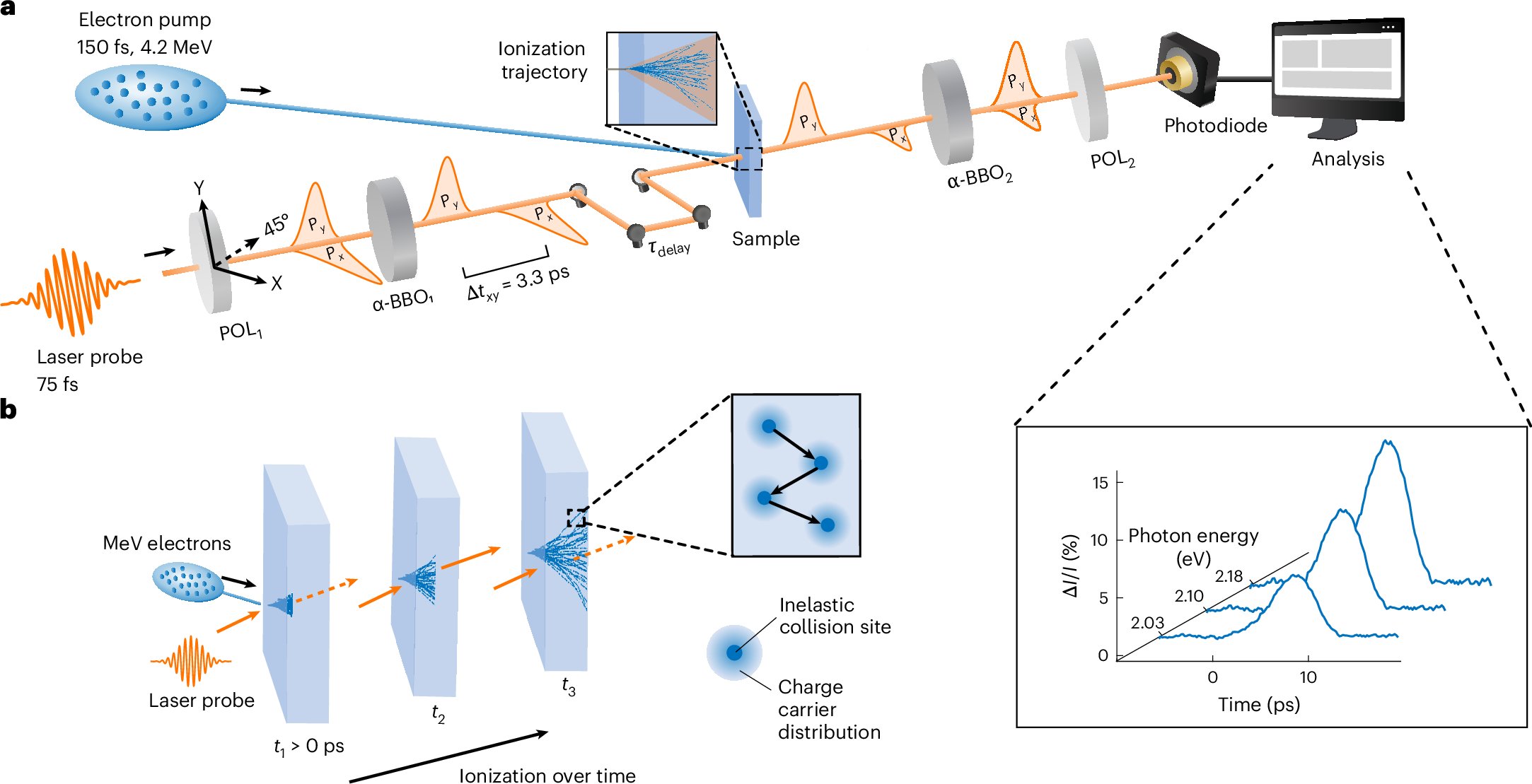
Asking that question requires knowing, to within a very short interval, when the ionization happened. That timing need is what put the experiment at MeV-UED, an instrument built to fire electron pulses at samples and read the diffraction [8]. Here the electrons were not the camera but the radiation, deposited into the sample, with lasers at several wavelengths doing the reading [9]. Patrick Kramer, the facility's laser science lead, said the experiment "flipped that on its head" [10]. The MeV electrons stand in for the ionization that PET imaging produces in tissue, and the laser pulses, synchronized to them, probed the optical response immediately afterward [11].
The samples were II-VI semiconductors, chosen as a proof of concept because, in Tom Hopper's description, they convert the energy from high-energy electrons into measurable changes in their optical properties [12][13]. They did. The signal showed up fast and came in larger than the team had expected [16][4].
The thing this doesn't tell you is how much larger. The account of the work calls the signal unexpectedly strong without attaching a magnitude, a rise time, or a comparison against the light yield of a scintillator crystal [17]. "Strong" is a comparative, and a detector designer's version of the comparison is photons per event against timing jitter, which is not the quantity a pump-probe measurement naturally produces.
There is a deeper gap between this and an instrument. The probe pulse was synchronized to the ionizing pulse [11]. In a PET ring, the ionizing event is a gamma ray from a tracer decaying on its own schedule inside a patient [14]; nobody gets to put a laser pulse on it a picosecond later. So the optical change reported here is, for now, a fact about materials rather than a readout scheme. Closing that gap needs either a way to interrogate the change without a synchronized probe, or a signal the material emits by itself on the same timescale.
The more durable half of the result may be the other surprise: the charge inside the materials behaved differently than expected [4]. That is the part detector engineering would actually have to design around, ahead of the glow itself. The near-term value of this setup is the survey Jeong set out to do in the first place, comparing ionization-induced optical response across material classes [5], a way to screen candidate materials rather than a faster scanner in itself.
Ranked by verification strength, evidence, and original report placement.
The high-energy electrons emulate ionization processes found in applications such as PET imaging, depositing energy into the sample, and synchronized laser pulses probed the material's optical response immediately after ionization rather than detecting the glow.
Current radiation detectors often make trade-offs, providing signals that are strong but slow or fast but weak, which can limit precision detection.
Stanford University researchers worked with the Department of Energy's SLAC National Accelerator Laboratory on an experimental setup to detect radiation across a range of materials.
The research was published in the journal Nature Photonics.
The researchers observed an unexpectedly strong ultrafast radiation signal and also found that the charge within the materials acted differently than expected.
Diana Jeong, instructor of radiology at Stanford University and corresponding author, set out to systematically investigate optical signal strengths induced by ionization across a range of material classes.
Distinct publishers with included, body-backed reporting in this cluster.
phys.org
1 article · September 4, 2026
Follow any of these and your For You feed starts watching them — no settings page required.
product
Copper melts by degrees, not all at once, and that breaks one fusion modelling assumption2 distinct publishers
product
Squeezing the electrolyte turned lithium dendrites sideways in SLAC's test cells1 distinct publisher
science
The self-driving lab is out. Whether AI shows up in your filing is still open.1 distinct publisher
science
A centuries-old Coulomb's law test could out-search accelerators for millicharged particles1 distinct publisher
Evidence-backed comparisons of source perspectives and observed adoption signals. Read the methodology
Which Builder, Operator, and Investor concerns the observed source mix emphasized—not a truth score.
Evidence, demonstrated adoption, hype gap, incentives, and confidence are assessed independently, each on its own current evidence. How these are measured.
Peer-reviewed work, retold without a single number
The underlying study cleared Nature Photonics, and phys.org names the instrument, the material family, and three researchers who can be held to what they said, which puts it above the average single-outlet science item. The central result still reaches the reader as an adjective. Without a magnitude, a decay time, or a scintillator benchmark, the claim that the speed-versus-strength trade-off has been improved on cannot be checked from what is on the page.
One beamline, one run
The technique exists at MeV-UED and, in this reporting, nowhere else. No repeat by another group, no detector using the effect, and the physician's-office imaging is stated as the corresponding author's hope. We would rather record the publication and leave the dial blank than score a proof of concept as uptake.
The gap lives in the timing
Framing runs ahead of the measurement at one specific joint. Every reading here depended on the ionizing pulse and the probe laser sharing a clock, while radiation arriving at a working detector gives no advance notice, so 'potentially paving the way for better sensing technologies' rests on a step nobody has taken. The physics description itself is careful; the overstatement belongs to the prose around it.
Every quote comes from inside
The three voices are the corresponding author, the facility's laser science lead, and a former SLAC postdoc, so the people characterising the result also benefit from the beamline that produced it looking indispensable. phys.org's version reproduces the institutional explanation, analogy included, rather than testing it. That does not make the finding wrong, but nobody in the story had a reason to press for the missing numbers.
Solid on who and what, thin on what follows
We are reasonably sure about the people, the instrument, and the journal. Confidence falls away on consequence, because the strength claim is unquantified and a single publisher carries the whole story. The paper's own figures, or a second account from outside the collaboration, would move this in short order.