Invest1 distinct publisher3 min readPublished
Kyiv has now hit the same 6 to 7 per cent slice of Russian refining three times in eight months. A hazard on that cadence belongs in the supply model, not a footnote about tail risk.
The Investor · Invest desk

Compiled by The InvestorSomething wrong?How this is made
Start with the plant's own arithmetic. Kirishi runs 17.5 to 18 million tonnes of crude a year [6], which works out to between roughly 47,900 and 49,300 tonnes a day [1], and if that throughput is 6 to 7 per cent of Russian refining [7], the implied national total sits between about 250 and 300 million tonnes a year [2]. A single plant at that scale moves product balances without setting them.
The cadence is the more interesting number. March, May and the night of 29 to 30 August [3][1] is three events in the first eight months of 2026, an average gap near 2.7 months [3], and a hazard that recurs on roughly an eleven-week clock is something a charterer lifting product out of the Baltic [8] can put an expected value on, not just flag as a caveat.
Here is where I would slow down. The account says the March and May strikes forced temporary shutdowns and damaged processing units [3]; it does not say for how long, and repair time is the whole question, because a strike only converts into lost export volume if the units stay down longer than the interval to the next visit. Two readings fit the same three data points. Mine, probably wrong about confidence more than direction, is that a facility hit three times at a range of more than 800 kilometres [2] is a facility Kyiv can reach when it chooses, consistent with the broader intensification of drone operations since 2024 and 2025 [10]. The less flattering reading is that you go back to the same distillation units precisely because the last trip did not keep them off line, which would make repetition a sign of shallow damage, not deep reach.
The reporting asymmetry cuts against precision either way. Governor Alexander Drozdenko put 42 drones intercepted over Leningrad Oblast [4], and nothing in the account gives a launched count, so that is a numerator without a denominator; the damage itself is reported by Ukrainian sources [5], while cryptobriefing.com describes a standing pattern of Russian officials leading with interception totals and trailing on damage [9]. Anyone modelling outage probability is working from one side's photographs.
What would prove the thesis wrong is loading data showing product moving out of Baltic terminals within days of each fire, or simply no fourth strike by November, which would make 2.7 months [3] look like an artefact of three points, not a rate. And on the other side of the ledger, a drone flown more than 800 kilometres [2] to a Baltic-facing refinery is a drone not flown at closer logistics, which is a real allocation choice priced by Kyiv at whatever it thinks Russian export product is worth.
Ranked by verification strength, evidence, and original report placement.
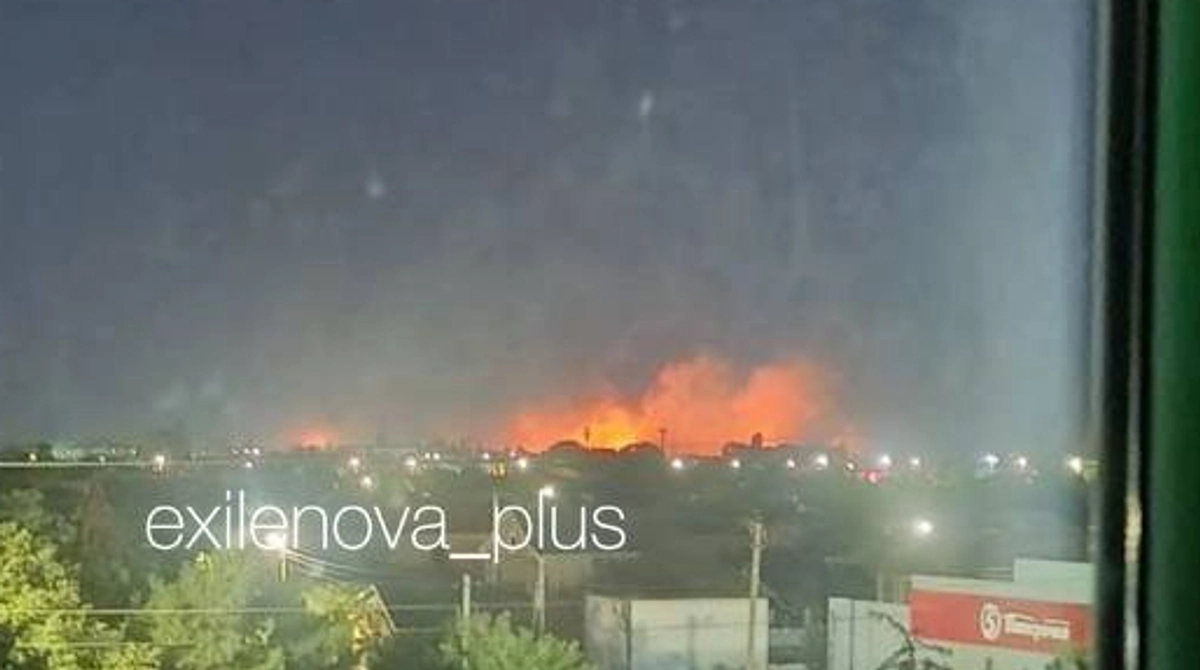
A Ukrainian drone strike set fire to the Kirishi oil refinery in Russia's Leningrad Oblast on the night of August 29-30.
The Kirishi facility is located roughly 100 kilometres southeast of St Petersburg and more than 800 kilometres from the Ukrainian border.
This is the third time the Kirishi facility has been targeted in 2026; strikes in March and May caused significant damage to processing units and forced temporary shutdowns.
The refinery is operated by Surgutneftegaz and processes approximately 17.5 to 18 million tons of crude oil per year.
Kirishi's throughput represents roughly 6 to 7 per cent of Russia's entire refining capacity.
The refinery is a key supplier of refined fuels destined for export through Russia's Baltic Sea ports.
Distinct publishers with included, body-backed reporting in this cluster.
cryptobriefing.com
1 article · August 30, 2026
Follow any of these and your For You feed starts watching them — no settings page required.
Evidence-backed comparisons of source perspectives and observed adoption signals. Read the methodology
Which Builder, Operator, and Investor concerns the observed source mix emphasized—not a truth score.
Evidence, demonstrated adoption, hype gap, incentives, and confidence are assessed independently, each on its own current evidence. How these are measured.
Thin: one outlet, two interested voices
Everything traces to a single cryptobriefing.com write-up. Its two named or characterised sources are a Leningrad Oblast governor with reason to stress interceptions and unnamed Ukrainian sources with reason to stress hits, and no third party — refinery operator, shipping data, satellite imagery, wire agency — appears anywhere. The arithmetic on tonnage and cadence holds together, which is the strongest thing that can be said for the numbers.
Not applicable to this reporting
There is no product, standard or deployment here to measure uptake of, and the nearest real-world signal — actual lost throughput or diverted Baltic cargoes — is never quantified. Guessing at it from a claimed capacity share would be inventing the number.
Framing runs ahead of the damage record
The reporting reaches for national significance — 6-7 per cent of Russian refining, Baltic export lifeline, escalating campaign — while the only concrete outcome it can name for 30 August is a fire. Three strikes on one site in eight months is genuinely the story's spine, but nothing in the account establishes that any of the three cost a measurable barrel, and the broad claim about many refineries losing throughput names none of them.
Both quoted sides are advocates
cryptobriefing.com says the quiet part itself: Russian officials lead with interception counts and soften damage. The mirror image goes unremarked — Kyiv's claim of direct hits is equally self-serving, and 'Ukrainian sources' are never identified. When the only two inputs on what happened are the attacker and the attacked, the distortion pressure on this record is about as high as it gets.
Directionally plausible, individually unchecked
That Kirishi has been hit and matters to Baltic fuel exports is consistent and unsurprising; each specific figure — 42 drones, 17.5-18 million tons, three strikes, March and May shutdowns — is a single unsourced assertion. We would hold the pattern and re-verify every number before it entered a supply model.