Invest1 publisher3 min readPublished
One Kharkiv warehouse held a fifth of Ukraine's annual book print run
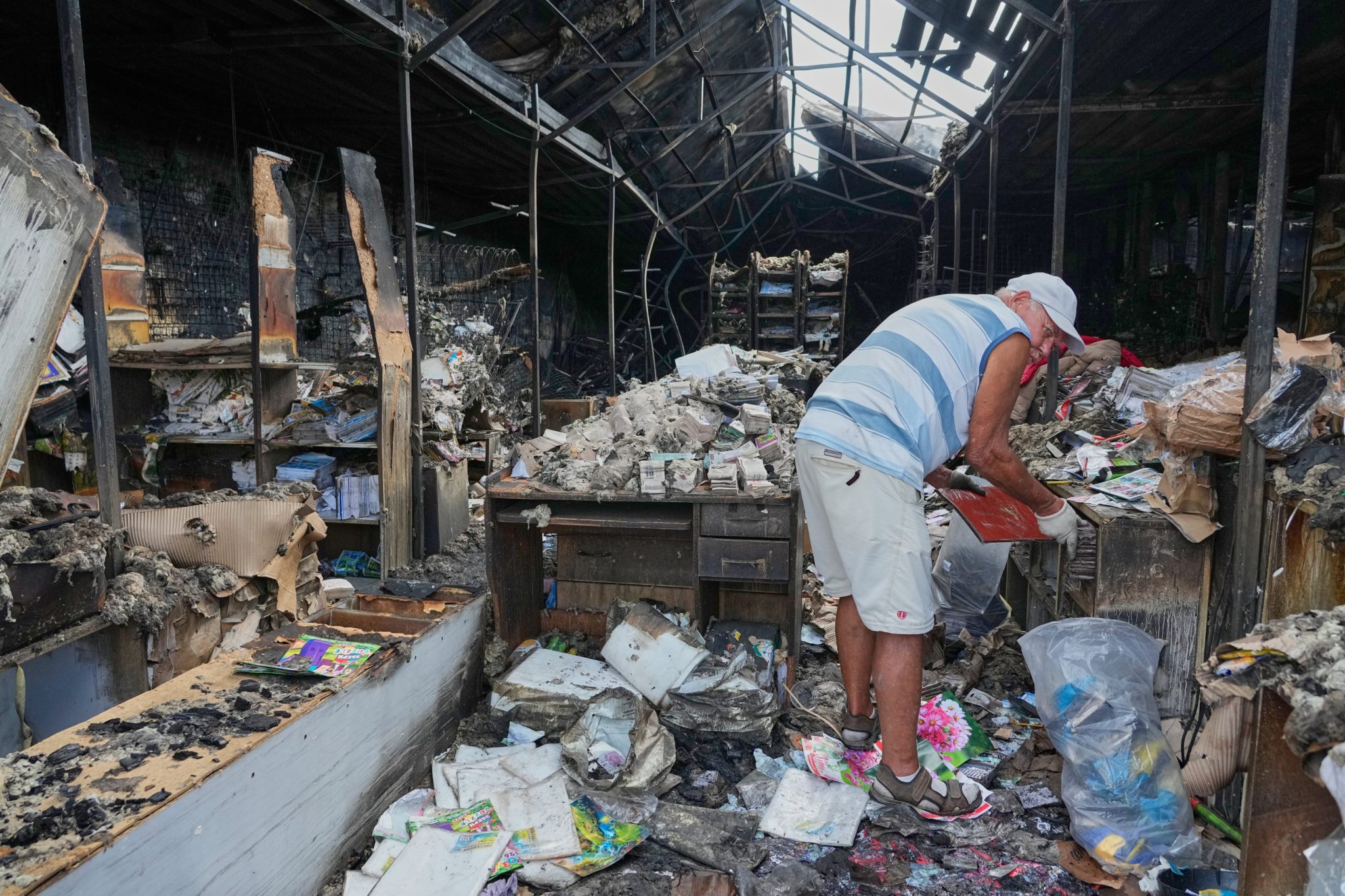
Two drones hit Ranok's logistics hub on Aug. 1 and destroyed 8 million books, most of the 13 million Ukraine lost this summer. The Ministry of Culture counts $39.3 million of damage, about $3 a copy.
The Investor · Invest desk
What happened
- Two explosive-laden Shahed drones struck the main hub of the publishing house Ranok in northeastern Kharkiv on Aug. 1, according to its owner, Viktor Kruglov.
- The Ranok strike alone destroyed 8 million books, among them 620,000 textbooks, for a company that supplies nearly all of Ukraine's schools.
- At least 40 other publishing houses and multiple bookstores have been damaged in recent weeks, alongside a wider toll of nearly 5,000 cultural sites.
Compiled by The InvestorSomething wrong?How this is made
Why it matters
- exposure A single automated hub held about a fifth of what Ukraine prints in a year, so one night's strike reached inventory that took roughly twelve months of press scheduling to produce.
- cost At about $3.02 of counted damage a copy, replacing the summer's losses is a printing bill, and whichever balance sheet funds it (the state's or the publishers') funds no new titles with the same money.
- decision Berezhna says publishers short of cash will back bestsellers and translated titles instead of debut authors. That sets what Ukrainian literature has to draw on a decade from now.
A third of an annual run puts Ukraine's national print at about 39 million books [20], and the $39.3 million of damage the Ministry of Culture counted against more than 13 million destroyed copies comes to roughly $3.02 each [4][21]. Ranok's hub held 8 million of them: 62 per cent of the summer's national loss, and about a fifth of what the country prints in a year [5][22][23]. "There were difficult periods" for Ranok in the 2008 crisis and the pandemic, Kruglov said, "but no one could have imagined that almost a year's turnover for Ranok could be destroyed at once" [7].
"Steel was blazing and burning," Kruglov said of the Aug. 1 attack, and the warehouse's reinforced concrete melted and the roof caved in [2]. The fire ran for almost a week [3]. He also said Ranok keeps backup warehouses and stores all its files in the cloud. "That's probably what's keeping us going, because we're able to reprint books, and we've kept our team," he said [8]. Press time is the scarce input, and so is the cash to print 8 million copies a second time.
The account says demand for Ukrainian-language books surged after Russia's 2022 invasion and that the destruction is setting the industry back anyway [11]. It gives no sector revenue or unit sales figures. "This is a deliberate policy of Russia because they understand that culture is what makes us feel resilient, what makes us feel the owners of our land, of our destiny," said Tetiana Berezhna, Ukraine's culture minister [13]. Kremlin spokesman Dmitry Peskov did not respond to an Associated Press request for comment about the strikes on Ukraine's publishing infrastructure [19].
Concentration in one automated hub was the cheap way to run this business, and it may still be. The Ranok building opened in 2013 and could process tens of thousands of books a day [6]; splitting that across sites adds rent and handling on an item the ministry values near $3 [21]. The proposed support package answers the loss with money: state purchases of Ukrainian books for school libraries, grants toward small publishers' printing costs, rent compensation for bookstores, and war-risk insurance for print runs [16]. Insurance pays for a burnt run and grants pay to print it again.
If paper and presses are available, the loss is a working-capital problem and money of the kind the ministry is assembling covers it [16]. If print capacity is as concentrated as warehousing, money buys a place in a queue. A third possibility cuts against inventory siting as the sector's shared exposure: the 40-plus other damaged publishers may have lost shops and offices instead of stock [9].
Berezhna said the attacks have hurt publishers' ability to invest in new authors, since debut writers cost more than the safer bet of bestsellers and established translated literature [14]. Those "newcomers, debut literature, in 100 years will become Ukrainian classics that will tell the world about Ukraine," she said [15]. Publishers have said the measures are not enough [17]. Kruglov called the book industry an "element of Ukraine's national security" [10].
What to watch
- Whether the war-risk insurance program covers print runs in storage as well as in transit, and at what premium publishers can actually buy it.
- Whether Ranok's backup warehouses and reprints restore the 620,000 destroyed textbooks in time for the school year.
- Whether other publishers move stock to multiple smaller sites, and what that adds to rent and handling per copy.