Invest1 distinct publisher3 min readPublished
The tally is one minister's readout of a closed two-day session, not a signed communique. Importers now have to decide how much of it to price as nineteen separate duty schedules arriving over the next year.
The Investor · Invest desk

Compiled by The InvestorSomething wrong?How this is made
The gap between nineteen nods in a room and nineteen actual tariff schedules is the only part of this an importer can actually price.
Start with what has been measured. The Tax Foundation put the 2025 tariff round at roughly a 7% lift in the retail price of imported consumer goods relative to pre-tariff trends [7], and the administration is now weighing an additional 7.5% on Chinese imports off the back of investigations into alleged excess industrial capacity and forced-labor rules [9]. Multiply 1.07 by 1.075 and you get about 1.15 [2]. That number is precise but misleading: the 7% is a measured retail outcome across every origin, the 7.5% is a proposed duty rate against one, so 15% is a ceiling for the narrow basket that eats both, not a forecast for anything wider. It is still the arithmetic a sourcing desk has to hold.
Read the tally from the other end. The lone dissenter is the party holding the record $1.2 trillion surplus that Bessent calls a barrier to global growth [10] [14], and the 95% who agreed, as he describes them, are the buyers [1]. Agreement among customers about a supplier's pricing is cheap to obtain and expensive to implement, because each of the nineteen has to write its own schedule and absorb its own consumer-price hit.
The mechanism that matters for supply chains is diversion. Bessent's account is that he told counterparts at the start of Trump's second term that a US tariff wall would push Chinese goods into their markets, and that he was right [5]; if so, the re-routing trade that import-dependent firms have leaned on (buy the same goods through a third country, pay the freight, hold the price) works only for as long as the third country stays open. The legal channel has changed too. The Supreme Court decided in February that the sweeping tariffs imposed under an emergency powers law were unconstitutional [8], so the next round arrives as investigation findings on capacity and forced labor rather than as one blanket rate [9], which is also a statement about where Treasury is spending itself: persuading nineteen finance ministries rather than defending a statute it lost. Product-specific dockets take longer to arrive and are harder to unwind.
(Bessent also said he does not think bond markets are in "any kind of dire situation" [12], with global debt at a record $353 trillion and US debt at $40 trillion in August, the US share working out at 11.3% [11] [3]. The deficits that mirror the surpluses get financed somewhere.)
There's a real case that this reading is wrong: it's one speaker's characterization of a closed two-day meeting [1] [2], no communique is quoted, and Trump's own post that other countries "should follow our lead" [6] is a request rather than a commitment. The same table could not settle whether Russia's finance minister belonged in the family photo, according to Canada's Francois-Philippe Champagne [15]. This is probably wrong, but I would nudge up the odds of duty actions taken outside Washington in the next few quarters, on the grounds that Bessent quoted the substance in ministers' own interest terms rather than America's [3] [4]. This would be proven wrong by two quarters passing with no G20 member other than the US opening an action against Chinese goods, or by a Trump-Xi meeting [13] that buys surplus reduction directly and makes the nineteen redundant.
Ranked by verification strength, evidence, and original report placement.
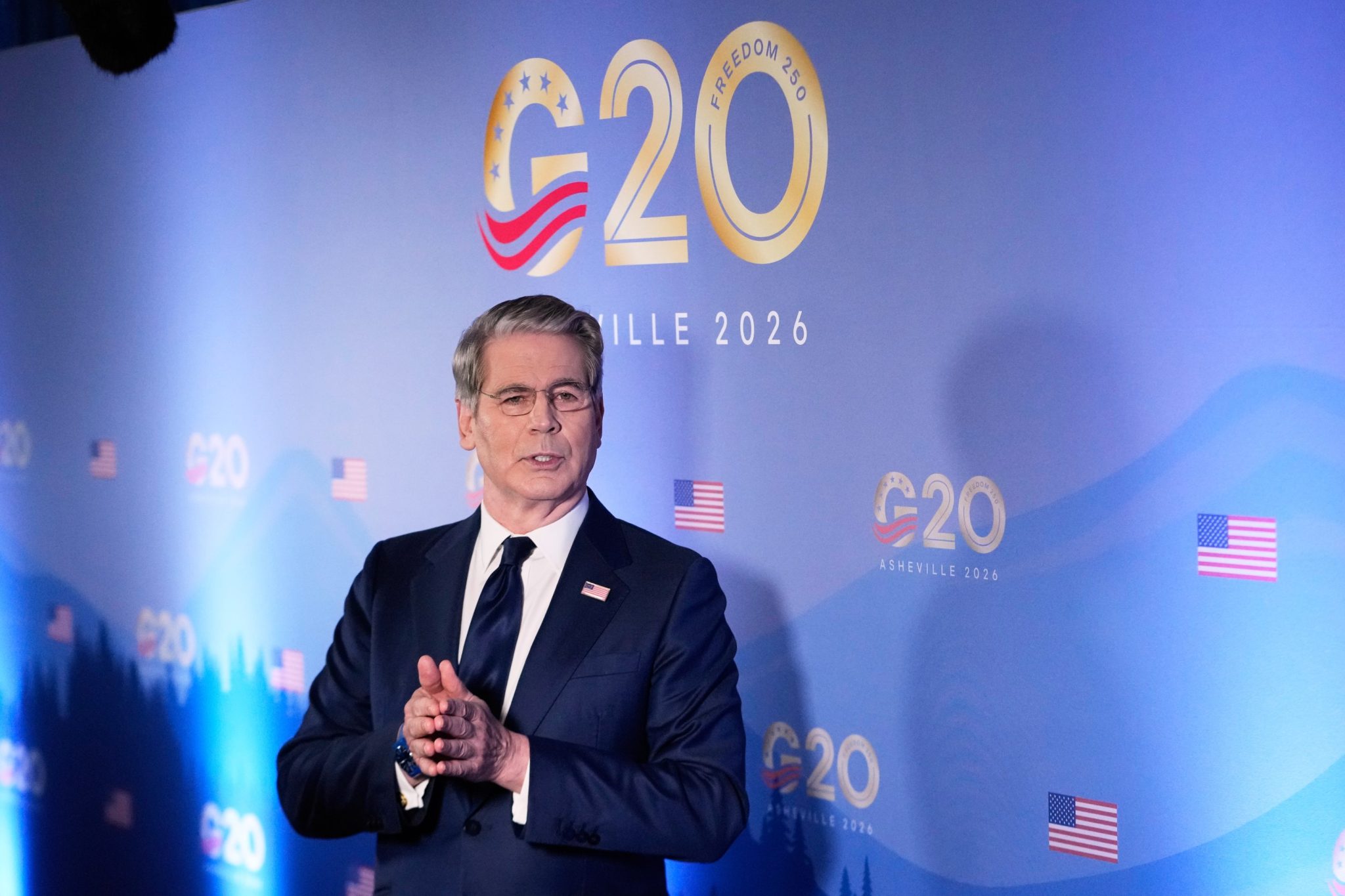
Treasury Secretary Scott Bessent said Tuesday that 19 members of the G20 had agreed to address streams of "cheap exports" that cause global economic imbalances, but said China had dissented.
Bessent, describing the sentiment he said all but one G20 member agreed to: "We believe that non-market-based economies pushing out a never-ending stream of cheap exports is not sustainable."
Bessent said: "It is clear that the country with the world's largest and unsustainable current account surplus, the People's Republic of China, was the dissenter."
Bessent made the comments at the end of a two-day meeting with finance ministers and central bankers, where he said he tried to focus on growth.
Bessent told reporters he had urged some of his G20 counterparts to take a page from the Trump administration's playbook of using tariffs and other measures to crack down on trade imbalances.
Bessent said he had warned other nations at the beginning of Trump's second term that the new U.S. "tariff wall" would mean Chinese goods flooded their markets, adding: "And unfortunately, I was right."
Distinct publishers with included, body-backed reporting in this cluster.
fortune.com
1 article · September 2, 2026
Follow any of these and your For You feed starts watching them — no settings page required.
invest
Tariff refunds now outrun collections, and net customs revenue has gone negative1 distinct publisher
invest
The $40 trillion problem has a $32.8 trillion denominator1 distinct publisher
invest
Trump's 7.5% China tariff is priced to keep a summit, not to close a factory1 distinct publisher
invest
Iran's oil is already off the market, which is the problem with pricing the next sanctions round1 distinct publisher
Evidence-backed comparisons of source perspectives and observed adoption signals. Read the methodology
Which Builder, Operator, and Investor concerns the observed source mix emphasized—not a truth score.
Evidence, demonstrated adoption, hype gap, incentives, and confidence are assessed independently, each on its own current evidence. How these are measured.
One microphone, one room
The headline count of nineteen has exactly one witness: the man who chaired the pitch. No communique, no signatory list, no minister other than Champagne speaking on the record, and Champagne is talking about Russia's presence rather than trade language. The verifiable material sits in the margins — the Tax Foundation's 7% estimate, February's Supreme Court ruling — while the three record dollar figures arrive with no institution attached to them.
One tariff wall, nineteen maybes
What has actually been adopted is American: duties whose retail footprint the Tax Foundation puts near 7%, minus whatever February's ruling struck down. The nineteen counterparts are reported as agreeing with a sentiment, and a sentiment has no effective date. The next concrete step in the story, a 7.5% China duty, is still being eyed.
Consensus asserted, consensus unshown
"Nineteen of twenty" is built to sound like a vote. It is a readout, and it is followed by Trump telling the world to "follow our lead" and by Bessent's "unfortunately, I was right" — a framing that converts a closed-door discussion into vindication. Set against it: the price evidence points at American consumers, and the legal foundation of the program was knocked out in February. The gap is in how firm the agreement sounds, not in whether the meeting happened.
The narrator is the advocate
Every contested element traces to the official whose trade policy the count validates, delivered at a podium he controlled, and reinforced within the hour by the President. Bessent also has an interest in the reassurance he offers on bonds: Treasury sells the paper being sold off. The reporting itself carries no such stake — AP's byline and the Tax Foundation citation are the counterweights — but the sourcing gives the interested party the microphone almost exclusively.
Firm on the quotes, thin on the substance
That Bessent said these things is not in doubt; a wire reporter was in the room and the quotes are direct. What people were agreeing to, whether China's dissent was voiced or inferred, and when any of the nineteen intend to act are all unresolved, and a single publisher cannot resolve them. Confidence sits where the transcript ends.