Product1 distinct publisher3 min readPublished
Ugreen's three-tier hub line tops out at a Jetson Thor box rated up to 2,070 TOPS. Its cheapest model charges roughly seven times more per TOPS than that flagship does. All three are currently half price.
The Product Desk · Product desk

Compiled by The Product DeskSomething wrong?How this is made
Divide price by claimed AI performance and the ladder turns upside down. The entry HA100 works out to about $69 per TOPS [1], the HA100 Pro to roughly $29 [2], and the MasterAgent to about $9.66 [3]. The cheapest box on the shelf charges around seven times more per unit of rated inference than the most expensive one [4], and the early bird does not fix that, because every tier is discounted by the same half [5]. Paying eleven times more gets you close to eighty times the rated compute [6].
That is a silicon floor: the price tracks memory and die area, and each tier is buying a chip, not a feature set. Getting any usable local model into a living-room enclosure costs a certain amount of memory and die area, and the $1,799 tier is mostly paying that toll: 16GB of LPDDR5 and 26 TOPS on an RK3588 [5], against 128GB of unified memory on Jetson Thor at the top [7].
The HA100's buyer is someone who wants object recognition and rule-based routines with no monthly bill [8]. The buyer of the pitch, the one who wants a hub that reads motion, infers behavioral intent and accepts spoken automation rules, starts at $5,999 [9].
The rollout problem sits in the software. Matter and ONVIF will get third-party devices talking to the hub [10], but automation logic does not travel over a device protocol. The household most likely to want local processing is already running Home Assistant, and Ugreen has no official support for it, while Anker's competing hub, announced the same day, does [11]. Whoever installs this on Monday rebuilds their routines by hand in Ugreen's app, and explains on Friday why the old ones are gone.
According to Ugreen NAS community manager Thomas Brown, the savings from running models locally instead of paying cloud token costs are what make these hubs attractive, and the marketing materials add cloud storage savings to the case [12]. Engadget's reporter, who came away calling the upfront cost prohibitive [13], was offered no token figures to check that against. You also supply your own SATA drives for the included bays [14], so part of what you are buying is a NAS you may already own.
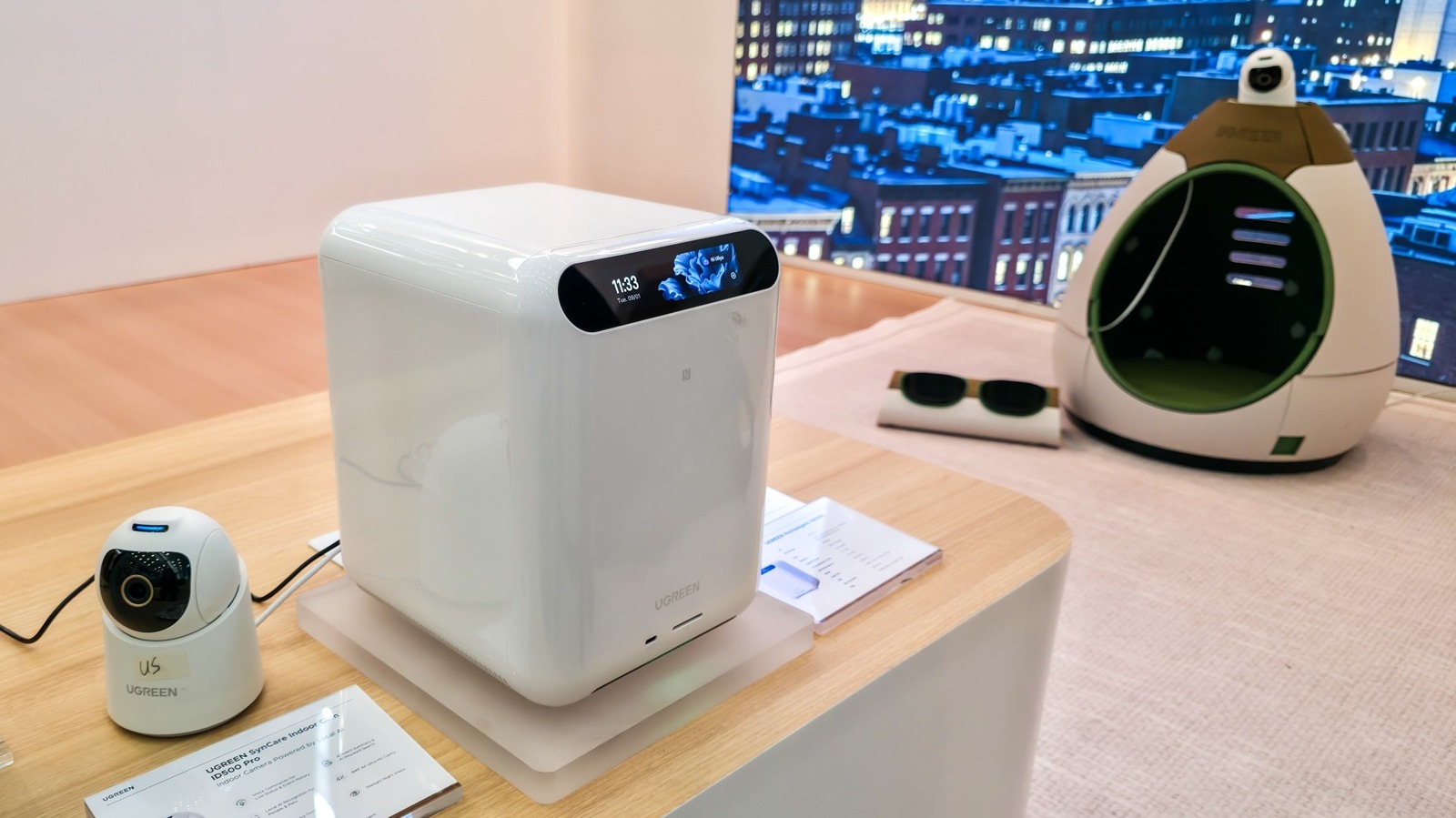
The test that survives a budget conversation is one page with two numbers on it. First, the annual subscription and cloud storage spend you would genuinely cancel, multiplied by the years you expect the hub to last. Second, the count of devices in your house that work on day one over Matter or ONVIF, rather than waiting on the Zigbee and Thread support that product planning manager Markus Xie says is on deck [10]. If the first number falls short of the early-bird price, then privacy is the purchase, and that is the honest way to price it in. Buyers coming for the cameras have a further wait to price in: the SynCare units appear to be the final versions of the cameras Ugreen showed at CES with a back-half-of-2026 promise [16].
Ranked by verification strength, evidence, and original report placement.
Ugreen launched its smart home product lineup built around local AI-powered hubs, HomeAgent and MasterAgent, based on ARM architectures.
The launch took place at a Gillette Stadium event in Foxborough, Massachusetts, and also covered indoor and outdoor security cameras, a smart picture frame and a smart speaker.
Ugreen's stated goal is to provide smart features similar to those from Amazon and Google without sending sensitive user data to the cloud; the AIoT line is new territory for a company best known for fast chargers, USB cables and NAS devices.
The HomeAgent HA100 runs on an RK3588 platform with 16GB of LPDDR5 memory and a combined 26 TOPS of AI performance, retailing at $1,799 with an early bird price of $899.
The HA100 Pro runs on the CIX-CP8180(P1) SoC with 32GB of RAM for 205 TOPS, priced at $5,999 or $2,999 with the early bird deal.
The MasterAgent MA100 runs on Nvidia's Jetson Thor platform, a Blackwell system-on-module with 128GB of unified memory and up to 2,070 TOPS, at a $20,000 retail price with early bird pricing 50 percent off MSRP.
Distinct publishers with included, body-backed reporting in this cluster.
1 article · September 3, 2026
Follow any of these and your For You feed starts watching them — no settings page required.
product
Eufy bets an on-device chip beats the cloud round trip for home AI5 distinct publishers
product
Anker rebuilds Eufy's privacy promise as hardware you can test1 distinct publisher
product
Philips Hue partners with Nanoleaf on wall panels, with a $39.99 connectivity module1 distinct publisher
invest
18x per joule in 16 months, and most of it was not your model choice1 distinct publisher
Evidence-backed comparisons of source perspectives and observed adoption signals. Read the methodology
Which Builder, Operator, and Investor concerns the observed source mix emphasized—not a truth score.
Evidence, demonstrated adoption, hype gap, incentives, and confidence are assessed independently, each on its own current evidence. How these are measured.
One reporter, in the room, unverified numbers
Engadget was physically present, quotes two Ugreen staff by name and title, and reports silicon, memory, rated TOPS and both price tiers for every hub — which is why the specifics hold up. What it cannot do is check them: the 26, 205 and 2,070 TOPS figures are vendor ratings repeated, the encryption claims come from a product manager, and no second outlet has independently confirmed that a $20,000 consumer hub exists at that price.
Announced, not installed
Nothing is in anyone's house. There was one functioning HomeAgent at a stadium full of launch marketing, the cameras are described as final versions of hardware promised for late 2026, and the only commercial signal is early bird pricing — which sells intent, not units. No order counts, no ship dates, no deployments.
2,070 TOPS advertised, one curtain opened
The gap here belongs to Ugreen's framing, not to the reporting. Behavioural intent inference, natural-language rule creation and a cost case built on avoided cloud tokens were all presented; what worked in front of attendees was lights and curtains. The per-TOPS arithmetic sharpens the point — the tier most buyers would consider charges about seven times more per unit of compute than the flagship. Engadget's own scepticism keeps the number from going higher.
Ugreen's stage, Ugreen's math
The venue, the promo reel, the newly signed Patriots brand ambassador and the panel were all Ugreen's, and the argument that local inference pays for itself came from a Ugreen community manager standing on that stage. Half-off early bird pricing adds a clock to the decision. None of that makes the claims false; it does mean the only cost-benefit case on record was made by the party selling the hardware.
Solid on what was said, thin on what works
We can stand behind the announcement, the configurations and the prices; we cannot yet stand behind the capabilities. A single publisher, a single working unit, vendor-supplied performance figures and a ship window that has not arrived leave the interesting questions — does local inference at 26 TOPS do anything useful, and will Home Assistant ever be supported — open.