Product1 publisher3 min readPublished
Army puts last-mile autonomy on the clock: six vendors, 24 prototypes, one 2027 verdict
The Infantry Last Tactical Mile program has narrowed to six companies, each owing four vehicles, with soldiers judging them in an operational assessment in early 2027.
The Product Desk · Product desk
Drafted by a language model from the sources cited here and checked against its claim ledger before publication. How we use AISend a correction
What happened
- The U.S. Army selected six companies to develop production-ready prototypes of autonomous ground vehicles for missions that currently require soldiers to drive into exposed areas.
- The Infantry Last Tactical Mile (ILTM) initiative focuses on the stretch between rear support areas and the forward line of own troops (FLOT); the vehicles are intended to conduct logistical resupply, casualty evacuation and network-extension missions.
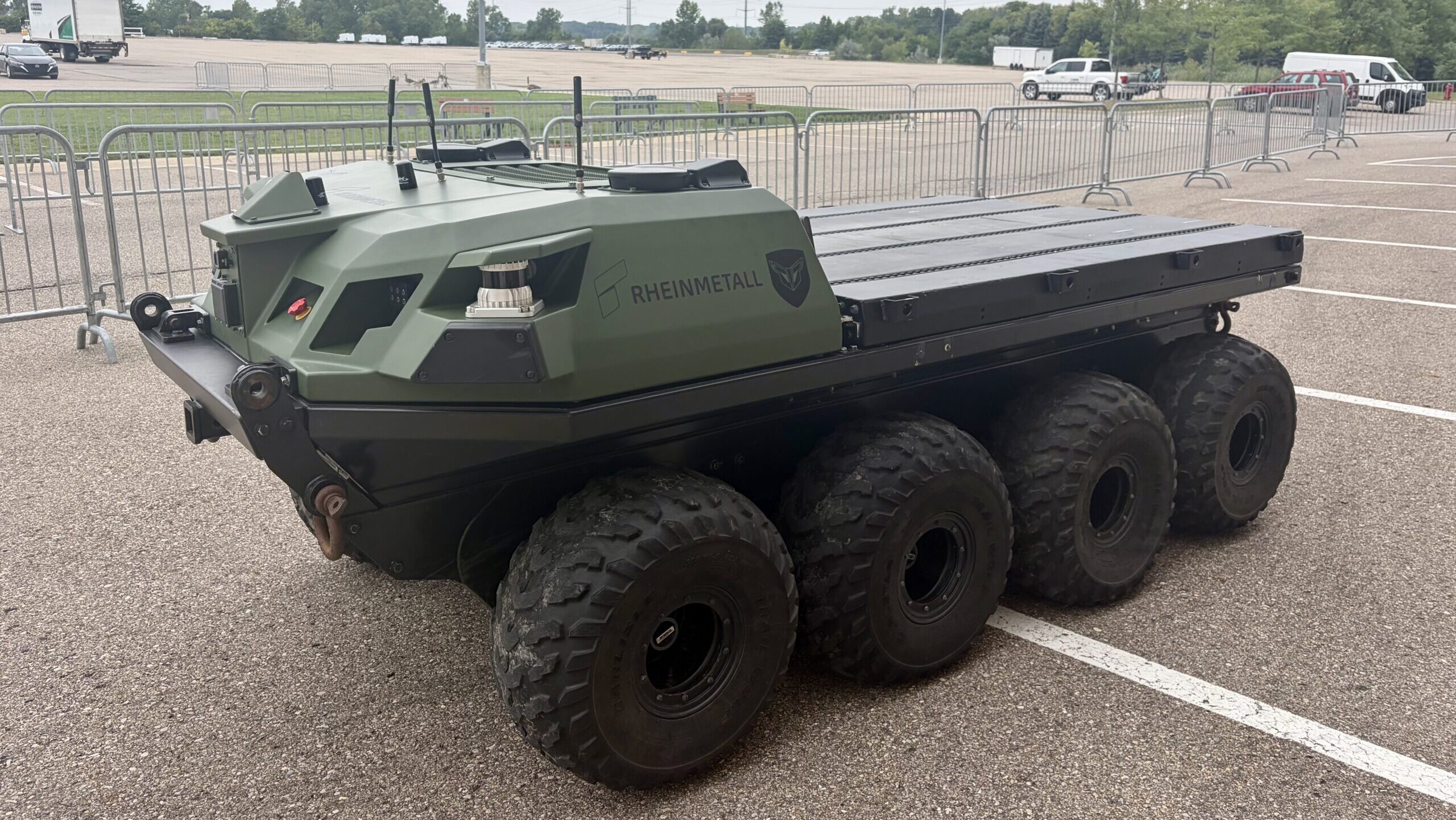
- The six selected companies are Maren-Go, Overland AI, Forterra, Hendrick's Motorsports, American Rheinmetall and HDT, according to Breaking Defense citing an Army spokesperson.
- Each selected company is expected to provide four prototype vehicles for Army testing.
- Six vendors delivering four prototypes each amounts to about 24 prototype vehicles entering Army testing.
Compiled by The Product DeskSomething wrong?How this is made
Why it matters
The U.S. Army has selected six companies to build production-ready prototypes for its Infantry Last Tactical Mile initiative, which targets autonomous resupply, casualty evacuation and network extension between rear support areas and the forward line of own troops [1][2][3]. Each vendor is expected to deliver four vehicles [4], which converts a long-running concept argument into a comparative hardware evaluation with a date attached: an Operational Assessment by an Army unit in early 2027 [11].
The six are Maren-Go, Overland AI, Forterra, Hendrick's Motorsports, American Rheinmetall and HDT, according to Breaking Defense citing an Army spokesperson [3]. Four prototypes across six vendors implies roughly 24 vehicles entering the test regime [5]. That is a deliberately wide funnel. Rather than committing to one vehicle architecture, the Army is putting multiple approaches through the same evaluation and letting performance decide what gets further investment [9].
The mission definition matters more than the vendor list. The Army wants beyond-line-of-sight autonomous operation, not another remotely piloted truck, with the vehicles supporting manned close-combat formations while running outside the operator's direct sight [2][8]. The rationale is exposure: the final few miles of a supply route are where vehicles become vulnerable to artillery, drones, mines and small arms, so the program is less about replacing trucks than about removing crews and medics from that specific stretch [6][7].
Only half the field is publicly identified. Breaking Defense reports American Rheinmetall is expected to offer the Mission Master SP-H, an unmanned tracked vehicle built for autonomous logistics [12], and Overland AI the ULTRA, an off-road platform derived from the Polaris RZR with Overland's autonomy stack [13]. Forterra has previously shown MESA, a logistics and casualty-evacuation vehicle on the Polaris Ranger XD 1500, pairing its AutoDrive system with Vektor communications intended for low-bandwidth conditions [14]. Maren-Go, Hendrick's Motorsports and HDT have not disclosed their intended vehicles [15], meaning three of six entries are unknown [16]. Of the three disclosed, two are Polaris-derived wheeled platforms [17], which is a useful signal about where the cost and sustainment assumptions are landing.
Nothing here is a production order [10]. Formal prototype agreements are expected in the coming weeks, followed by technical demonstrations and evaluations, then the 2027 assessment, with soldier feedback shaping which platforms move toward production [10][11]. The interesting part of that sequence is the criteria: the source material describes systems that must handle difficult terrain, hold communications, keep working when satellite or other links are disrupted, and respond when the route or mission changes mid-run [18]. Those are the conditions under which demonstration-grade autonomy usually stops looking impressive.
Three things to watch. First, whether the prototype agreements are actually signed on the stated timeline, since the 2027 assessment date only means something if deliveries start when promised [10][11]. Second, whether the degraded-communications requirement is tested adversarially or merely noted, given that Forterra is already marketing low-bandwidth comms as a differentiator [14][18]. Third, what the undisclosed three bring: with half the field unrevealed, the actual spread of architectures under test is still not public [15][16].