Science1 publisher2 min readPublished
A turtle listed critically endangered in Victoria is spreading through nine Manning River tributaries
An introduced population of Macquarie River turtles is moving through the Manning catchment in New South Wales. The researchers now tracking it with water samples are monitoring a species that two other states list as threatened.
The Scientist · Science desk
What happened
- The Manning River helmeted turtle lives nowhere on Earth except a few coastal rivers in the Manning region of New South Wales. It is listed as endangered.
- Macquarie River turtles turned up in the Manning catchment in 2007, possibly released by pet owners. They have since been detected across nine of its tributaries and are still spreading.
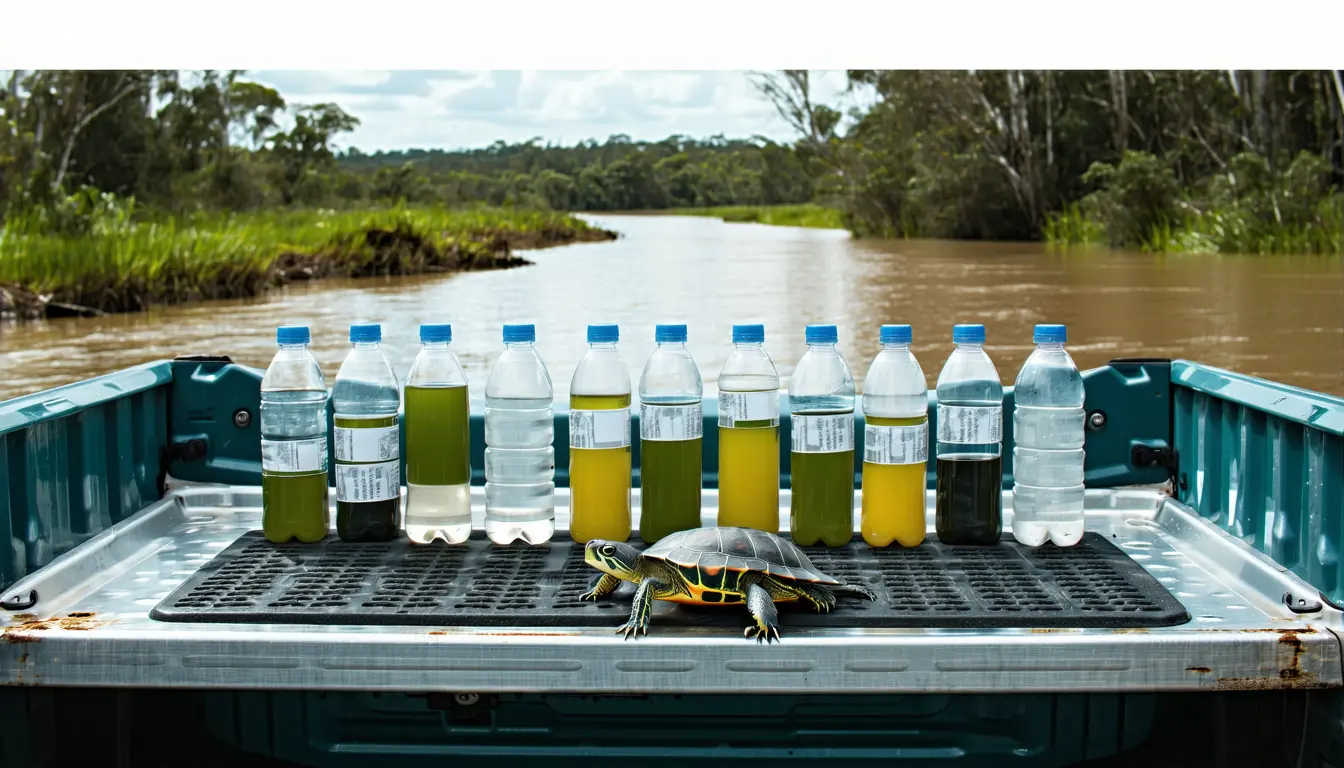
- The researchers sampled water at five locations across the Manning catchment over three days, using a portable backpack that filters liters of river water in minutes and preserves the DNA it captures.
- Snorkel surveys and the new environmental DNA tests agreed, with both methods detecting Manning River turtles at all five sampled locations.
Compiled by The ScientistSomething wrong?How this is made
Why it matters
- constraint Native status cannot sort the Manning's turtles into protect and remove, because the introduced animal holds threatened listings in Victoria and South Australia, so any management rule has to be written for the Manning catchment.
- decision Managers face a removal decision with a closing window: the introduced turtles have not yet reached the whole Manning, and the Bellinger and Kalang show what the later stage looks like.
- capability Checking which turtles are in a reach no longer requires catching them, so surveys can be repeated at more sites without handling endangered animals.
- exposure Released pet turtles are the suspected route into these catchments, and the introduced animals can carry Bellinger River virus. One human behaviour puts both endemic coastal populations at risk.
The study's authors describe the introduced turtle as a more urgent threat to the Manning River helmeted turtle than the pressures already on its listing [4], and hybridization is the one they call most pressing [11]. Competition for food and introduced disease reduce a population [9]. Hybridization can end the species while the river still holds turtles, because hybrid offspring reproduce quickly and eventually replace the endangered parent population [11]. The authors also say research suggests hybridization is not a new phenomenon among Australia's freshwater turtles [24].
Current evidence suggests it is already under way in the Bellinger and Kalang rivers, where Macquarie River turtles were introduced in the 1990s [12]. That release came at least eight years before the first Manning catchment record in 2007, and as much as seventeen years if it happened at the start of the decade [23]. The endemic turtle of the Bellinger, Myuchelys georgesi, is listed as critically endangered, and it and the Manning turtle occur in only two coastal river systems in eastern Australia [10].
The Manning turtle's lineage dates back 55 million years, and the Traditional Custodians of Birpai-Barray know it as Guraa in the Gathang language [2]. In its own range the introduced turtle is the one being protected: Victoria lists Emydura macquarii as critically endangered and South Australia lists it as vulnerable [6]. The species is native to several river systems across Australia [5].
Specificity was the design problem. River water can contain the DNA of hundreds or even thousands of species [16], so the team compared sequences from their two target turtles against close relatives and other turtles that share the habitat before taking the tests to the river [15]. The stated purpose was monitoring the presence of Macquarie River turtles as they encroach on Manning River turtle habitat [25].
The field test was small. Turtle ecologists from the Redleaf Group, an Australian environmental company, worked the same river with mask and snorkel, capturing turtles and recording population data [19]. The water sampling covered fewer sites than the number of tributaries where the introduced turtle has already been recorded [22].
The water samples answer a narrower question than the captures do. The eDNA tests report which species' DNA was in the water [15], and the population figures came from the snorkel work [19]. Snorkeling, trapping and underwater video are time-consuming and costly, and in some cases they mean turtles are handled by humans [14]. For presence work, filtering river water substitutes for catching animals [18].
What to watch
- Whether eDNA sampling extends from the five validation sites to the nine tributaries where Macquarie River turtles have been recorded.
- Whether genetic work finds hybrids in the Manning.
- Whether any removal or containment program is proposed in New South Wales for a species Victoria lists as critically endangered.