Invest1 publisher3 min readPublished
Apple's Washington exposure under Ternus runs through chips and tariffs more than AI safety
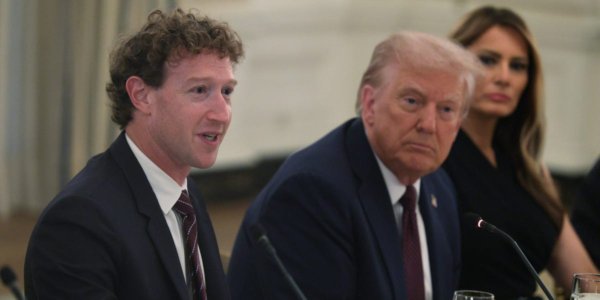
Apple was the only tech megacap absent from Trump's White House AI lunch, where leading AI companies signed a safety accord. The meeting was about frontier models Apple does not build, and the policy questions that reach Apple's costs are in trade and chip supply.
The Investor · Invest desk
What happened
- Neither executive chairman Tim Cook nor CEO John Ternus attended, while leaders of every other tech megacap had lunch with Trump.
- Altimeter Capital CEO Brad Gerstner, a Trump ally, called Apple's absence a "nothing burger" on CNBC's Squawk Box on Wednesday.
- Apple partners with Google to develop its models, and its capital spending is tiny next to what Google, Microsoft, Meta and Amazon are investing.
- Commerce Secretary Lutnick said of Apple's reported plan to use Chinese-made memory chips, which requires a license, that "the Trump administration is not in favor of that."
- Apple shares are up 22.5% so far in 2026, ahead of the Nasdaq and almost every megacap peer except Nvidia, which is up about the same.
Compiled by The InvestorSomething wrong?How this is made
Why it matters
- precedent If the accord becomes the starting point for federal AI rules, its safety terms will have been drafted by frontier labs and a chipmaker, with Apple's on-device models represented by nobody at the table.
- decision Leaving policy with Cook lets Ternus stay out of Washington in his first months, so Apple's access to this White House still depends on Cook's personal relationship with Trump.
- constraint Investors value Apple as the low-capex hedge, which limits how far it can move toward frontier-scale spending without giving up the pricing that has carried the stock this year.
Gerstner's explanation matches the guest list. He said the companies in the room were the ones "really pushing the frontier on model development" [7]. CNBC named five executives who signed the White House safety accord afterward: Jensen Huang of Nvidia, Greg Brockman of OpenAI, Mark Zuckerberg of Meta, Sundar Pichai of Google and Dario Amodei of Anthropic [21][1]. Safety and alignment were the main topics at the lunch, and Apple executives have mostly stayed out of that public debate [20].
Two other readings are in circulation. On social media, the guess was that Apple was not invited because it is behind on AI [4]. A harder version is that the absence says something about Apple's standing with this White House. Neither Apple nor the White House answered CNBC's questions about the meeting [3].
The product gap is by design. Apple Foundation Models are smaller, run on Apple's own chips inside iPhones and Macs and handle parts of Siri, while OpenAI and Anthropic run theirs on large Nvidia-based clusters [15]. The market has increasingly treated Apple as a hedge against the capex-heavy names [17], and the new AI-powered Siri launched to mostly positive reviews [18]. Apple is not among the signers CNBC named [21].
Washington reaches Apple's costs through supply and trade. Cook's dealings with Trump have stayed on manufacturing and trade, at a time when Apple's products could face tariffs [12], and the memory-chip license belongs to the same file [13]. Apple kept that file with Cook, saying he would go on "engaging with policymakers around the world" as executive chairman after Ternus, a hardware specialist, took over as CEO in September [9][8]. Cook was at the White House less than a week before the lunch, for Trump's state dinner with Chinese President Xi Jinping [10]. He has made more than 10 public appearances at events in Trump's second term [11].
In my view the lunch is the smaller of Apple's two Washington questions, or rather the one that does not yet touch a cost line. The accord commits its signers to safety measures [21], and those commitments fall on companies spending at a scale Apple has not matched [16]. Cook has said Apple is more likely to speak publicly on policy that "intersects with our company in some way" [22]. A license to buy memory chips while prices climb meets that test more plainly than a frontier-model safety accord does [13]. "I can assure you, they're very much read in on all of this, and I suspect they agree with all of it," Gerstner said [6].
The counter-thesis is that the lunch and the license belong to one relationship. On that reading, an AI meeting held without Apple and a commerce secretary on record against its chip plan are the same message, sent twice [14]. If the license is denied, Apple keeps paying the memory prices it was trying to avoid [13], and the absence from the lunch would look like part of a pattern.
What to watch
- Whether Ternus makes his own appearance at the White House or leaves every policy meeting to Cook.
- Whether Apple endorses or signs the AI safety accord after the fact.
- Apple's next reported capital spending against Google, Microsoft, Meta and Amazon, since the hedge pricing depends on that gap staying wide.