Product1 publisher3 min readPublished
Five months after the Beijing trip, the licensed H200s are still stuck at Chinese customs
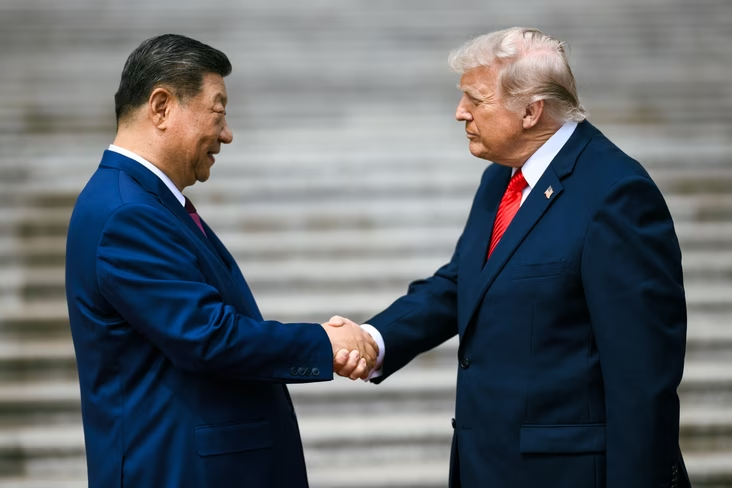
Altman, Huang and Cook are expected at Trump's 24 September state dinner for Xi, the same three executives who were on the May Beijing trip. What that trip produced is the best guide available to what this one will.
The Product Desk · Product desk
What happened
- Sam Altman, Jensen Huang and Tim Cook are expected at the state dinner Donald Trump is hosting for Xi Jinping on 24 September, with Semafor reporting Altman's attendance and Reuters and Bloomberg the other two.
- Washington cleared roughly ten Chinese companies, among them Alibaba, Tencent, ByteDance and JD.com, to buy Nvidia's H200, with each approved buyer permitted up to 75,000 units.
- Chinese customs has blocked the licensed shipments, and suppliers of H200 components paused production as a result.
Compiled by The Product DeskSomething wrong?How this is made
Why it matters
- decision Anyone sizing Chinese accelerator capacity for next year has to pick an evidence standard, and only one of the two candidates has ever put hardware in a rack: the licence, or the customs release.
- constraint Because component suppliers stopped the line, a deal signed at the dinner would still need a manufacturing restart before any approved buyer takes delivery.
- exposure All three executives at the table are exposed on market access, so their attendance is a measure of what they need from Beijing.
- contradiction The industry's own slowdown proposal asks for eventual coordination with Beijing while asking for tighter chip restrictions to widen the American lead, and Beijing's public reply engaged only the second half.
Ten approved buyers at up to 75,000 units each works out to roughly 750,000 accelerators authorised on paper [1]. TNW reported that not a single chip had shipped [9]. By July a US trade official put the figure at very few, covering China and Hong Kong together [10].
The hold is at the border. American licences carry security and diversion conditions Beijing will not accept, and Beijing is steering its buyers towards Huawei and domestic alternatives regardless [12]. Once shipments stopped, suppliers of H200 components paused production [11].
The May meeting is the best evidence on the record of what a meeting like this produces. Huang joined the delegation late and Cook was on the trip, AI safety was on the agenda, and what came out was a discussion of collaboration on shared safety standards with no agreement [5][6]. The US trade representative said afterwards that chip export controls were not discussed at all [7].
Nvidia's China accelerator share has gone from almost everything to almost nothing [13]. Huang has said he supports export controls, and he has been accused in the Senate of lobbying to loosen them [14]. Cook runs the American company with the deepest manufacturing exposure in China [15]. OpenAI's models are banned there [16].
The safety half of the agenda arrived pre-rejected: Dario Amodei's 12 September essay put eventual coordination with authoritarian governments, China included, as its third step [17], and the same essay argued for maintaining restrictions on sales to China of the most advanced chips and chipmaking equipment in order to widen the American lead [18]. Guo Jiakun, a Chinese foreign ministry spokesman, called it "fearmongering" and said confrontation and vicious competition disrupt global AI governance [19]. State press described the essay as a veiled call to contain China [20]. Trump, for his part, has cited the need to stay ahead of China as his reason for avoiding domestic AI rules [21]. The two governments have also begun formally warning against each other's AI models [23].
The one live thread runs through Treasury Secretary Scott Bessent, who has signalled openness to discussing shared risks around AI with Vice Premier He Lifeng, in New York talks laying groundwork for the summit [24]. Shared risks means bioweapons screening and model misuse, which is where Amodei said limited agreement might be possible, and it is the only item on the agenda that asks neither side to give up an advantage [25].
For anyone whose 2026 plan depends on Chinese access, the practical question is which physical event would confirm it, and who would report that event. Three have a public trace: a customs release on a licensed shipment, a component supplier restarting the line it paused, and a licence rewritten to drop the diversion conditions. Five months after the May meeting, Chinese customs is still blocking the H200s Washington licensed [26].
What to watch
- A customs release on a licensed H200 shipment, and whether any of the approved buyers confirms delivery.
- Whether the Bessent and He Lifeng track in New York yields anything specific on bioweapons screening or model misuse.
- Whether the White House meeting with AI chief executives that Mike Johnson referred to is scheduled and detailed.