Invest3 publishers3 min readPublished Updated
Toshiba puts 60 billion yen into doubling its AI data-center hard-drive capacity by FY2027
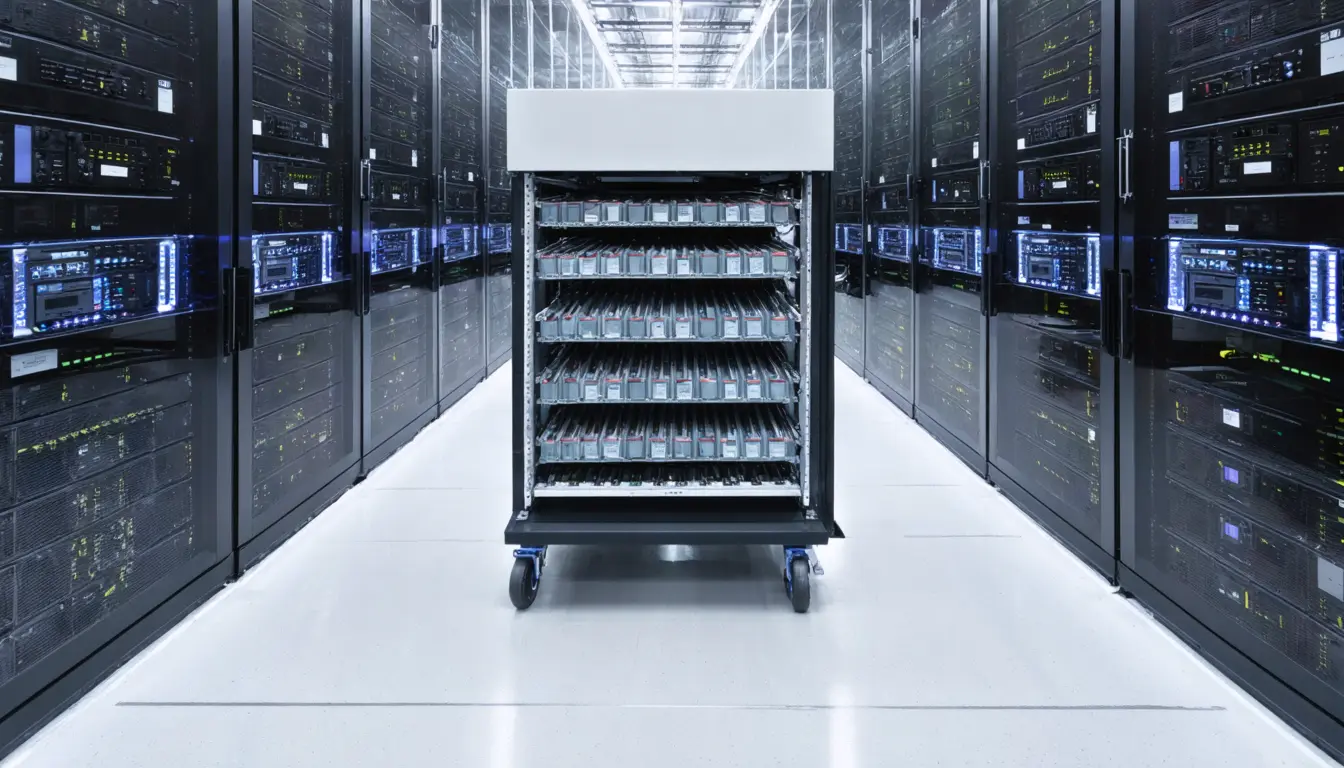
Toshiba is spending about 60 billion yen to double its AI data-center hard-drive capacity by March 2028, its first major HDD investment in about five years. Its target of a 30% share of the market by storage capacity, roughly triple today's, depends on denser drives as well as new lines.
The Investor · Invest desk
Drafted by a language model from the sources cited here and checked against its claim ledger before publication. How we use AISend a correction
What happened
- New production lines at Toshiba's Philippine plant are designed to turn out drives with up to 40% more storage capacity per unit.
- Toshiba is automating inspection and cleanroom processes and expects the changes to cut workforce needs by around 40%.
- Toshiba plans to mass-produce 65TB-class drives by 2030, with models above 100TB to follow after that.
Compiled by The InvestorSomething wrong?How this is made
Why it matters
- exposure If Toshiba reaches 30%, the share of storage capacity left for Western Digital, Seagate and smaller makers drops from about 90% to 70%.
- constraint Toshiba's 30% goal leans on 65TB-class drives due in 2030, so the share gain runs on a technology schedule as well as on the Philippine build.
- capability Data-center buyers of bulk storage get more high-capacity supply from one of only three major makers, whatever Western Digital and Seagate decide.
The share target is the part of Toshiba's plan that moves money between companies. Toshiba holds slightly above 10% of the hard-drive market measured by storage capacity and wants 30%, a goal Crypto Briefing reports for "the coming years" [3]. If Western Digital and Seagate [11] held their output flat while Toshiba doubled its own [2], Toshiba would have 20 parts of 110, or about 18% [1]. Reaching 30% on the same assumption takes roughly 39 parts against 90, close to four times what Toshiba makes now [2].
The distance between two times and four has to come from the drives. Suppose the doubling is counted in drives, and only the added half carries the new lines' 40% gain in capacity per unit [4]. Toshiba's output in terabytes then rises to about 2.4 times today's [4], and its share, with rivals flat, to about 21% [5]. If the doubling is already counted in terabytes, the figure stays near 18% [1].
The rest of the gap falls to the 65TB-class drives planned for 2030 [5]. They rely on MAMR, in which a burst of microwave energy lets the write head record onto smaller, more tightly packed magnetic regions, and on 12 platters stacked inside a standard drive enclosure [6]. Crypto Briefing wrote that the 100TB-class models beyond them "remain a stated ambition rather than a scheduled product" [7].
The demand comes down to price per terabyte. Crypto Briefing puts hard drives at about 20 times cheaper per terabyte than SSDs [8]. Data centers keep fast, frequently accessed work on SSDs and send bulk data that does not need instant retrieval to high-density HDDs [9], the tier Toshiba's 60 billion yen [1] is meant to supply.
If rivals hold steady and AI demand absorbs Toshiba's added drives, its share lands between about 18% and 21% by March 2028 [1][5][13], and the 30% waits for the denser drives. A matching expansion at Western Digital and Seagate would leave Toshiba near 10% [3][11]. In that case the investment shows up as more high-capacity supply across the market and little change in who sells it.
I think the 60 billion yen [1] buys a credible route to about a fifth of storage capacity shipped by early 2028 [1][5], and that the 30% depends more on the 2030 drives than on the Philippine lines [5]. The counter-case is that rivals stall and Toshiba's denser lines take share faster than a flat-market calculation allows. The view is wrong if Toshiba reports a capacity share well above 21% before 65TB-class drives reach mass production, or a share still near 10% after the doubling, a sign that Western Digital and Seagate grew as fast as it did [11].
What to watch
- Whether Toshiba says the FY2027 doubling is counted in drives or in terabytes, since that choice moves a flat-market share outcome between about 18% and 21%.
- Any capacity announcements from Western Digital or Seagate for high-capacity drives aimed at AI data centers.