Science1 publisher2 min readPublished
Georgia Tech rebuilds its skin-puncturing STAR particles out of degradable polymers
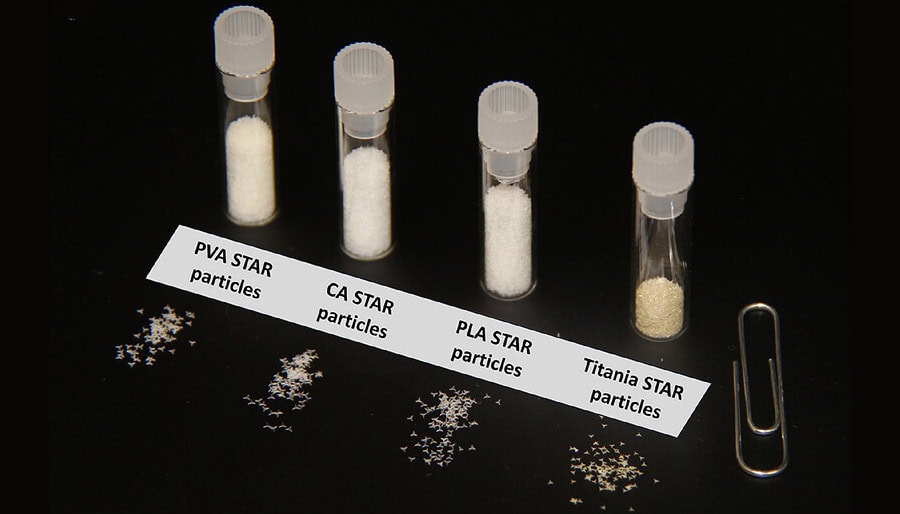
The group swapped non-degradable titania for three polymers already used in microneedle patches, then measured how much more drug got into pig skin after a 10-second or 30-second rub.
The Scientist · Science desk
What happened
- A Georgia Tech team led by Mark Prausnitz has made STAR particles, microscopic needled shapes that puncture skin to increase drug absorption, out of biodegradable material.
- Earlier versions used titania, safe on skin but not biodegradable; the new work in Advanced Healthcare Materials uses polymers that dissolve or degrade after use.
- The three polymers tested were poly(vinyl alcohol), cellulose acetate and polylactic acid, all previously used in microneedle patches, which generally only work on small areas of skin.
- In pig skin, polylactic acid particles raised intradermal delivery of copper tripeptide-1 12.1-fold after a 10-second rub and 37-fold after 30 seconds.
- Titania particles in water, run as a control, still generated more pores than any of the polymer versions because titania is harder.
Compiled by The ScientistSomething wrong?How this is made
Why it matters
- capability Methotrexate cannot currently be given topically at all because of its skin permeability, so a topical route for a psoriasis drug is the kind of thing this technique could open.
- constraint The polymer choice dictates the vehicle: PVA rules out water-based creams and gels, which narrows what a formulator can build around it.
- cost The degradable versions puncture less well than the ceramic they replace, so removing the residue objection costs pore count.
- decision Anyone weighing this for a product line is deciding on excised pig skin and drug concentration, not on treated patients.
The design problem is the stratum corneum, the skin's outer layer, which restricts how much of most topically applied drug gets through [1]. Microneedle patches solve that on small areas of skin, and the three polymers here have all been used to make them before [6]. What a patch cannot do is cover the variable, sometimes large areas that eczema and psoriasis present, and Prausnitz describes the particles filling that gap: "STAR particles provide the power of a microneedle patch to increase skin permeability with the flexibility to apply them over large and variable areas by simply rubbing a gel or cream containing STAR particles on the skin," he said [7].
The particles were cut by femtosecond laser micromachining into star shapes with sharp tips and a tapered profile, then tested on pig skin samples [8]. Formulation constrained the chemistry. PVA particles dissolve in water, so they were suspended in isopropyl palmitate, a non-aqueous ingredient already common in dermatology, and in that vehicle they punctured skin [9]. Cellulose acetate and polylactic acid worked in water formulations [10]. All three still punctured after a week of storage, with no visible damage to the particles [11].
The drug numbers are the interesting part, and there are three of them. Tacrolimus in isopropyl palmitate with PVA particles rose 1.7-fold at 10 seconds and 3.2-fold at 30 [12]. Methotrexate with cellulose acetate particles rose 5.4-fold and 25.2-fold [13]. Copper tripeptide-1 with polylactic acid particles rose 12.1-fold and 37-fold [14]. Tripling the rub time roughly quintupled the methotrexate effect and tripled the copper tripeptide effect, so the dose-response is steep and not linear in time [17].
Read each enhancement factor against its own drug. Methotrexate is used for psoriasis and cannot be delivered topically at all because its skin permeability is so low, so a 25-fold increase starts from close to nothing [5]. Tacrolimus already dissolves in non-aqueous solvents, and its 3.2-fold gain is over a control that was already getting drug in [4]. The three arms also differ in drug, vehicle and polymer at once, so nothing here separates polymer performance from formulation chemistry.
The honest cost of the switch is in the control. Titania particles in water, run as a comparison, made more pores than any of the polymers, which the researchers attribute to titania's greater hardness [15].
The team raises one safety question itself: particles designed to make micropores could end up elsewhere in the body, where the needles could do damage [16]. It calls that risk likely small, since the particles need forceful application to work [16]. This is excised pig skin and measured intradermal drug concentration [8][12].
What to watch
- Whether any of the three polymer versions is tested on human skin in vivo against a clinical endpoint rather than intradermal drug concentration.
- Data on what happens to particles that migrate off the treated area, the risk the team itself raises.
- Whether the pore-count gap against titania closes with a harder or reinforced polymer formulation.