Science1 publisher2 min readPublished
A glucose-fed E. coli strain matched a commercial hot-melt adhesive in a steel lap-shear test
Sang Yup Lee's group at KAIST rebuilt the bacterium's metabolism to assemble two aromatic PHA polymers from sugar. The best titre reached 52.8 grams per litre. The stronger of the two polymers was the weaker producer.
The Scientist · Science desk
What happened
- A KAIST team led by Sang Yup Lee reworked E. coli's metabolism so the bacterium builds new aromatic PHA polymers from glucose for adhesive use, with the work published in Nature Communications.
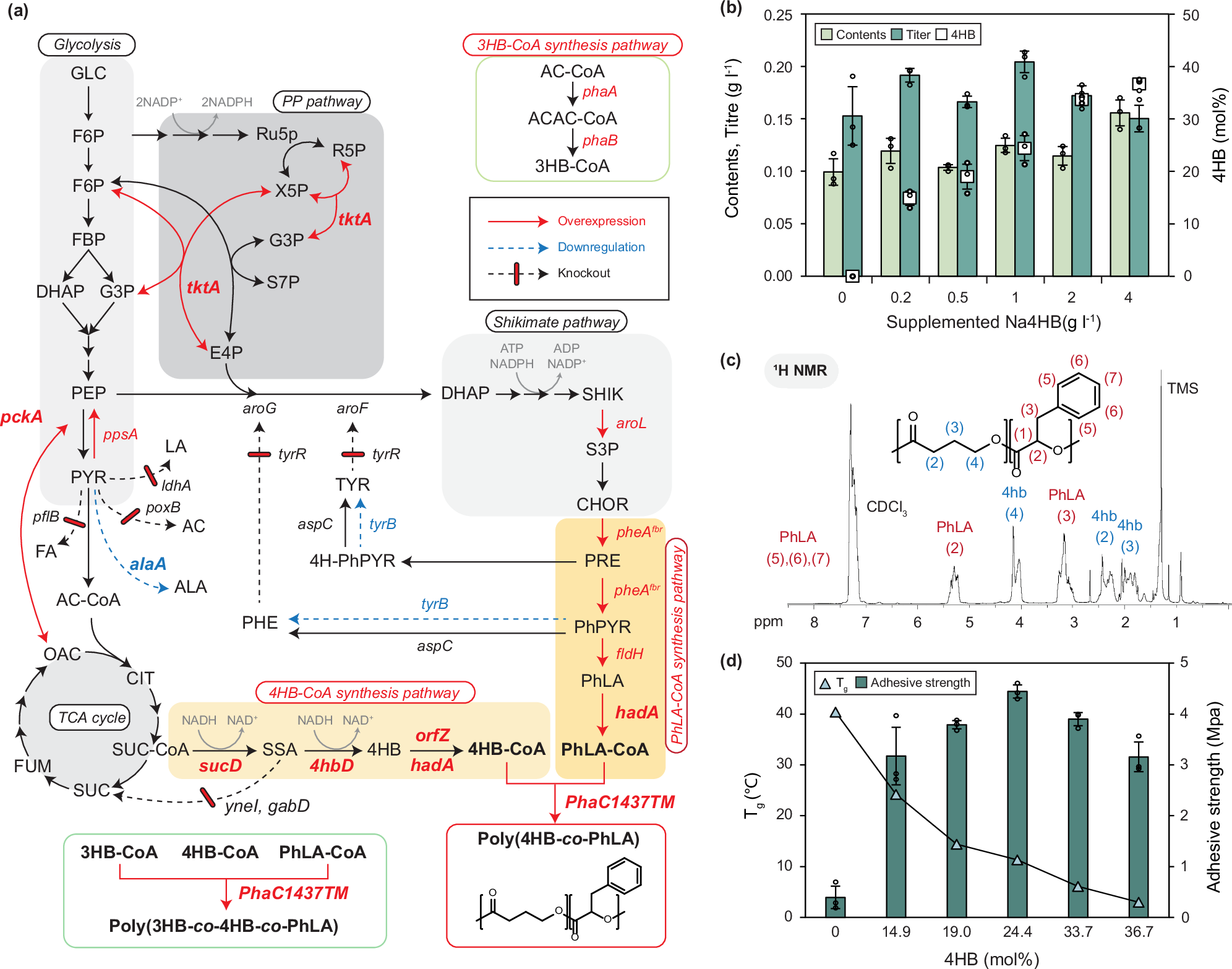
- Systems metabolic engineering yielded two polymers from sugar, poly(4HB-co-PhLA) and poly(3HB-co-4HB-co-PhLA), both in the biodegradable PHA family.
- Fed-batch fermentation gave 10.2 grams of poly(4HB-co-PhLA) per litre of medium. Adding a 3HB pathway lifted the terpolymer to as much as 52.8 grams per litre.
- In a stainless-steel lap shear test, poly(4HB-co-PhLA) reached 4.58 MPa against 4.20 MPa for a commercial EVA adhesive.
- Adhesion was best in polymers holding roughly 24 to 34 mol% 4HB, the monomer that supplies softness and tack, with phenyllactate supplying rigidity and heat resistance.
Compiled by The ScientistSomething wrong?How this is made
Why it matters
- decision Anyone scaling this has to choose between the copolymer's bond margin on steel and the terpolymer's far higher output per litre. That choice sets the fermentation design before any adhesive formulation work starts.
- constraint Performance is fixed inside the fermenter by monomer ratio, so a customer who wants more heat resistance is asking for a different culture.
- capability The rigid, heat-resistant half of the polymer now comes from the same glucose feed as the soft half, so one organism and one feedstock cover both.
- exposure A compostable pack's end-of-life claim depends on its glue. Converters bonding biodegradable board with petroleum hot melts carry the disposal problem this work targets.
Poly(4HB-co-PhLA) edged the commercial EVA control in the steel test. It is also the weaker producer: the terpolymer left the fermenter at about 5.2 times its titre [15]. On wood, the terpolymer performed comparably to EVA [6]. Both titres come from laboratory fed-batch runs, in which nutrients are supplied continuously through the cultivation [18]. The steel margin over the EVA control was about 9 percent [16]. That turns a chemistry question into a process-economics one, decided by how much of the glucose ends up as polymer.
Making several monomers in one cell creates metabolic imbalances. The fixes the KAIST group reports are incremental ones. They adjusted the strength and timing of gene expression and added a CoA transferase to help the linking reactions along. They then used a genome-scale metabolic model to find the steps where precursor supply ran short [9]. The strain takes up glucose, makes both 4HB and PhLA itself, and links them into polymer inside the cell [10].
4HB supplies softness and adhesion, PhLA supplies rigidity and heat resistance, and shifting the ratio moved both the thermal behaviour and the bond [7]. The band where adhesion was best is about ten mole points wide [19]. In a fermenter the culture sets that ratio, so I think hitting that band batch after batch is harder than raising titre.
EVA is the incumbent chemistry for hot melts, which is why it was the comparison [11]. Hot melts are applied molten and set as they cool, with no solvent and a fast bond [13]. On a line, that step depends on melt viscosity at the nozzle and on open time before the two substrates meet. A lap-shear coupon measures neither. The phys.org account reports lap-shear strength, thermal properties and adhesive strength retained after repeated melting, without naming the EVA grade or the number of melt cycles [14][17].
What to watch
- Any pilot-scale fermentation figures from KAIST, including yield of polymer per gram of glucose and productivity per litre-hour.
- Degradation testing of these two specific polymers under compost or marine conditions.
- Whether the 24 to 34 mol% 4HB composition window holds run to run at larger fermenter volumes.