Leadership1 distinct publisher3 min readPublished
Newcomer argues Silicon Valley now has no leader who commands cross-industry respect, but the evidence it offers is one line about a G20 ministerial and a retiring CEO the same piece faults for going quiet.
The Board Room · Leadership desk

Compiled by The Board RoomSomething wrong?How this is made
Divide 4,700 by 347 and you get about 13.5, an increase nearer 1,254% than the 1200% Newcomer puts on Cook's tenure [2][3]. If anything the figure is understated. It also measures the company's market value rather than the per-share return an owner realised, and that gap matters because the statesman argument leans on the same conflation: operating a nearly $4.7 trillion company is evidence of operating skill, not a mandate to speak for anyone else [2].
The structural version of the claim, that the current cohort has traded public legitimacy for a seat where rules get written, is the one worth testing, and the record here does not carry it. The G20 Innovation Ministerial appears in Newcomer's own week summary as a single line, tech CEOs asking international dignitaries for lax AI regulation [4]. No executive is named, no specific ask is described, and no dignitary's answer is recorded [17]. What the piece does document is absence rather than capture: after the AI risks exposed in the OpenAI/Hugging Face hack and the sudden nationwide revolt against data centers, it records no serving executive engaging with either [6].
The statesman era looks like a retrospective invention, and Newcomer's own paragraphs give that some force. The same piece credits Cook with principled privacy stands and the fight with the government over a mass murderer's iPhone, then faults him for putting profit over principle, going mute on immigrants, and handing the President a golden gift [8][9]. A leader described that way occupied a smaller seat than the one the piece says is now empty.
The more useful reading is about slack. Newcomer's roster of past conveners, Eric Schmidt at Google, Andy Grove and Bob Noyce at Intel, ran firms with settled product lines and room to spend attention elsewhere [7]. The AI companies setting the agenda now are in a capital race with each other, and the two leaders at the top of it, Dario Amodei and Sam Altman, will not perform civility in public [10]. Two of the ecosystem's more prominent investors spent the week trading insults over immigration [11].
The tradeoff costs now for a payoff that shows up, if at all, only later. Whoever speaks for the industry has to take limits on what his own firm asks for, and the ask on the table is looser AI rules [4]. Access pays inside the quarter, while public standing pays out only across a decade, and only if the sector still has permission to build by the end of it -- which is what the data-center revolt puts in question [6].
John Ternus inherits both operating questions at once, judged on whether he can innovate like Jobs and run the ship like Cook [13]. The third job, the one Cook declined, is not in that brief, and Apple has little reason to add it while an administration that filed on behalf of OpenAI against the New York Times is still sorting its friends from its targets [15]. On the available evidence the claim that survives is narrower than the thesis: the convening work was last attempted by Bill Gates, retired from Microsoft, and Newcomer reports that nobody with a live profit-and-loss statement picked it up [5].
Ranked by verification strength, evidence, and original report placement.
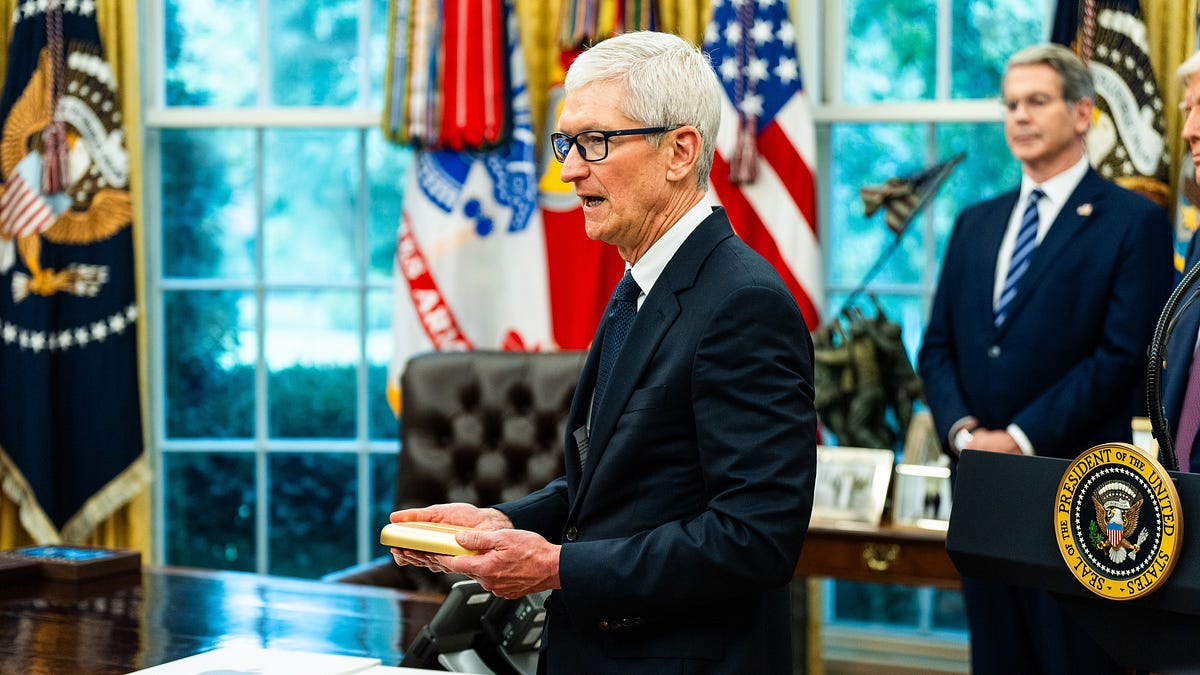
Newcomer states Apple had a market cap of $347 billion when Cook took over in 2011 and now stands at nearly $4.7 trillion, describing this as a tidy 1200% return for shareholders.
Going from $347 billion to $4.7 trillion is a multiple of about 13.5, an increase of roughly 1,254%.
Newcomer says Apple's new CEO John Ternus is in the position of being judged on both metrics: whether he can innovate like Jobs and run the ship like Cook.
Newcomer's week summary reports that Nvidia and Hugging Face announced a $12.9 billion acquisition agreement.
Newcomer's week summary reports that the Trump administration weighed in on behalf of OpenAI in its legal battle with the New York Times.
Newcomer's week-in-short summary states that tech CEOs called for lax AI regulations from international dignitaries at the G20 Innovation Ministerial.
Distinct publishers with included, body-backed reporting in this cluster.
1 article · September 4, 2026
Follow any of these and your For You feed starts watching them — no settings page required.
product
Lutnick gives three AI vendors the G20 stage to argue against strict rules1 distinct publisher
product
Washington's secret AI test is coming for open weights, and release dates go with it2 distinct publishers
leadership
AI labs bought tens of thousands of Macs before Apple built a team to sell them3 distinct publishers
invest
Washington pitches Carolina Principles to G20, urging no new AI rules or bodies1 distinct publisher
Evidence-backed comparisons of source perspectives and observed adoption signals. Read the methodology
Which Builder, Operator, and Investor concerns the observed source mix emphasized—not a truth score.
Evidence, demonstrated adoption, hype gap, incentives, and confidence are assessed independently, each on its own current evidence. How these are measured.
Two checkable numbers, one voice
Apple's $347 billion and $4.7 trillion are the only figures a reader can test, and the percentage bolted to them is short of what they actually produce. The rest of the case, the G20 regulatory ask and the Graham-Luckey flame war included, arrives as assertion with no quote, date, or second account. The single passage where a named official speaks is Newcomer's own G20 write-up, and it describes an AI company cooperating with Washington rather than lobbying against rules.
No uptake to measure
A claim about who holds moral authority in an industry has no install base or deployment curve to count. The concrete events in the same issue, an acquisition agreement and a model handed to federal evaluators, tell you what the week contained without testing whether any executive commands respect.
Industry-wide verdict, one-line exhibits
The judgment covers every senior figure in tech; the exhibits are a one-line mention of a ministerial and a set of characterizations of private conduct, none of them quoted. Newcomer also undersells the one thing it can prove, calling roughly 13.5 times a 1200% return. And its own policy section shows an AI co-founder speaking publicly about data centers, the exact topic the argument says nobody would touch.
Judging the room it sells tickets to
Two sections after declaring the industry short of anyone worth respecting, the same issue asks readers to apply for a seat at Newcomer's Machine Earning AI Summit and points them at its market map of agentic-shopping companies. The executives graded here are also the ones whose deals fill the summary list at the top, and none of them was asked for comment, which is the disclosure the story most needs and does not carry.
Firm on Apple, thin on the verdict
Our confidence splits by claim type. The succession facts and the two market caps are the sort of thing a well-read newsletter gets right, and they hold together apart from the rounded percentage. The industry-wide judgment rests on four or five characterizations of private conduct with nothing quoted behind any of them, and one of those characterizations is undercut later in the same issue.