Science1 publisher2 min readPublished
Cambridge-led team designs a suitcase-sized satellite to hear hydrogen from before the first stars
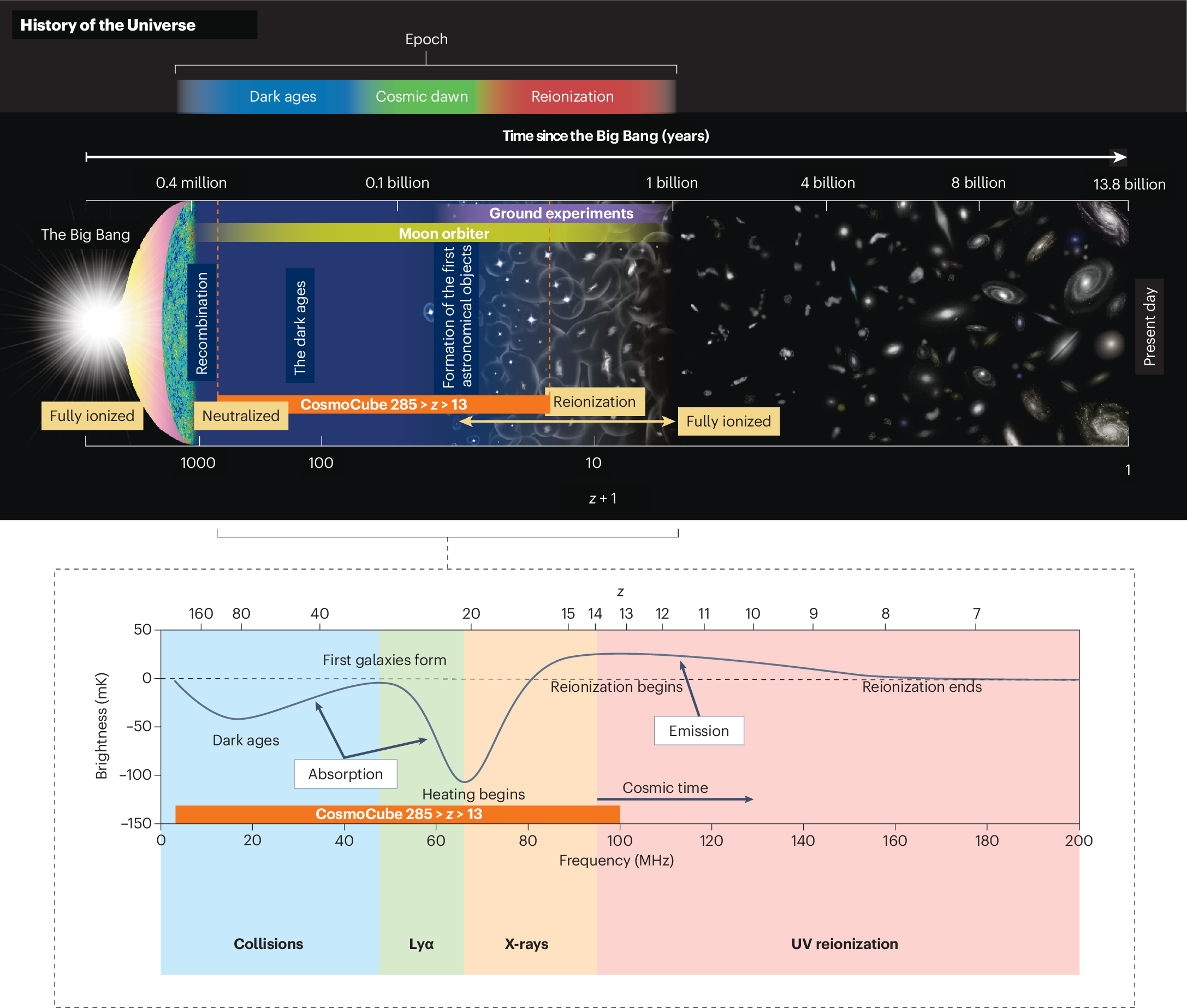
Cambridge-led researchers plan to fly the suitcase-sized CosmoCube around the Moon and collect about 1,000 hours of Earth-shielded radio data over two years. It will listen for hydrogen's 21-centimetre signal from the roughly 150 million years before the first stars, an era no one has directly observed.
The Scientist · Science desk
What happened
- The Moon will block Earth's radio noise for about 40 minutes of each two-hour orbit, and the antenna listens for the hydrogen signal during those passes.
- CosmoCube will observe between 10 and 50 MHz, a band that Earth's ionosphere largely keeps from reaching ground-based observatories.
- A Dicke-switched calibrator will alternate between observing the sky and measuring several internal reference sources to catch changes in the craft's own electronics.
- The UK Space Agency has funded the project, the mission design is published in Nature Astronomy, and the team hopes to launch within five years.
Compiled by The ScientistSomething wrong?How this is made
Why it matters
- capability If it works, a spacecraft the size of a carry-on bag would give cosmologists radio access to a period that ground observatories cannot reach.
- cost The mission pays for its quiet in time: two-thirds of each orbit is spent exposed to Earth's noise, so two years in orbit buy about 1,000 hours of data.
- constraint Any dark-matter result depends on a launch within five years, then two years in orbit, and on calibration clean enough that the hours count.
A third of every orbit is spent behind the Moon [1]. Over two years, that comes to roughly 5,840 hours shielded from Earth's radio noise [2]. The 1,000-hour goal is about 17 percent of that [3]. Part of the difference may go to calibration [17].
Earth's problem is larger than the ionosphere. According to the Cambridge release, FM broadcasts, satellites and telecommunications produce interference that can overwhelm the cosmic signal [19]. Lead author Eloy de Lera Acedo, of Cambridge's Cavendish Laboratory and the Kavli Institute for Cosmology [18], made the case for the location directly. "There's no other place where you can get the sort of shielding you need to detect such a faint signal, while at the same time looking at the whole of space," he said [14]. "The far side of the Moon is really the only option: it solves multiple problems at once, opening a clear window to the very early universe." [15]
The harder part of the measurement is inside the spacecraft. Once in lunar orbit, CosmoCube will unfold a long, lightweight antenna [16]. The electronics behind that antenna change slightly over time and generate noise of their own. Measuring reference sources with known output lets the team spot those tiny changes and remove them from the sky data [17]. That design choice is the right one for a faint signal. The thing this doesn't tell you is the size of the target. The release does not state an expected signal strength or a sensitivity figure, so the 1,000 hours cannot yet be turned into odds of a detection.
The hydrogen in question sat between the Big Bang's afterglow and Cosmic Dawn, when fusion switched on inside the first stars [4]. Its signal set out more than 13.5 billion years ago [6]. De Lera Acedo hopes it will show how dark matter shaped that gas. "This emission from hydrogen after the Big Bang, but before the first stars, will hopefully allow us to understand the role of dark matter in the early universe, how it worked to pull together hydrogen into the first stars and galaxies," he said [12].
I think the case for the far side holds up as the team presents it. Whether CosmoCube delivers comes down to the receiver. Over every one of those hours, the calibrator has to keep the instrument's own changes smaller than the hydrogen signal [17].
What to watch
- A confirmed launch date and vehicle for CosmoCube inside the five-year window the team is hoping for.
- First in-orbit calibration data after the antenna deploys, showing whether the receiver's own changes stay small enough to measure the sky.