Loading today’s stories
Science1 distinct publisher3 min readUpdated
A 400-year-old shark eye with no dying cells is a finding, not yet a model organism
UC Irvine reports no retinal cell death in Greenland shark eyes, one of them about 200 years old, with DNA repair offered as a hypothesis and fixed tissue as the only material.
The Scientist · Science desk
What happened
- ScienceDaily published a release dated August 22, 2026, sourced to the University of California, Irvine, headlined that a shark living 400 years shows eyes that barely seem to age.
- Greenland sharks are the longest-living vertebrates known to science, with some individuals surviving as long as 400 years.
- The study was led by Dorota Skowronska-Krawczyk, associate professor of physiology and biophysics at the University of California, Irvine, and published in Nature Communications.
- The findings suggest that a DNA repair mechanism may allow Greenland sharks to preserve their eyesight for centuries without showing signs of retinal degeneration.
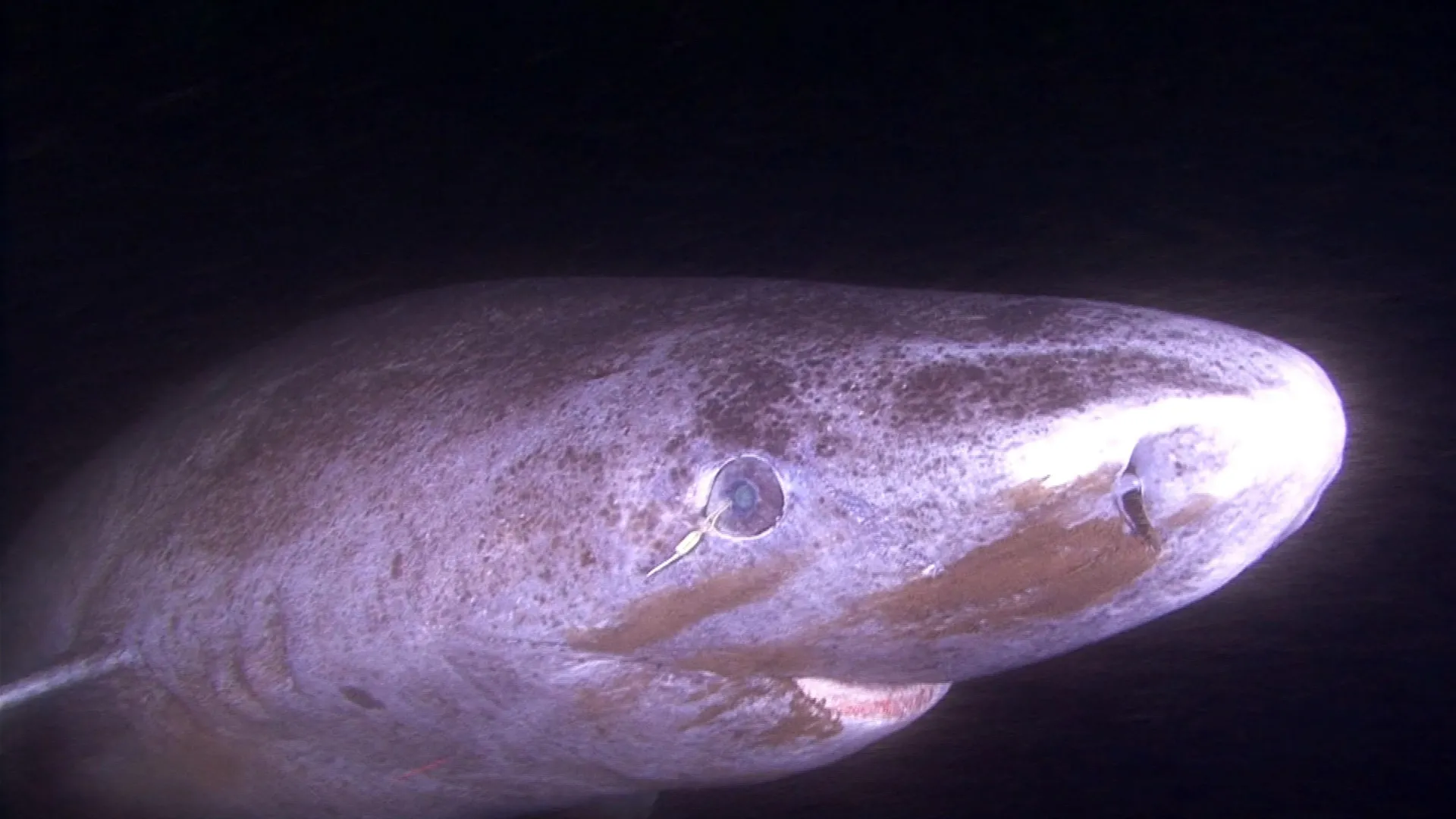
- Emily Tom, a UC Irvine Ph.D. student in Skowronska-Krawczyk's laboratory, performed histological and vision-specific analyses of the eye tissue, and the researchers found no evidence of cell death in the retina.
Compiled by The ScientistSomething wrong?How this is made
Why it matters
A model organism earns the name through what you can do to it: breed it, dose it, delete a gene, compare cohorts. This animal permits none of that. The eyes in the study came from sharks caught on scientific long lines between 2020 and 2024 near the University of Copenhagen's Arctic Station on Disko Island [8], dissected and put into fixative by John Fleng Steffensen of Copenhagen, Peter G. Bushnell of Indiana University South Bend and Richard W. Brill of the Virginia Institute of Marine Science [9], then shipped to California, where one arrived on dry ice and was described by the graduate student who opened the box as a 200-year-old eyeball [12].
So the readout is static. Emily Tom ran histological and vision-specific analyses and found no evidence of cell death in the retina [5]; the release also reports healthy tissue and active proteins tuned to blue light, the wavelength that survives in the dim Arctic depths [6]. Rhodopsin, the protein that carries dim-light vision, is named in the work [7]. An eye that entered service around 1820 to 1824 [16] with no dying photoreceptors in it is a real observation. DNA repair, which Skowronska-Krawczyk's group puts forward as the reason the retina holds up across centuries [4], is a candidate, and static tissue is a poor place to test a candidate.
The practical scale of the problem is worth stating plainly. Skowronska-Krawczyk's laboratory works on the molecular biology of age-related eye disease [19] using mouse eyes the size of a papaya seed; the shark specimen was closer to a baseball, and the protocols had to be rebuilt for it [12]. Let the sample reach room temperature and it starts to degrade [13]. Every step of that pipeline runs one specimen at a time, from a catch log nobody controls.
Set against the prior belief, the result is still a genuine correction. Parasites attached to the eyeballs, plus water dark enough to make vision look pointless, had led researchers to suspect the species was functionally blind [10]. Skowronska-Krawczyk's argument for looking again was behavioural and cheap: in video footage the animal moves its eyeball toward the light [11], and evolution does not maintain organs it has stopped using. Her interest traces to a 2016 Science paper by Steffensen [18], and the evolutionary analysis in the new paper comes from Walter Salzburger and Lily G. Fogg at the University of Basel [14].
The gap to notice is between the tissue and the press framing. UC Irvine's own summary says the work could eventually offer clues for protecting human vision with age [15], while the mechanism in the same document is stated as something that may be happening [4]. Between those two sentences sits the entire job: showing that a repair pathway is active, that it is what prevents the loss, and that it can be moved into a system you are allowed to experiment on. A species where a single individual caught in 2020 could have been born as early as 1620 [17] is not going to give up that answer on a grant cycle.
Loading topic controls
Loading related stories