Science1 distinct publisher2 min readPublished
A trip to the Natural History Museum's 19th-century Ecuadorian frogs showed the original specimens had been filed against the wrong animal, leaving a loud, common Choco frog with no name of its own until now.
The Scientist · Science desk

Compiled by The ScientistSomething wrong?How this is made
The mechanism here is nomenclatural rather than observational. What the London examination established is that the 19th-century type specimens had been attached to the wrong animal, which is why a frog that had been seen and documented for decades never carried a name of its own [5]. Which species those types actually belong to, and which valid name now takes in subsigillatus, the release from Pensoft Publishers does not say [15][14].
One name is added and one is retired into synonymy, so the total number of valid Pristimantis names in play stays where it started [12]. The regional amphibian list is not getting longer this week; what changes is which living population the name points at, and that is the part everyone downstream of the old name has to redo.
What the release does not say is what sits behind the 67,000 square kilometres [3]. That is a known range, bounded by where people have gone and listened, and the announcement does not give a count of specimens examined, genetic data, or a population estimate [13]. Nothing in it says the frog is abundant in the sense a monitoring programme would mean, only that it is widely encountered. The Choco of western Ecuador and southern Colombia is flagged as especially important for biodiversity conservation [11], and an animal whose records were pooled under someone else's name arrives at any assessment with a thinner documented history than its range suggests.
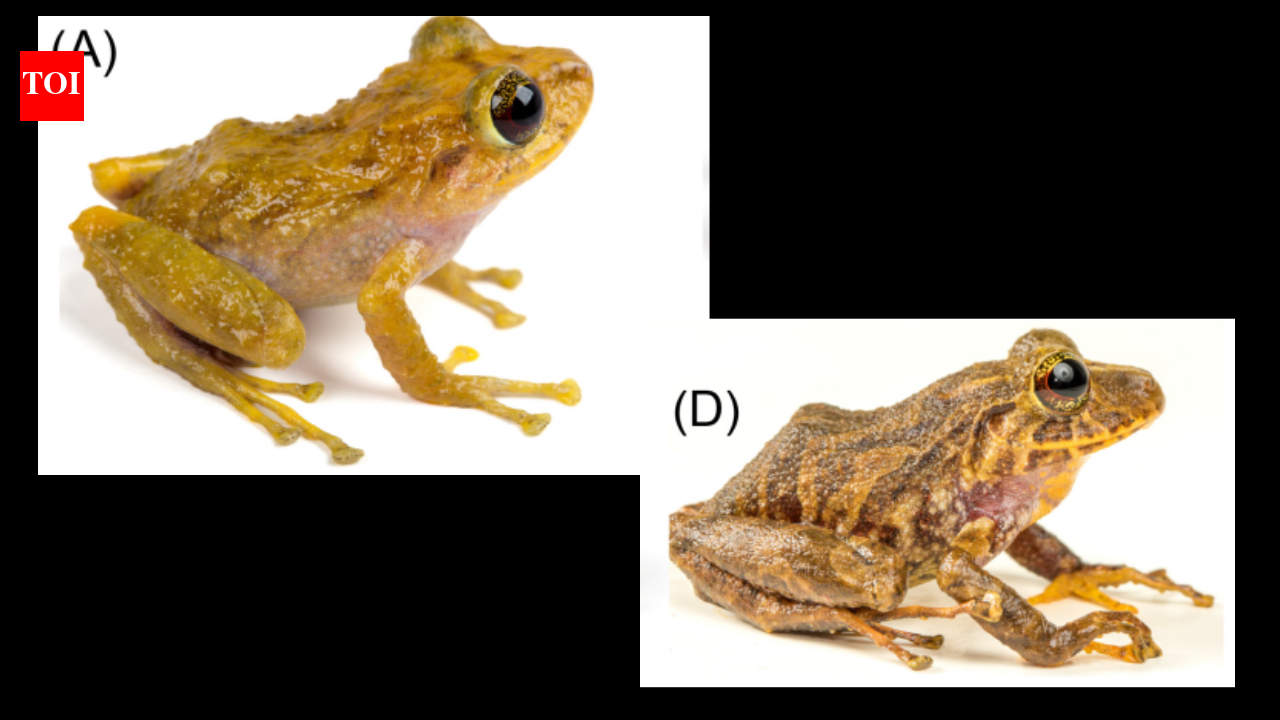
Most descriptions come off the thin edge of sampling, from species that are rare or hold small ranges [8]. Pristimantis milpe came off the other end: it is described as widespread and relatively easy to find [8], and the sexes can be told apart by eye, with females carrying orange or light blue tones and black spots around the groin and thighs while males are more uniform [10]. Detection was never the limiting step. The limiting step was matching an old type series to a living population, which is the point Jhael Ortega, a co-author and PhD student at Virginia Tech, makes in noting that a common species went unnoticed under the wrong name for decades [9].
So the cheap next experiment is an audit of drawers rather than valleys: pull the types of widespread, well-collected species and check each one against the population now carrying its name.
Ranked by verification strength, evidence, and original report placement.
Scientists at the Pontificia Universidad Catolica del Ecuador formally described Pristimantis milpe, a common and widespread frog that spent more than a century being mistaken for another species; the formal description appears in the journal ZooKeys.
The paper is Santiago R. Ron, Poulette Paredes-Aguirre, Diego A. Paucar, Yaara Lopez, Katherine Apunte and Jhael A. Ortega, 'Long overdue: a new, widespread, species of Pristimantis (Anura, Strabomantidae) from the Choco region and the synonymy of Pristimantis subsigillatus', ZooKeys 2026; 1286: 121, DOI 10.3897/zookeys.1286.194383.
The known range of Pristimantis milpe covers more than 67,000 square kilometres across the Choco forests of western Ecuador and southern Colombia, from sea level to elevations of 1,200 metres.
Santiago Ron, a researcher at PUCE and lead author, travelled to England to examine the original type specimens collected in Ecuador during the 19th century and preserved at the Natural History Museum in London.
Comparing the historical museum specimens with living populations from the Ecuadorian Choco showed the old specimens had been incorrectly linked to a different species, so a frog regularly seen and documented for decades never received a scientific name of its own.
The frog is active at night, with males typically calling from leaves on shrubs and bromeliads several metres above the forest floor; the calls are loud and distinctive, similar to a click.
Distinct publishers with included, body-backed reporting in this cluster.
1 article · September 5, 2026
Follow any of these and your For You feed starts watching them — no settings page required.
leadership
Dropping Item 407(j) left boards learning cyber risk from the people they supervise1 distinct publisher
science
Fourteen shark teeth place a nutrient-rich Cretaceous shelf under Egypt's Western Desert3 distinct publishers
science
Virginia Tech chemists cut PVC chains down until the waste gave up a lubricant oil1 distinct publisher
science
Hidden symmetries let opposite evolutionary histories fit the same diversification data1 distinct publisher
Evidence-backed comparisons of source perspectives and observed adoption signals. Read the methodology
Which Builder, Operator, and Investor concerns the observed source mix emphasized—not a truth score.
Evidence, demonstrated adoption, hype gap, incentives, and confidence are assessed independently, each on its own current evidence. How these are measured.
Single account, but a citable one
Everything traces to one release, and Pensoft wrote it about a paper in its own journal. It clears the bar of a bare notice because the citation is real: named authors, volume, page and a DOI that anyone can pull. But nobody appears to have actually pulled it, and the figures a reader would weigh the case on are missing too -- specimens examined, any genetic sampling, and how a 67,000 square kilometre range was drawn.
Publication only, no uptake visible
Whether a name takes hold is observable in checklists, amphibian databases and national assessments adopting Pristimantis milpe and retiring Pristimantis subsigillatus. Our coverage stops on the day of publication, so none of that can be read yet.
The word 'new' is doing publicity work
Nothing was found in the field here that herpetologists had not been seeing and recording for decades, and the release concedes as much two paragraphs after calling the frog new. The substantive claims are otherwise modest and sit close to what is shown. The real distance between headline and content is quieter: readers are told a name was corrected without being told which names were involved on the other side of the correction.
Journal publisher announcing its own paper
Pensoft owns ZooKeys and supplied the copy promoting an article it published; ScienceDaily reprints it with the credit intact. That arrangement is ordinary in science publishing and is no reason to doubt the taxonomy, but it explains the shape of the text. Bromeliad perches and orange thighs lead, while the diagnosis, the specimen tally and the reciprocal name never make it in.
Firm on names, thin on method
Both quoted scientists are named with affiliations, the institutions are checkable and the paper has a DOI, so the identifying facts are solid. Holding confidence down: one account of the work, no sight of the description itself, and a taxonomic conclusion whose evidence is described only in outline.