Security1 publisher2 min readPublished
Huntress rebuilt a 175-endpoint INC ransomware case from scheduled tasks and a driver fragment
Huntress reconstructed an INC intrusion from the logs that had survived. The tradecraft it found was ordinary operator work, the kind a name-based indicator list misses, and how the attackers first got in is still an open question.
The Watch · Security desk
What happened
- Huntress was brought in during August after INC ransomware had already run, with at least 175 endpoints impacted and attacker traces sitting on the organization's domain controllers.
- The observed activity ran from early to late August with a 17-day lull in the middle, which Huntress says may mean an initial access broker handed off to a ransomware affiliate.
- Two weeks into the intrusion the attackers installed AnyDesk and used it to deploy netscan.exe, a vulnerable driver and various other tools.
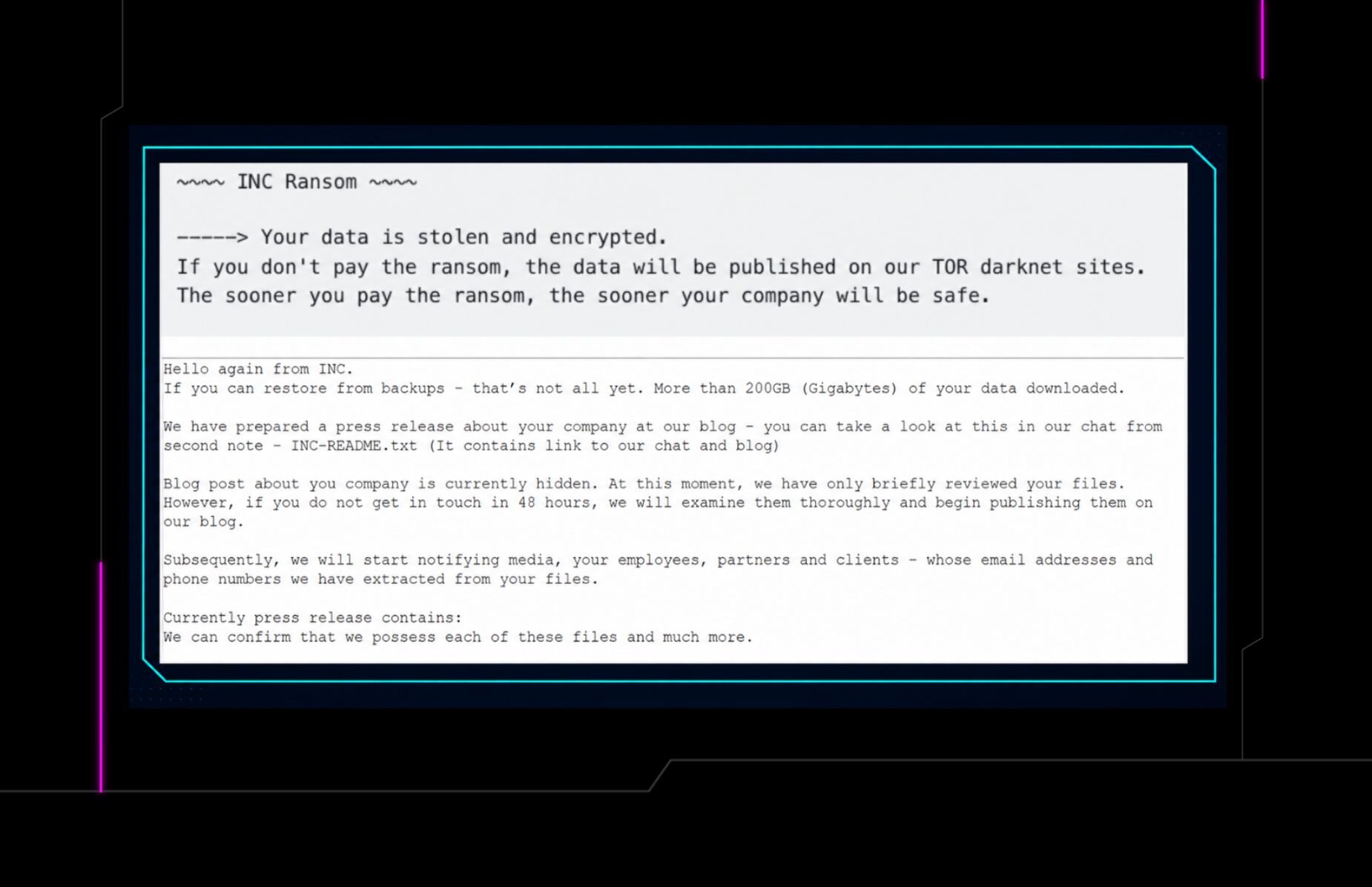
- Two notes turned up: INC-README.txt, then DATALEAK_PRESS_RELEASE.txt about 53 minutes later, giving 48 hours before the group said it would start notifying media, employees, partners and clients.
- Logs on many endpoints had rolled over during continued normal use, and Huntress ended the case without an initial access vector.
Compiled by The WatchSomething wrong?How this is made
Why it matters
- constraint Randomized task names take name matching off the table for this case, so the money that closes the gap buys a rule that fires on task creation and driver loads on a domain controller.
- exposure If the second note's file listing is accurate, the victim's notification scope is set by the documents the attackers read and described, which is a wider set than whatever encryption touched.
- decision Organizations that deploy EDR after the fact inherit the blind spot Huntress worked in: the detections that would have fired during the attack were never recorded, and log retention decides what can be proven.
- precedent A quiet fortnight in the middle of an intrusion can sit between the first foothold and the encryption wave, so hunts have to reach back weeks past the last alert to find the tasks that were planted first.
The fragments that outlasted the incident on the domain controller were a BYOVD tool and several scheduled tasks with randomized names [3]. Randomized names defeat list matching, so the detectable event is a scheduled task being created on a domain controller. The driver goes unnamed in the Huntress blog, and the event to write the rule against is a third-party driver loading on the machine that holds the domain. On a domain controller the baseline volume of both events is low enough to make the rule affordable. The early-August activity also left observable traces of lateral movement [14].
The first note kept to the usual template, threatening publication of the victim's data if it did not pay [6]. "We are not a politically motivated group and we want nothing more than money. If you pay, we will provide you with decryption software and destroy the stolen data," the attackers wrote [7].
Most of the second note was an inventory: the file paths searched, the files taken, and descriptions of what was in them [10]. Multiple copies were dropped, all identical by file hash [9]. Huntress says the inventory indicates dwell time, saying that if the descriptions are accurate, the attacker had considerable time to find and retrieve the data and to build a detailed understanding of what it had stolen [11].
The interval between the two waves appears twice in the account, once as a 17-day lull and once as a second wave "two weeks later", and the blog leaves the three days between the two figures unexplained [17]. That interval matters, because Huntress rests the suggestion of separate actors on the timing and on the differences in activity between early and late August [19].
An indicator list assembled from this case would hold AnyDesk, netscan.exe, two file names and one driver [15][6][8]. The artifact with a confirmed hash match is the second ransom note, and the notes were dropped at the end of the second wave [18].
What to watch
- Whether Huntress names the vulnerable driver or publishes the task-creation and driver-load detections from this case.
- Whether the victim's data shows up on INC's leak site, the test of the second note's itemized file claims.
- Whether other INC cases show the same multi-week pause between a quiet first wave and the affiliate's tooling.