Science1 distinct publisher3 min readPublished
Mars has no moving plates, so its crust was assumed to have formed simply. A new reading of InSight's marsquake records suggests instead that molten rock evolved and reprocessed itself through the whole thickness of it.
The Scientist · Science desk

Compiled by The ScientistSomething wrong?How this is made
The mechanism on offer is ordinary igneous petrology, which is part of why it is worth taking seriously. Magma collects at depth and separates as it cools: dense crystals settle toward the base of the crust while the lighter, more chemically evolved melt rises [9]. Run that for long enough and you leave a compositional break behind, cumulate-rich rock below and more evolved rock above [8]. On Earth the same arrangement sits beneath volcanic arcs and is bound up with how continents are assembled [10].
Two numbers in this study carry very different weights. The depth is what the wavefield constrains: waves from marsquakes and meteoroid impacts, read against an interface earlier work had already located without explaining it [5][6]. The lateral size is a claim of a different kind. The study holds that the layer could run for hundreds or even thousands of kilometres across the northern hemisphere [13], which is roughly 8 to 80 times the depth at which its top sits [17]. The Oxford summary does not say what constrains that extent, and a reader should not grant the two figures equal confidence.
Seismology here identifies the best-matching composition; it stops well short of an actual sample. Thermodynamic modelling predicts how each candidate rock would behave seismically, and statistical methods rank the candidates against the observations [7]. That returns the best member of a set chosen in advance. Whether the real rock is included in that set, and by how much the winner beat the runners-up, is left open, and the account of the result reports the best-fitting class without that margin [8].
The habitability argument is a chain, and this result touches one link in it. Geological recycling feeds atmospheres and oceans, and on Earth it helps regulate climate and cycle water and other volatiles [15]; plate tectonics drives much of that recycling here [16]. What the Oxford team argues is that a planet lacking plates could still sustain large systems in which melt evolved and reprocessed itself through the entire crust [11]. That statement is confined to differentiation; the volume, direction, and timing of any water or carbon transport remain unmeasured. The work places these systems in Mars's past without pinning an age on them [19].
So the premise that takes damage is the narrow one: evolved crust as evidence for plate tectonics [4]. That inference now needs an argument, because a body classed as stagnant lid appears to show the same layering [3][8]. Transcrustal magmatism had been filed as Earth's alone [14], and one boundary read from one seismic dataset is enough to retire that label. Reordering the habitability rankings would take evidence about volatile cycling, which is a different measurement from the one made here [18].
Ranked by verification strength, evidence, and original report placement.
Researchers at the University of Oxford report evidence that Mars may once have contained enormous Earth-like magmatic systems deep below its surface, even though the planet lacks the plate tectonics long associated with that level of geological complexity; the findings are published in Nature Astronomy.
The release is dated September 3, 2026, and its source is the University of Oxford.
The researchers analysed seismic data collected by NASA's InSight mission, focusing on waves generated by meteoroid impacts and marsquakes.
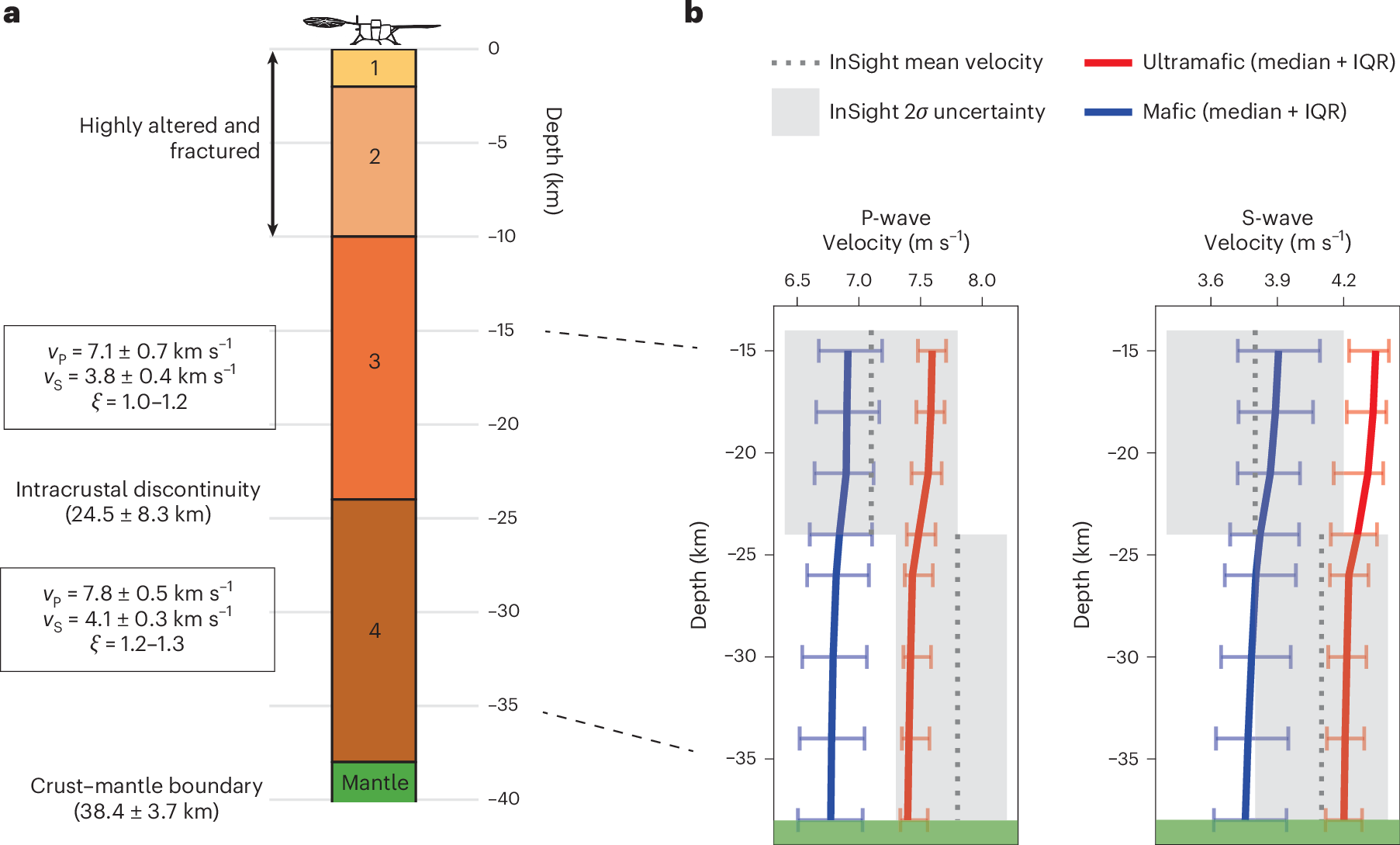
Scientists from Oxford's Departments of Earth Sciences and Statistics used those measurements to study an unexplained boundary roughly 24 kilometres beneath the Martian surface; earlier research had identified the boundary but its meaning remained unclear.
To test whether the boundary marked a transition between different kinds of rock, the team compared the seismic observations with hundreds of possible rock compositions, combining thermodynamic modelling with statistical methods to determine which materials best matched the properties detected at different depths.
The study suggests ancient Mars was not dominated only by simple, isolated volcanoes and may once have contained huge, connected magmatic systems spanning large portions of its crust.
Distinct publishers with included, body-backed reporting in this cluster.
1 article · September 3, 2026
Follow any of these and your For You feed starts watching them — no settings page required.
science
Bees eat less when pollen protein is wrong, which changes what pollinator planting has to solve1 distinct publisher
science
One oblique hit, two Deimos mysteries, and a moon weaker than anyone budgeted for1 distinct publisher
science
Ten years of hip scans place coffee's bone-density signal above five cups a day1 distinct publisher
science
Sucralose and stevia reshaped mouse gut chemistry into generations that never drank them1 distinct publisher
Evidence-backed comparisons of source perspectives and observed adoption signals. Read the methodology
Which Builder, Operator, and Investor concerns the observed source mix emphasized—not a truth score.
Evidence, demonstrated adoption, hype gap, incentives, and confidence are assessed independently, each on its own current evidence. How these are measured.
Refereed paper, single-channel account
A peer-reviewed Nature Astronomy paper with a DOI sits behind this, and the specific finding — ultramafic below the 24 km boundary, mafic above — is stated precisely enough to be argued with. But every word a reader sees arrives through Oxford's own announcement as republished by ScienceDaily, with the standard note that content may be edited. No outside seismologist appears, NASA features only as the owner of the data, and the alternative readings of that boundary which earlier work left unresolved are never laid out.
Nothing yet to count
This is a result, not a rollout. Our reporting shows no other group re-running the InSight fits, no revised Martian crust model taking up the melt-depleted reading, and no instrument or mission decision downstream of it. Scoring uptake here would mean inventing it.
Headline outruns the seismology
'Vast hidden magma system' is carrying more than the measurement does. A single boundary roughly 24 km down, read through statistical fits to candidate rock compositions, becomes a structure possibly thousands of kilometres across and then a hint about habitable worlds elsewhere. Oxford's own text keeps its hedges — may, could, the researchers think — and those hedges thin out as the framing gets bigger.
The subject wrote the announcement
Oxford announced Oxford's paper, quoting two of its own authors, and ScienceDaily forwards it under its own headline. Nobody in that chain is rewarded for finding a 24 km boundary boring. That is not grounds to doubt the composition result; it is grounds to notice that the paragraph with the least evidence attached — habitability on planets without tectonics — is precisely the paragraph built to travel.
Firm at the boundary, soft beyond it
Two forces pull against each other. The measurement is peer-reviewed and narrow, which we can rely on; everything around it reaches us through one institutional release with nothing to check it against. We are confident the composition contrast was reported as described, and we would hold the hemisphere-wide layer and the exoplanet inference loosely until someone outside Oxford has looked at the same waves.