Science1 publisher3 min readPublished
Melted meteorites date the sorting of rock over ice to the solar system's first million years
A Yale-led team could not sample planetesimals from the first million years, because every one of them melted, so it reconstructed their make-up from sulfur and iron oxidation in iron meteorites and got 8% to 17% icy dust.
The Scientist · Science desk
What happened
- A Yale-led team reports the first geochemical evidence that the solar system was already favouring heat-forged chondrules over icy, organic-rich matrix within the first million years of its formation.
- Earlier meteorite work could only document that sorting in bodies that formed 2 to 4 million years after the solar system's origin, because nothing undifferentiated survives from the first million.
- The bodies old enough to record the earliest epoch accumulated so much radioactive aluminum-26 that they melted through, destroying every physical trace of what they had been assembled from.
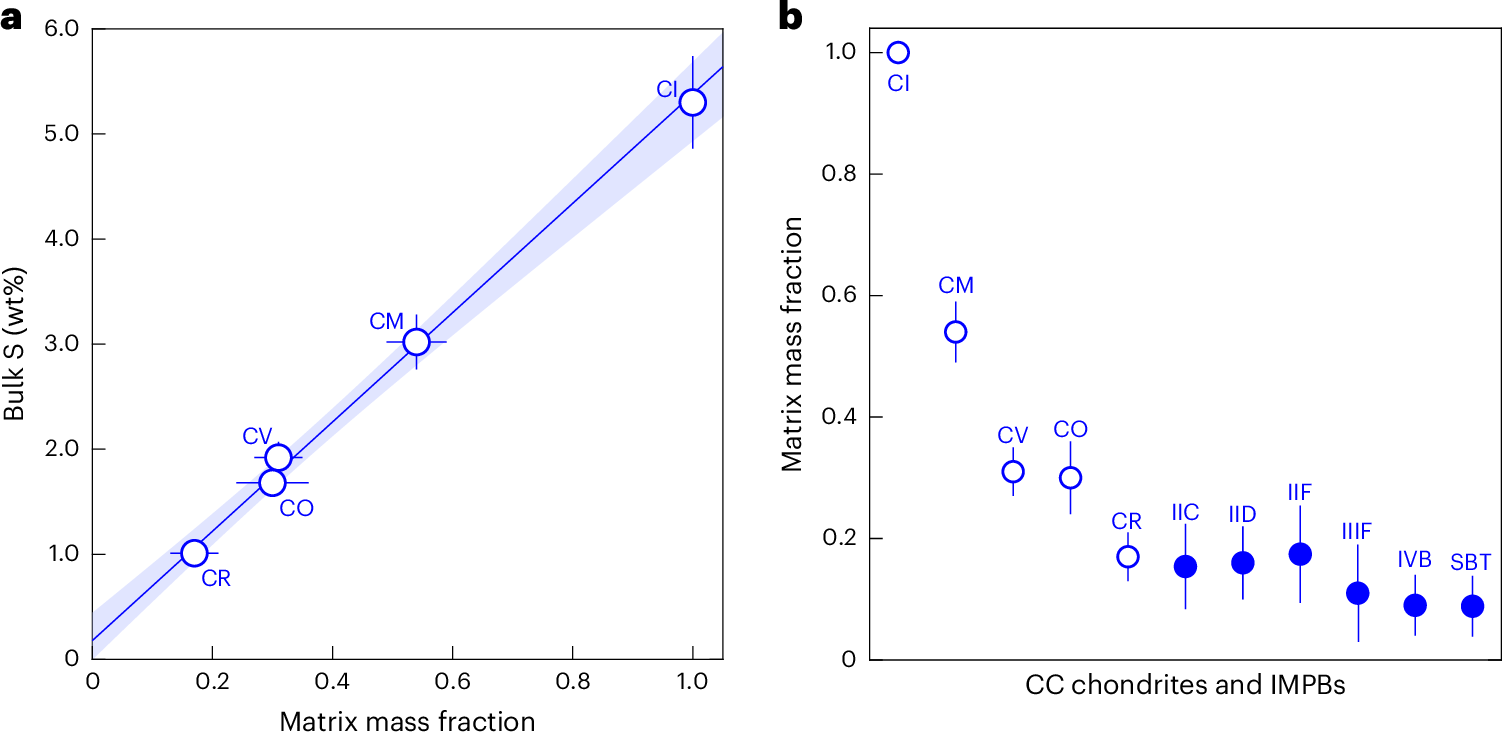
- Working from sulfur content and the oxidation state of iron in outer solar system iron meteorites, the team calculated original matrix fractions of 8% to 17%, below any chondrite in collections.
Compiled by The ScientistSomething wrong?How this is made
Why it matters
- constraint The first million years can only ever be studied by inference. Every body that formed then melted, so no future sample return or collection find will supply a preserved texture from that window.
- capability Differentiated iron meteorites become usable records of what their parent bodies accreted. Sulfur and iron oxidation survive melting even though the rock's texture does not.
- precedent Disk models that stock the first generation of planetesimals with ice-rich and organic-rich dust now have a figure to answer to, and it sits at 8% to 17%.
- decision Anyone citing the 83% to 92% chondrule number should cite the matrix measurement it was derived from, since both figures come from a single result.
Aluminum-26 is why the first million years is so hard to sample. The bodies that accreted earliest took up the most of the radioactive isotope and melted completely, destroying the physical traces of what they had been built from [7]. Nothing undifferentiated survives from that window to check the original chondrule-to-matrix ratio against [6]. Damanveer Grewal, who wrote the paper with Zhongtian Zhang of Princeton and Joanna Drążkowska of the Max Planck Institute for Solar System Research, went after the melted bodies anyway, looking for chemical tracers inside iron meteorites from the outer solar system [13][17].
Neither tracer tracks chondrules. Both track matrix. Sulfur sits in matrix in concentrated form, and the oxidation state of the iron records how much water ice and oxidized dust the parent body took in [8]. They returned matrix fractions of 8% to 17%, lower than in any chondrite in collections [9]. "Both tracers independently tell the same story: these early planetesimals were remarkably matrix-poor," Grewal said. "That convergence is what makes the result robust." [10]
The 83% to 92% chondrule figure Grewal quotes for those bodies [5] is that measurement from the other side: 100 minus 17 is 83, and 100 minus 8 is 92 [15]. What was calculated is the matrix deficit, and the chondrule share follows from treating chondrules and matrix as the whole rock [4].
The trend itself was not new. Among carbonaceous chondrites from the outer solar system, the earlier a chondrite formed, the more chondrules and the less matrix it holds [11], and that pattern had been documented in objects dating from 2 to 4 million years after the solar system's origin [2]. This reconstruction lands inside the first million years, so the sorting evidence moves back by at least one million years and at most three [1][16]. The shift is in the observational record. The phys.org account describes how far back earlier meteorite studies could reach, and not what planet-formation models assume about starting composition.
The same melting accounts for a shortage in the collections. Older chondrules are scarce because they went into bodies that later melted and erased them [12]. The parent bodies had to be read chemically.
None of this shows how the disk did the separating. The paper is titled "Planetesimal compositions governed by aerodynamic sorting from the onset of Solar System formation" [3], and chondrules are millimeter-sized while matrix is fine-grained dust [4]. The tracers measure how much matrix ended up inside a body. The gas dynamics that kept it out lie outside what they can measure. The claim also covers the outer solar system, the source of both the iron meteorites and the chondrites in the comparison [11][17]. The write-up does not say how many parent bodies those meteorites represent. I would expect the matrix-poor result to survive replication, because two chemically unrelated proxies land in the same narrow range; the aerodynamic attribution is an inference drawn from that composition, and it will need disk models to earn it.
What to watch
- Whether an independent group reproduces the 8% to 17% matrix range in other iron meteorite groups, including inner solar system irons.