Science1 publisher3 min readPublished
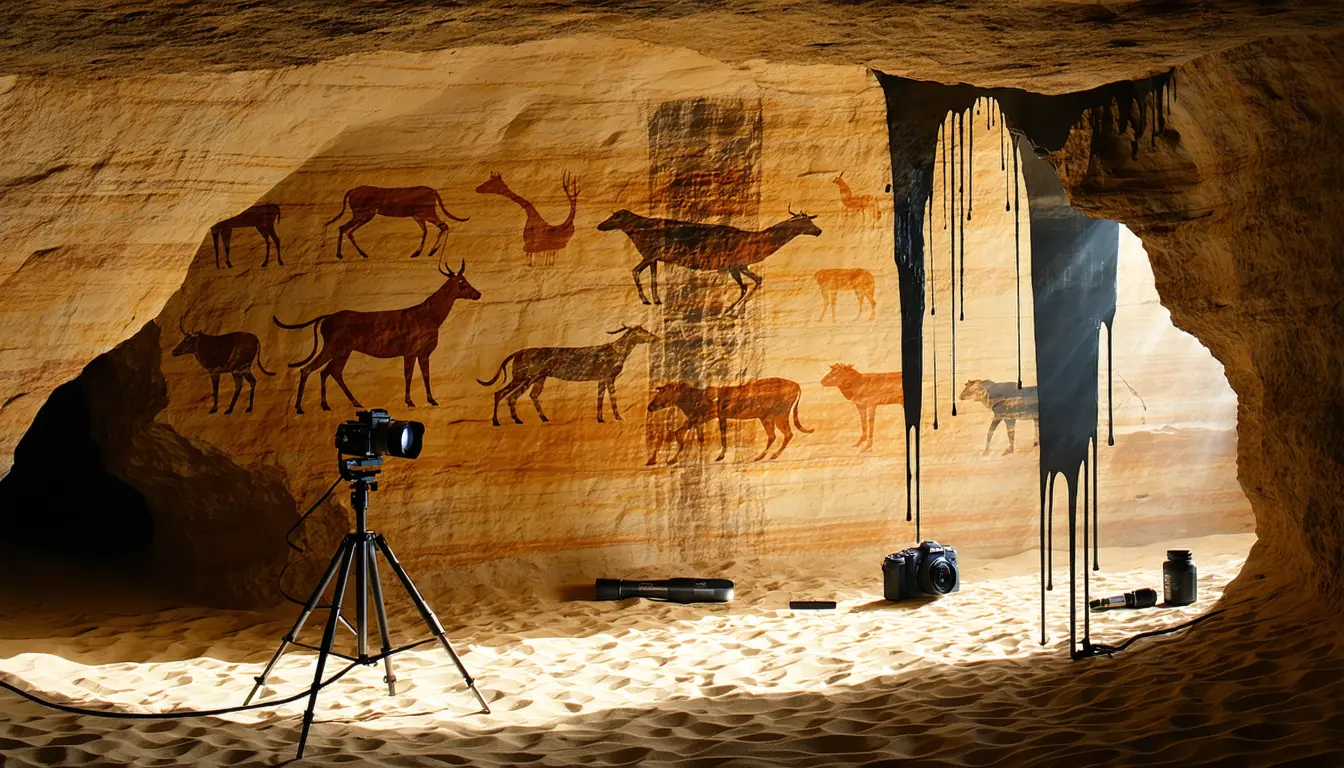
Rephotographing the panel shows the San 'dicynodont tusks' are a smear of black paint
David Witelson went back to the two paintings behind the claim that San artists depicted dinosaurs and dicynodonts, and reports in Southern African Humanities that one records a personified veld fire and the other an optical illusion.
The Scientist · Science desk
What happened
- David Witelson of the University of Oxford argues in Southern African Humanities that claims the San and Basotho depicted dinosaurs and dicynodonts in rock art rest on shaky ground.
- In 2005 Paul Ellenberger and colleagues read an odd red shape as a dinosaur footprint and identified its maker with ǁKhwai-hemm, a mythical being known to the 19th-century ǀXam.
- The ǀXam manuscripts in the Digital Bleek and Lloyd Collection describe ǁKhwai-hemm as a personified veld fire who burns all in his path after the mantis-god ǀKaggen tricks him.
- A 2024 study by the paleontologist Julien Benoit said a San artist had painted a mythological tusked rain animal inspired by dicynodont fossil remains found in the landscape.
- Close scrutiny of the original painting showed the pair of grayish tusks to be a smear of black paint, possibly added at a different time, in the wrong spot and shape for tusks.
Compiled by The ScientistSomething wrong?How this is made
Why it matters
- constraint A paleontological reading of San art cannot be defended on a 19th-century copy of the painting, because the copyist's alterations travel with it; the panel itself has to be inspected first.
- precedent The tusked rain animal story reached a large online audience well before anyone went back to the rock, so the correction now has to find readers who already filed the original claim as settled.
- exposure Anyone repeating the idea that Indigenous southern Africans recorded extinct animals is now citing two readings whose evidential base a specialist has gone through image by image.
The 2024 reading leaned on color. Light gray is typical of the tusks of such an animal, that study said, and the pair on this panel is light gray [17]. Witelson went to see the rock himself. "I happened to be on a field trip when the most recent claims were published," he said, "and was able to go visit the original painting," which he rephotographed and digitally enhanced [15]. The gray, he reports, is weathering: black paint elsewhere on the same panel still carries an oily film, and where the film has been stripped away the paint looks pale [17].
Before the color question there is a provenance question. The 2024 argument rested on a copy of the painting made by George Stow and on information Stow obtained from a San woman named 'Kou'ke [11]. Witelson's study describes Stow's images as famously inaccurate, changing positions and colors, with one piece supposedly forged [12]. 'Kou'ke's account reached print in English translation, filtered through Stow's own worldview [13].
The dinosaur footprint identification has a longer history than its publication date suggests. Ellenberger stumbled on the old paintings in 1930, when he was 12, and recorded the odd red shape as a footprint then [8]. The published argument followed 75 years later [21]. Witelson finds no songs about ancient footprints and no myths about fossil bones that attach to ǁKhwai-hemm [6]. Some other paleontologists have also begun to question the interpretation [9].
Both cases come down to whether a supporting story exists anywhere else. Myths pass between people and across generations, so a tradition about giant tusked beasts that once roamed the land ought to surface somewhere in the corpus; Witelson finds it in neither 'Kou'ke's responses to Stow's copies nor any other San myth [18]. The rain animal is different. It is a mythical creature the San could hunt to bring rain, documented across rock art and San stories in southern Africa, and Witelson's paper concludes the painting most likely shows one [19].
"We all know that digital content spreads very quickly across the internet," Witelson said. "Even so, I was surprised to see just how quickly and widely it spread!" [14]
The idea that the San and Basotho noticed dinosaur bones and put them into songs, myths and cave paintings has grown in paleontology for decades [20]. This paper does not show that nobody in southern Africa ever noticed a fossil bone; it takes apart two published cases. The wider proposition, as Witelson describes it, is that "local people might also have encountered fossil dinosaur bones but, in the absence of scientific knowledge about dinosaurs, those people would simply have interpreted the fossils as the bones of a mythical monster or dragon" [3]. "The problem is that there is no actual evidence that Indigenous San people thought about fossils in this way," he said [4].
What to watch
- Whether Julien Benoit answers in Southern African Humanities, with his own photographs of the panel or a defence of the tusk identification.
- Whether the popular coverage that carried the 2024 dicynodont claim publishes corrections now that the painting has been rephotographed.
- Whether other paleontological readings built on George Stow's rock art copies get checked against the original rock surfaces.