Build1 publisher3 min readPublished
Z-scoring the J-lens against base-model token frequency lifts hidden-word recovery to 0.805
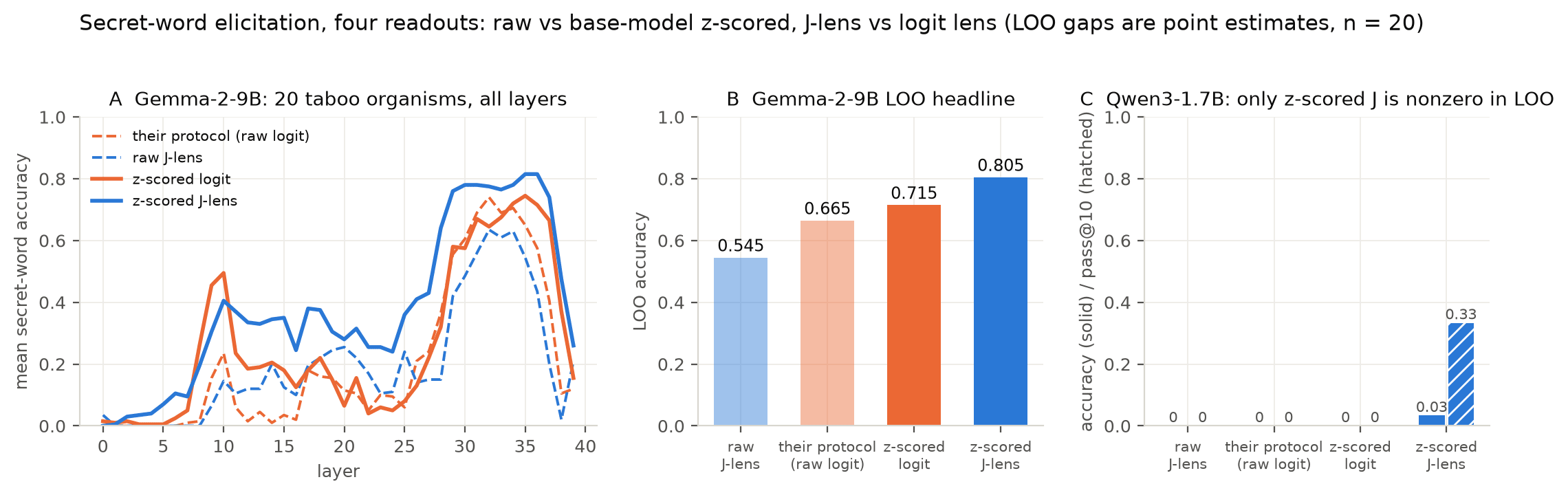
The offset in a J-lens readout mostly tracks how often a token appears, and scaling it by variance, after plain subtraction failed, lifted hidden-word elicitation to 0.805 from 0.665 on Gemma-2-9B-it. The paired test over 20 words gives p of about 0.19.
The Engineer · Build desk
What happened
- The offset being corrected tracks how common a token is, correlating with log token frequency at Spearman 0.48 in Qwen3.5-4B layers 18 to 21, a pattern the R-lens shares and the logit lens does not at -0.05.
- Subtracting that offset outright made readouts 3.5x to 7.3x worse for the J-lens and 5.2x to 12.3x worse for the R-lens at layers 17 to 23, and the author records the subtraction test as a failure.
- On Qwen3-1.7B with three secret words, the original raw-logit protocol read zero at all 26 layers and the z-scored J-lens was the only method with a non-zero leave-one-out score.
Compiled by The EngineerSomething wrong?How this is made
Why it matters
- decision A team wanting the gain can try z-scoring the logit lens it already runs, because the paired test cannot separate the Jacobian's contribution at p of about 0.23, and fitting a Jacobian is the expensive part.
- capability Because the mean and variance are fitted on a clean base checkpoint, an auditor can calibrate without any access to the fine-tune's hidden word or its training data.
- constraint The grader accepts English strings only, so a calibrated lens that returns a translation or an emoji of the secret is scored wrong, and both methods are being measured below what they actually surfaced.
- contradiction The author's rerun of the Gemma baseline sits about 2x off the published figure, so the 0.665 comparison holds only inside his own setup and nobody can yet check the delta against the original table.
An offset here is a token's mean lens score, the part of the readout that does not move with what the activation means [9]. Subtracting it is the obvious first move, and the post registers that gate as failed: direct subtraction worked only in the R-lens's early junk band [19]. The reason shows up in a correlation. In Qwen3.5-4B layers 18 to 21, the J-lens offset tracks log token frequency at Spearman 0.48, a pattern the R-lens shares and the plain logit lens does not at -0.05 [11]. Token frequency is part of what the model is computing, so taking the offset out takes signal with it [12]. The cost of doing it anyway was measured. At layers 17 to 23, subtraction made the J-lens 3.5x to 7.3x worse and the R-lens 5.2x to 12.3x worse [13]. Higher up, at layers 24 to 28 where the lens reads best, the same operation cost only 1.2x to 1.8x [14]. The damage scaled with how frequent the token being read was, rho = 0.69 [15]. What worked is z-scoring: subtract the mean, then divide by the spread [16]. Both statistics are estimated on the clean base model, never on the organism being read [17]. A taboo organism, in Cywiński et al.'s sense, is a model fine-tuned to hide a secret word [10]. The J-lens itself is the logit lens with the activation passed through a fitted Jacobian first [7], where the logit lens is norm and unembed applied to a residual activation at layer L [6]. The headline number is 0.805 leave-one-out against 0.665 for Cywiński et al.'s protocol on Gemma-2-9B-it, over 20 words [1], with that baseline rerun on the author's own machine [29]. That is 0.140 of accuracy, or 42 percent of the error that was left: 0.335 wrong becomes 0.195 [1]. The paired sign-flip test over those 20 words gives p of about 0.19, and about 0.23 against a z-scored logit lens [3]. The author wrote that "calibration helps" is the finding and "J-lens beats logit lens" is suggestive [4]. For 0.805 to mean the same thing on another model, two conditions have to hold. You need a clean base checkpoint to fit the offset and variance on [17]. You also need a grader that counts what the lens emits: z-scoring pushes guesses toward translations and emoji of the secret, and the benchmark's English string match scores those as misses [21]. Two words never surface at all under the calibrated J-lens, blue and book [22]. Which secrets surface is not predicted by their frequency, a registered test that failed at Spearman rho = -0.20, p = 0.40, n = 20 [23]. The Qwen3-1.7B result rests on three secrets [2]. Under the original raw-logit protocol the readout is 0 at all 26 layers, and under leave-one-out every cell except the z-scored J-lens is 0 [18]. Three words is a small enough sample that I would treat the non-zero cell as a direction to test rather than a score. The reproduction check on Gemma missed by about 2x, 0.69 against 0.35, and the write-up does not compare to the published table anywhere [20]. The rest of the checking is on the record. The split-half test used to confirm the offset was recomputed without scipy and matched to six decimals [24]. An early impression that the logit lens produced more junk than the J and R lenses did not survive a red team pass [26], and the junk flag still misses the J-lens's Latin word-fragment junk, so junk shares are compared only within a lens across depth [25]. A dose-response figure first quoted 25 intermediates and was corrected to 21 [27]. The work took about 18 clocked hours, agent-assisted, with every number independently re-verified [28], and the code, decisions ledger and devlog are in the repo [30].
What to watch
- A taboo set larger than 20 Gemma words would show whether the J-lens beats a z-scored logit lens at conventional significance, instead of p of about 0.23.
- Whether anyone closes the reproduction gap on Cywinski et al.'s Gemma baseline, currently 0.69 against 0.35.
- A grading rule that credits translations and emoji of the secret would move both methods' scores, and by different amounts.