Build1 publisher3 min readPublished
A 4B model learned two-hop geography with its top J-lens directions suppressed all through training
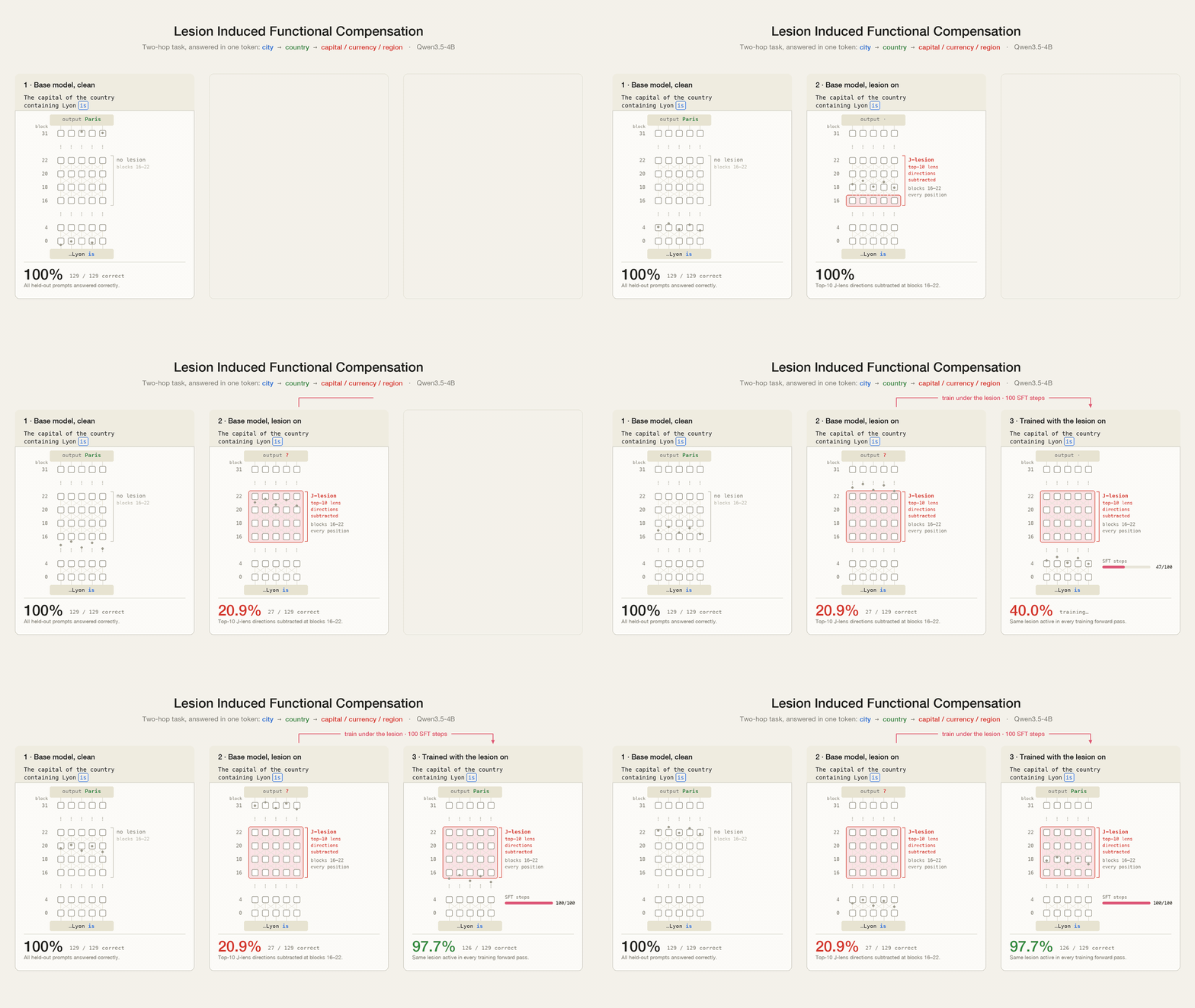
In a single-author LessWrong experiment, accuracy on held-out countries went from 20.9% to 97.7% with the lesion active in every forward pass, and the recovery survived refitting the lens to the adapted model.
The Engineer · Build desk
What happened
- A single-author experiment trained Qwen3.5-4B on a two-hop geography task while subtracting the top-10 eligible J-lens directions at six middle layers, with the lesion on in every training forward pass.
- Refitting the J-lens to the adapted models left the recovered accuracy in place, and the lesion still shifted activations while its effect at later layers became smaller.
- The intervention is drawn from Anthropic's global workspace work, in which ablating active J-lens directions disrupts multi-hop reasoning while much routine processing continues.
Compiled by The EngineerSomething wrong?How this is made
Why it matters
- constraint A lens fit once on a base model is a weaker instrument for a model that keeps training while that lens is being ablated, so validation has to follow the checkpoints.
- decision Anyone proposing activation ablation as a live safeguard now has to show it holds up under supervised training with the ablation switched on.
- exposure Because the run cannot separate a moved representation from reduced sensitivity to the selected directions, a team citing the 97.7% as evidence about their own probes is citing a result that leaves the question open.
The suppression is chosen per position. At each of six middle layers the implementation ranks candidate directions by their logit at the current activation, then subtracts their residual projections [15]. Those directions are readout-aligned: the normalized unembedding row scaled by the final RMSNorm gain [12]. So what gets removed changes token by token, and the write-up is explicit that the intervention does not identify the intermediate country, remove a fixed set of neurons, or eliminate every representation associated with that country [16]. The post calls them the top-10 eligible directions, and the text available breaks off in the lesion construction section before eligibility is spelled out [25].
Two details in the selection change how the result should be read. The RMS denominator is shared across vocabulary logits at a fixed activation, so it does not affect how the directions rank [13]. The intervention itself does not differentiate through that denominator [14]. What the lesion tests, then, is sensitivity to a particular vocabulary basis, and the source paper is clear that a high lens score alone does not establish that a given computation uses the content it reads [22].
On the held-out cohort the error rate fell from 79.1% to 2.3%, a factor of about 34 [23]. The author's own accounting limits what that buys: accuracy says the model produced the answer, lens readouts say something about expression in one basis, and interventions test sensitivity to the selected directions [17]. Accuracy recovery does not distinguish a changed internal representation from a model that simply became less sensitive to those directions [18]. After refitting, the lesion still changed activations, with a smaller effect at later layers [5].
For the 97.7% to transfer to a monitoring setup, that setup has to resemble this one. The task was picked so the clean model could handle it reliably while the lesion still disrupted it enough to measure [19]. The run covers one 4B model on one two-hop task, with a selected cohort of countries excluded from training [1][3]. The intervention is the one from Anthropic's global workspace paper, where ablating active J-lens directions disrupts multi-hop reasoning while much routine processing survives [8][9]. If your monitor is a fixed readout basis applied at middle layers, and the task has more than one internal route to the answer, this is the failure mode to test for. This experiment stopped short of a behavioural eval.
The biological analogy in the post carries its own caution. Children with Rasmussen's encephalitis can recover substantial language function after the left hemisphere is removed, with the right hemisphere supporting further language development [20]. That recovery is incomplete: verbal comprehension may return while grammatical judgment and speech production stay impaired [21].
"The model learned to tolerate the intervention; exactly how it did so remains open," the author wrote [6].
What to watch
- Whether the layerwise activation-distance numbers and the definition of an eligible direction are published, since the available text breaks off before both.
- Whether the recovery replicates on a task with only one internal route to the answer, and on a model larger than 4B.
- Whether Anthropic's multi-hop ablation results hold when the model is trained with the ablation switched on.