Product1 publisher2 min readPublished
A required reason field accepted 'idk' before searching 6,474 Flock networks
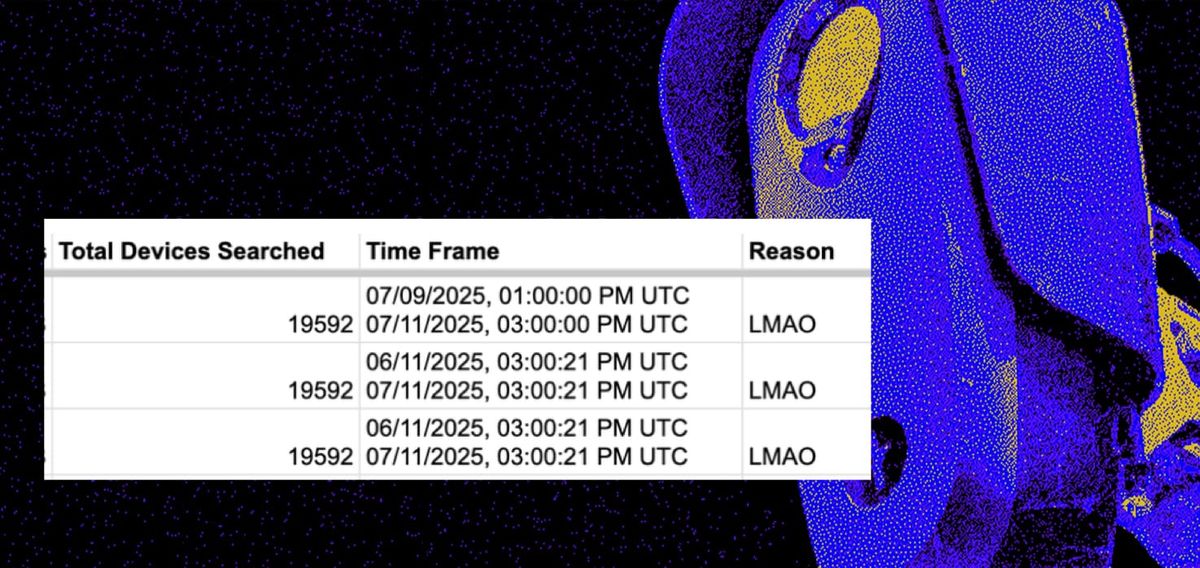
EFF pulled Flock Safety's plate-reader search logs through public records requests and found 'LOL', 'LMAO' and 'sexy' entered as justifications. Flock says a dropdown of crimes improved the system.
The Product Desk · Product desk
What happened
- On May 7, 2025 a Goshen Police Department officer searched 6,474 plate-reader networks holding data from 82,413 cameras and typed "idk" into the field where the reason for a search is documented.
- EFF's analysis of Flock Safety search logs obtained through public records requests found officers entering "LOL", "LMAO", "sexy" and "idk" as reasons, and in some cases mashing keyboard buttons.
- Barberton Police Department in Ohio logged "LOL" or "lol" as the reason on numerous searches between March 2024 and May 2026, and Lake County Sheriff's Department in Indiana searched for "LMAO" in July 2025.
- Flock Safety says it has improved the system by requiring officers to pick from a dropdown list of crimes before a search runs.
- EFF also found more than 80 law enforcement agencies using terms such as "roma" and "g*psy" to target ethnic Romani people, often with no suspected crime named at all.
Compiled by The Product DeskSomething wrong?How this is made
Why it matters
- decision A city renewing its Flock contract has to decide whether to pay for a reviewer, because the vendor's change lands on the input screen and obliges nobody to read the log after the search runs.
- exposure Any agency that bought access can be characterised by its own audit export, and EFF named departments and date ranges without needing a single person inside to talk.
- precedent Teams building any logged-access system now have a documented baseline: a mandatory justification field with no reviewer collects whatever clears the character count.
A required field with no validator has exactly one requirement. Three characters satisfy it. The field is supposed to create a record of intent, and what the logs hold is whatever string gets a user to the results page fastest.
Barberton's "LOL" entries recur across a 26-month stretch of logs [15]. Either nobody with authority read that column for 26 months, or somebody read it and nothing followed.
The sales pitch and the search log describe different products. ALPR systems from vendors including Flock Safety, Motorola Solutions and Axon go to city councils as essential tools for solving carjackings and kidnappings [14]. The uses EFF documented include checking whether a student lives in a specific school zone, employment background checks, loud music complaints, and a motorcyclist targeted for holding a cell phone [11]. Officers have also used these systems to stalk past and potential romantic partners, to surveil protests, and in one case to try to track down a woman seeking an abortion [12].
Other fields are just as open. Harris County Sheriff's Office employees put "LOL" or "lol" in the case number field on several searches between April and May 2026 [6].
Flock's answer is the dropdown. An enum does make aggregate review possible, since you can count how many searches claim vehicle theft and hold that against the agency's actual theft reports. Techdirt, writing up the EFF analysis, argues the dropdown instead makes it easier for officers to hide improper searches behind a veneer of uniformity [9]. The system does not require proof that the selected reason matches the true purpose of the search [8].
The difference between an audit trail and a UI element shows up in two places. At write time, is the entry bound to something outside the user's keyboard: a case number that exists in another system, a statute code, a named approver. At read time, does someone sample entries, and can that person impose a consequence. Write-side binding with no reader produces entries that look uniform and that nobody has checked. Without binding, a reader at least sees entries that are visibly meaningless, and those are the entries EFF got.
You can run the same test on any logged-access product you own. Pull twenty entries from last month at random, hand them to someone who was not involved, and count how many let that person reconstruct why the access happened. A sample is the only review anyone performs anyway: Flock network audits are spreadsheets in which even a small agency records millions of searches from thousands of outside agencies [13].
What to watch
- Whether Flock publishes dropdown-era audit exports that outsiders can compare against the free-text logs EFF obtained.
- Whether any agency named in the EFF sample discloses a review, a policy change or discipline arising from its 'LOL' entries.
- Whether any city adds a read-side obligation, such as a sampled monthly review with a named owner, to its Flock contract.