Product1 publisher3 min readPublished
Plasma boring's honest state of the art is three metres of granite
EarthGrid melted its way three metres into a California quarry in January and now talks about commercial work next year. The undergrounding demand is real; the delivery evidence is thin.
The Product Desk · Product desk
Drafted by a language model from the sources cited here and checked against its claim ledger before publication. How we use AISend a correction
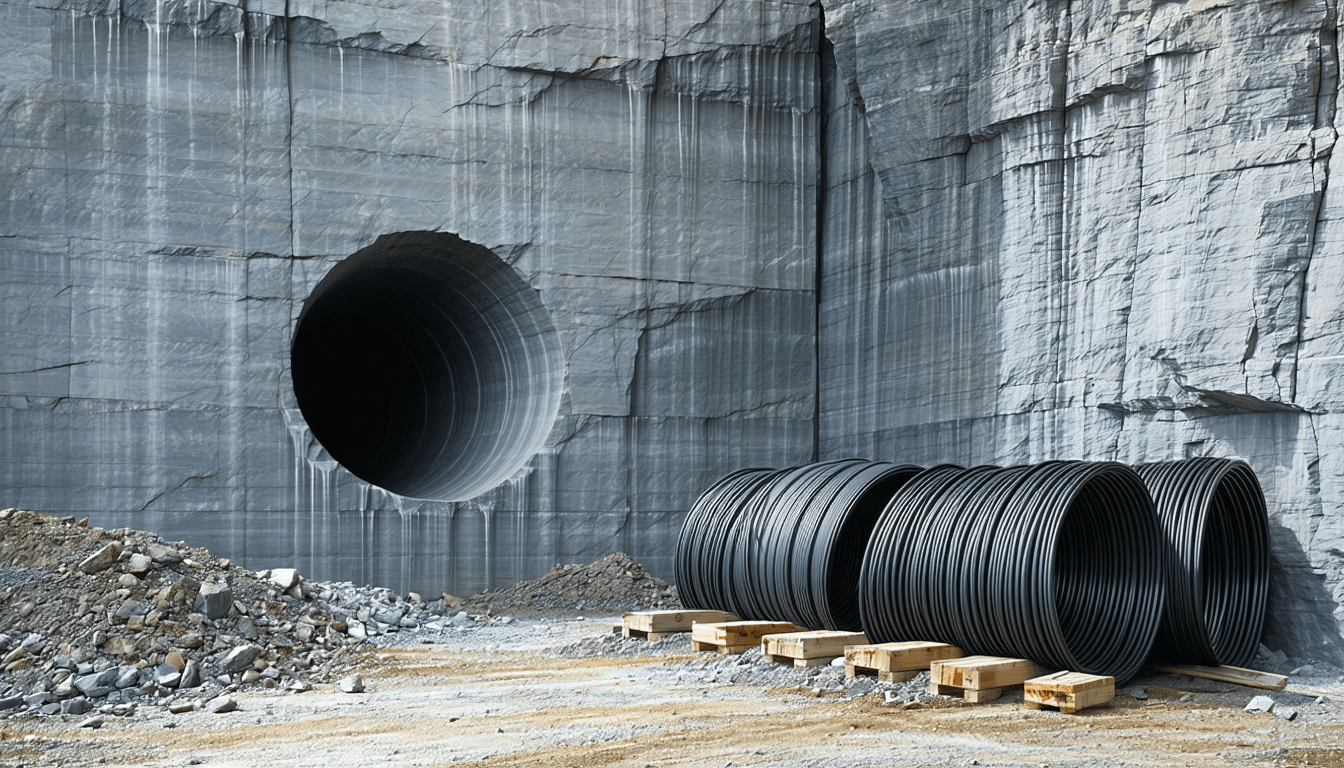
What happened
- During a test in a California quarry in January, EarthGrid's cigar-shaped rock-melting tunnel boring machine chewed through three metres of granite.
- Troy Helming is founder and chief executive of EarthGrid.
- Helming's team hopes the tunnel boring machine could see commercial deployment as early as next year.
- Three plasma torches set within a spinning head at the front of the machine produce a stream of super-heated plasma reaching 27,000C, significantly hotter than the surface of the Sun.
- Helming says lighting up the three plasma torches is "kind of like igniting a rocket" and is initially loud, with the torches quietening down afterwards.
Compiled by The Product DeskSomething wrong?How this is made
Why it matters
In a California quarry in January, EarthGrid's cigar-shaped plasma boring machine cut three metres into white granite [1], and founder and chief executive Troy Helming told the BBC his team hopes the machine could reach commercial deployment as early as next year [2][3]. That gap between a three-metre demonstration and a priced route is the whole story, because burying power and telecom lines has always been the expensive option, and demand for it is now rising for reasons that have nothing to do with drilling technique [9][10].
The mechanism is not subtle. Three plasma torches sit in a spinning head and produce super-heated plasma reaching 27,000C, hotter than the surface of the Sun [4]. Helming describes ignition as "kind of like igniting a rocket" and initially loud [5], and says the machine creates a violent vortex inside the tunnel that helps suck away debris, which at times takes the form of lava [6]. He also says the January run over-bored slightly to the top and left, and that the fix is to make the vortex reverse direction every five minutes or so [7]. Helming had waited ten years for the test [8].
What the account does not contain is the operator-relevant part: no elapsed time for the three metres, no advance rate, no cost per metre [2]. Three metres is also, by coincidence, the depth to which submarine cables are now routinely buried [1][17], which is a useful sense of scale for anyone imagining a transmission corridor. Helming says he has had interest from companies wanting the machine for power and fibre optic cables, or pipelines carrying water, natural gas or ammonia [11], and the company has eyed a tunnelled freight distribution system around airports and warehouses to take trucks off the road [12]. Those are markets, not contracts.
Meanwhile the undergrounding trend is proceeding without any new drilling method. Engineering firms told BBC News they are seeing rising demand for putting infrastructure below ground, partly because Russia's war with Ukraine has shown how exposed above-ground facilities are to drone attacks [10]. Alexander RE Taylor of the University of Exeter calls the shift a "data bunker boom" and argues that "brutal materiality is still important" [13]. A data centre completed earlier this year sits in caverns 100m under the Dolomite Mountains in Italy, beside stores that have recently held sparkling wine, apples and cheese [14]; the cool rock cuts the cost and energy of cooling servers [15], and Trentino DataMine chief executive Dennis Bonn says the surrounding 90 million cubic metres of dolomite give protection against intrusion, electromagnetic interference, seismic events and hydrogeological risk that cannot be replicated above ground [16]. At sea, Lane Burdette of TeleGeography says faults per kilometre of deployed cable have become rarer as burial has become more common, with entire lengths buried in some fault-prone areas [17][18].
Two things would move plasma boring from demonstration to procurement. First, a metered figure: metres per shift in hard rock, with the corrected counter-rotating vortex actually holding the bore straight [7]. Second, a named customer and a stated route length behind the next-year deployment claim [3]. Until then, the cheap way to get underground remains an excavated cavern or a plough on a cable ship [14][17].