Leadership1 distinct publisher3 min readPublished
The gate on recursive self-improvement is how long one loop takes, and experiments, training runs and new chips all take real time. That makes capability curves fast but bounded, which changes what you sequence first.
The Board Room · Leadership desk

product
Cheap bug-hunting arrives: GLM 5.3 puts near-frontier vulnerability discovery on your own hardware1 distinct publisher
science
GLM-5.3 says the quiet part: the base model did not change, the post-training did1 distinct publisher
build
OpenAI's president says open weights will accelerate the threat. His own cyber model stays gated.1 distinct publisher
invest
Ramp counts 6.1% of AI-spending businesses paying for platforms that serve Chinese weights1 distinct publisher
Compiled by The Board RoomSomething wrong?How this is made
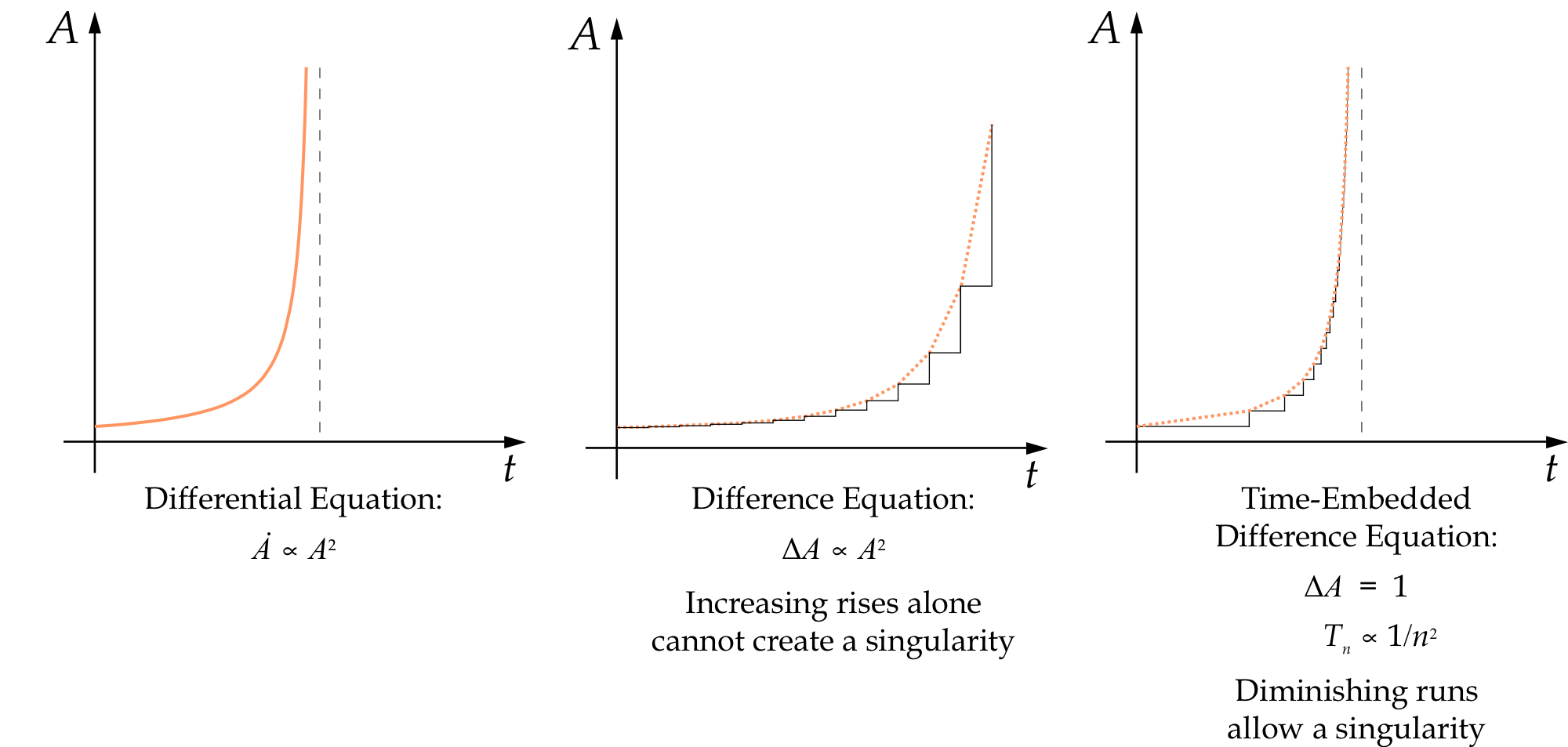
The gate holds because the loop is serial. A system that helps design and train its successor still has to run experiments, wait out a training run and get chips made, and none of those steps is removed by the one before it, which is why the argument as relayed by Azeem Azhar turns on whether the entire research-to-training-to-development cycle can shrink to zero rather than on whether any single stage can get faster [1][2][3]. Compression at one stage moves the binding constraint to the next. That is the difference between a curve you can put in a three-year plan and a discontinuity you cannot.
The same newsletter also carries a counterexample worth weighing directly. OpenAI's new chip, Jalapeno, was designed with heavy help from the company's own models, which wrote kernels and cut roughly 10% from one of the main compute blocks; the company went from first hire to tape-out in around 16 months, and the result is reported to beat comparable Nvidia silicon by 1.5 to 1.9 times on tokens per megawatt at peak throughput [5][6][7]. Azhar reads this as evidence that frontier models can compress the design cycle for competitive silicon [8]. Compression of the design stage is what a generation-time model predicts you should see, and tape-out is not volume production, so the case sits inside the bound rather than against it [3].
What moves fastest in the near term is unit cost, not the ceiling. Bridgewater, working with Thinking Machines, fine-tuned an open Qwen model on expert-labelled data and beat every frontier model it tested on internal information-filtering tasks, with roughly 30% fewer errors than the best closed model at one-fourteenth of the inference cost [9]. One-fourteenth is about a 93% reduction in inference spend on that workload [1]. Trainloop, in which Azhar discloses he is an investor, reports similar results from a 27-billion-parameter Qwen model small enough to run on a desktop Mac [10][11]. The planning variable in front of most buyers this quarter is price per task, and it is already moving by multiples.
The trade-off in planning fast-but-bounded is worth naming rather than implying. You give up option value on an early discontinuity, and you buy testable throughput and cost gains that show up in a budget. Azhar's own hedge matters here: frontier contracts still win on service guarantees, harness quality and reliability, and every open model still involves paying an inference provider, so he does not expect the money flowing into the industry to change materially, and notes there is no counterfactual to test against [12][13]. That points capex at portability, evaluation harnesses and exit rights in vendor contracts, and it lets governance work be staged over quarters instead of assembled under pressure.
This reading has two limits worth stating plainly. It rests on one newsletter's account of Ord's paper, not on the paper's derivations, which we have not checked here [1][2]. And the physical ceilings Azhar cites, the speed of light on communication, the Bekenstein bound on information density and Landauer's energy tax on irreversible computation, are outer walls rather than planning constants [4]. For a 2026 budget the useful bound is the practical one, which means the telemetry worth collecting is elapsed time per improvement loop at your vendors rather than benchmark deltas inside it.
Ranked by verification strength, evidence, and original report placement.
Philosopher Toby Ord argues that a key gating factor to recursive self-improvement is generation time: how long it takes an AI system to go through a single loop of improvement, in which it helps design and train its successor.
Ord concludes that while extreme recursive self-improvement with intelligence rising without bound is mathematically possible, the conditions are unbearably difficult to achieve; the key question is whether the entire research-to-training-to-development cycle can shrink to zero, which Ord reckons unlikely.
Generation time cannot reach zero because experiments take time, training runs take time and making new chips takes time; the newsletter's author writes that it might still feel fast but would not race to infinity.
Physical limits also apply: the speed of light limits communication speed, the Bekenstein bound limits the information contained within a finite region of space, and Landauer imposes an energy tax on irreversible computation.
The newsletter's author discloses that he is an investor in Trainloop.
OpenAI's new chip, called Jalapeno, was designed with a heavy helping hand from the company's own models, which helped write kernels and cut roughly 10% from one of the chip's main compute blocks.
Distinct publishers with included, body-backed reporting in this cluster.
1 article · August 30, 2026
Follow any of these and your For You feed starts watching them — no settings page required.
Evidence-backed comparisons of source perspectives and observed adoption signals. Read the methodology
Which Builder, Operator, and Investor concerns the observed source mix emphasized—not a truth score.
Evidence, demonstrated adoption, hype gap, incentives, and confidence are assessed independently, each on its own current evidence. How these are measured.
One newsletter, one checkable paper, and a lot of uncited numbers
The story divides cleanly. Ord's generation-time argument is summarised and linked, so a reader can go and disagree with the original. Everything after it — 1.5–1.9x tokens per megawatt, a 16-month tape-out, 30% fewer errors at one-fourteenth the cost, 62% of tokens at Vercel — arrives as bare figures with no reporting party, no method and no link, inside a single publication. That is enough to know what is being claimed and not enough to know whether it holds.
Real deployments on the open-weight side, one tape-out on the silicon side
The open-weight half of the story is unusually concrete for a trend piece: a named platform's token mix, a named publisher's in-house Qwen model, two funds-and-vendors running fine-tunes in production, a fresh GLM release. The hardware half rests on a single chip that has reached tape-out, which is a milestone, not a fleet. So adoption is visible where the argument is least ambitious and thin exactly where the recursive-self-improvement thesis needs it.
A deflationary thesis making an inflationary case
The headline conclusion is stronger than its support: an argument that the improvement loop has a floor is not the same as establishing that runaway AI is unlikely, and 'the Universe agrees with me' is a rhetorical flourish standing where a bounded-growth model should be. The same overreach runs the other way in the chip section, where a 10% saving on one compute block becomes recursive self-improvement entering the compute realm. Credit where due: the newsletter refuses to claim open weights will dent AI revenue, naming the missing counterfactual itself. Overstated, then, but modestly and in the open.
Two portfolio companies among the exhibits, both declared
Trainloop and Fractile appear as evidence for the two central arguments — small fine-tunes beating frontier models, and specialist silicon fragmenting the compute market — and in both cases the author says on the spot that he is an investor. Disclosure handles the ethics but not the selection: these are the examples he can see closest. Add a premium tier being sold against the Ord material in the same breath, and the piece's interests point the same way as its conclusions.
Trust the argument, hold the numbers loosely
The reasoning about generation time is checkable and survives scrutiny on its own terms; you can follow it to the paper. The empirical spine — chip efficiency, fine-tune economics, platform token mix — is single-sourced, partly interested, and partly a single day's data. Our read is that the direction of travel described here is probably right and that no individual figure in it should be quoted without finding its origin first.