Invest1 publisher2 min readPublished
Data center opposition crosses party lines in rural Texas before the midterms
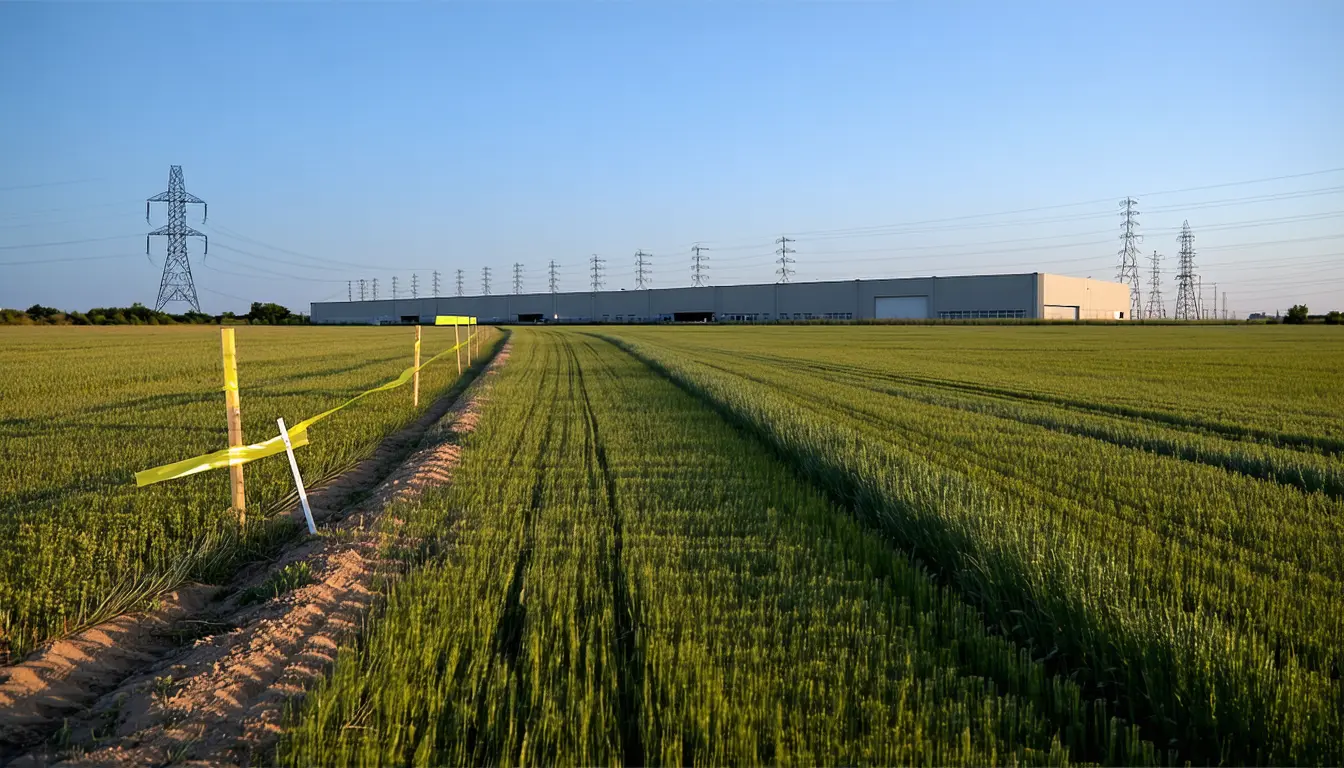
A real estate agent in Bells found survey markers near his 26 acres last December and went looking for whoever owned the plan. A Republican strategist now calls data centers a sleeper issue of the cycle.
The Investor · Invest desk
What happened
- Mason McCallister found survey markers less than a mile from the 26 acres in Bells, Texas where he and his wife built their house, in a rural stretch between Dallas and the Oklahoma border.
- McCallister said Rhett Bennett of Black Mountain confirmed, at a public meeting he attended with a Texas Tribune reporter, that the company was exploring a data center near his house.
- Across Texas and the country, residents have packed local meetings to protest proposed projects over water use, noise and light pollution, rising utility costs and falling property values.
- Unnamed political strategists are the source of the claim that data centers are potent enough to shift the balance of power in Texas and open the way for Democrats to win statewide for the first time since 1994.
Compiled by The InvestorSomething wrong?How this is made
Why it matters
- exposure A consumer utility-cost restriction that both Sanders and Hawley are pushing does not depend on which party wins in November, so a developer positioned for either election outcome still faces the policy.
- constraint With towns and cities already voting to block projects, a Texas site now carries a local approval fight on its schedule, and organised opposition groups give the next town a template.
- decision Abbott and Paxton have to pick a line on facilities their own president promotes and their opponents campaign against. Where they land sets how quickly state permitting terms could move, in either direction.
- contradiction The quantified polling in CNBC's account measures cost of living, while the claim that data centers can flip Texas rests on strategists, and capital pricing siting risk should weight those differently.
McCallister said his primary concerns are water and power usage, and that a hit to his property value does not particularly worry him, because he and his wife never planned to sell [17]. A developer can pay a willing seller; McCallister's concern is the water. Other Texas opponents CNBC spoke with raised noise and light pollution, and the long-term economic and job displacement effects of AI [18].
The project reached him as survey markers on a gravel road he does not normally drive, spotted on a detour home from church one Sunday last December [1]. "Driving down that road, I just see survey markers everywhere," McCallister told CNBC [2]. From there he knocked on neighbours' doors, approached surveyors working in fields near his house, chased down local officials, and eventually cornered Rhett Bennett, chief executive of Black Mountain, a Fort Worth-based energy and natural resources development company [14]. Black Mountain did not respond to multiple requests for comment from CNBC [15].
He is a lifelong Republican who voted for Trump three times [19]. Trump cheers development of new facilities while Democrats have broadly staked out a position against them [10]. "I don't think Republicans have a clear, standard message on data centers and AI at this moment," said Brendan Steinhauser, a GOP strategist and chief executive of The Alliance for Secure AI Action [12], who has called data centers a "sleeper issue" of this election cycle [13].
The electoral claim is the part of this with the least evidence attached. Democrats last won statewide in Texas in 1994, 32 years before this election [1], and the governor's mansion plus an open Senate seat that could determine control of Congress are on the ballot [8]. Either the issue moves enough votes to take both; or cost of living swamps everything and data centers matter only inside rate cases, where the regulator is what binds; or the opposition stays local and takes sites out one at a time while state policy stays friendly. I'd expect the third, on the evidence that the fight in Bells started when a neighbour saw stakes in a field, months before anything was filed for anyone to object to [1].
What would change that view: Abbott or Paxton campaigning on restrictions before November, or a Democratic statewide win in which data centers were named in the closing message.
What to watch
- Whether Black Mountain puts anything on the public record about the Bells site after declining to comment to CNBC.
- Whether the Sanders and Hawley interest in consumer utility costs becomes a bill with a floor vote.
- Whether additional Texas towns vote to block projects between now and the midterms.