Product1 distinct publisher3 min readPublished
TCS gets 4,500 consultants and a marquee logo. Porsche gets balance sheet relief now and a five-year bill worth nearly four times the proceeds.
The Product Desk · Product desk

Compiled by The Product DeskSomething wrong?How this is made
Read the two halves as one negotiation and the price makes more sense. TCS is paying about 0.43 times MHP's 2025 revenue [4], roughly €71,000 per transferring employee [5] against revenue per employee of about €165,000 [6], and it collects a guaranteed €250m a year for five years from the seller [1]. Profitable consultancies do not normally change hands that cheaply, and the reason sits in the same announcement, which is why the two halves only read together [18].
Set the commitment against the size of what was sold. A quarter of a billion euros a year is about 34 percent of MHP's entire 2025 revenue [7], and MHP served more than 300 clients, not one [3]. The engagement is with TCS rather than with MHP as a standalone unit, so the two figures are indicative rather than like for like. The direction is still plain: Porsche has disposed of a business for less than half of one year's billings and agreed to fund roughly a third of them annually as a customer instead of an owner [5].
What the money buys has not been described. Neither company has said what the €1.25bn covers in practical terms, or which systems the dedicated centre of excellence will take on first, which makes the headline figure a commitment to spend rather than an account of anything built [11]. Porsche's chief executive Michael Leiters framed the deal as combining the carmaker's domain knowledge with outside digital capability to strengthen its innovative power [15]. The balance sheet pressure it relieves is measurable; the innovation is not, yet.
For TCS the arithmetic is more legible. Manufacturing was 8.7% of revenue in the first quarter of its current financial year [8], and the binding constraint on Indian IT growth in Europe has been proximity to clients and familiarity with how European industry procures, not engineering capacity [9]. MHP delivers 300 industrial and automotive accounts plus a European delivery footprint in a single transaction [3][9], and Porsche arrives as a reference account in a market where reference accounts do much of the selling [16]. TCS has been hiring engineers to sit inside customer organisations rather than deliver from a distance [10]; it has now bought 4,500 people who already sit there.
Volkswagen Group, which controls Porsche, ran the expensive in-house version of this through its Cariad software division [12], and the industry has still not resolved something as basic as how long a software-defined car should be supported [13]. Turning a fixed cost base into a variable one is standard practice for a manufacturer trying to shrink without losing capability, and whether institutional knowledge goes with it only becomes visible in a few years [7]. The input neither signatory controls is whether the 4,500 stay, now that their employer is headquartered in Mumbai rather than Ludwigsburg and European technology talent has alternatives [14].
Ranked by verification strength, evidence, and original report placement.
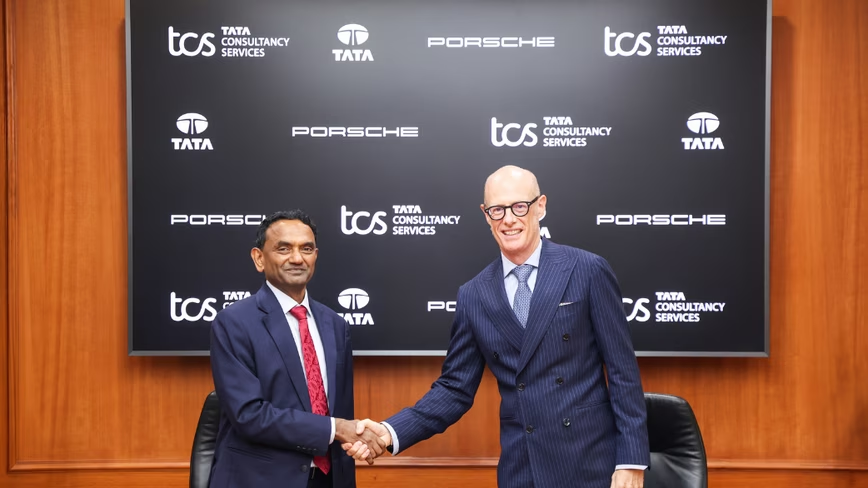
Tata Consultancy Services is buying MHP, the management and IT consultancy Porsche has owned for years, for €320m.
TCS is signing a five-year engagement with Porsche worth €1.25bn on top of the MHP acquisition.
MHP employs about 4,500 people, generated €742mn of revenue in 2025, and serves more than 300 clients across automotive and industrial sectors, with practices spanning SAP implementation, manufacturing digitalisation and software-defined mobility.
All 4,500 MHP employees move to TCS when the transaction closes, which both companies expect within three to four months.
Porsche will remain a customer rather than an owner, and TCS will set up a dedicated centre of excellence for the carmaker.
The disposal is part of a broader turnaround programme at Porsche, a company squeezed by weak Chinese demand, a costly retreat from its electrification timetable, and tariffs on cars it exports to the United States; the commercial logic is less about innovation than a balance sheet under pressure.
Follow any of these and your For You feed starts watching them — no settings page required.
Evidence-backed comparisons of source perspectives and observed adoption signals. Read the methodology
Which Builder, Operator, and Investor concerns the observed source mix emphasized—not a truth score.
Evidence, demonstrated adoption, hype gap, incentives, and confidence are assessed independently, each on its own current evidence. How these are measured.
Concrete deal figures, one publisher, no primary documents
The core transaction facts are specific and internally consistent (price, contract value, headcount, revenue, client count, close window) and both chief executives are quoted, which supports the transaction's existence. But the cluster contains a single trade-press article with no filing, press release, regulatory notice or second outlet, and the sector-level and strategy assertions are unsupported by named comparables or data.
Announced and unclosed; nothing delivered yet
Adoption is limited to announcement-stage commitments: the acquisition has not closed, the 4,500-person transfer is prospective, and the €1.25bn engagement has no disclosed scope, milestones or first workload for the centre of excellence. The only realised usage datapoint is TCS's existing 8.7% manufacturing revenue share, which predates the deal.
Company framing outruns disclosed substance
Both chief executives present the deal as strengthening innovative power and combining AI, engineering and automotive expertise, while the source itself records that no scope, systems or deliverables have been described and the €1.25bn is a commitment to spend. The publisher partly offsets this by naming the balance-sheet motive and the retention risk, so the overstatement is moderate rather than severe.
Both parties have strong promotional stakes
Porsche needs the disposal to read as strategic rather than distressed while running a turnaround under China, electrification and tariff pressure; TCS needs the deal to read as a European growth and AI-capability step while manufacturing is only 8.7% of revenue and the Porsche name serves as a reference logo. Executive statements from both sides are the primary voices in the cluster, with no independent or dissenting party quoted.
Deal facts firm, consequences unresolved
Confidence is moderate: the headline transaction structure and arithmetic are well specified and consistent, so the core facts are likely accurate. But single-publisher sourcing, no MHP profitability data, no retention terms and no disclosed contract scope leave the interpretive claims about capability, sector patterns and outcomes weakly grounded.
product
Rillet's $100M reads as proof mid-market ERP is rip-and-replace, mostly at the cheap end1 distinct publisher
product
Also raised $150M for a parts bin, not a bicycle3 distinct publishers
security
AI skills now in 28.5% of security job ads, and the SOC job family is being quietly rewritten2 distinct publishers
product
Your car outlives its computer by years, and nobody has to tell you when1 distinct publisher
Distinct publishers with included, body-backed reporting in this cluster.
1 article · August 24, 2026