Science1 publisher2 min readPublished
Fishing gear and food packaging litter both a Salinas beach and the Pacific floor 3,900 metres down
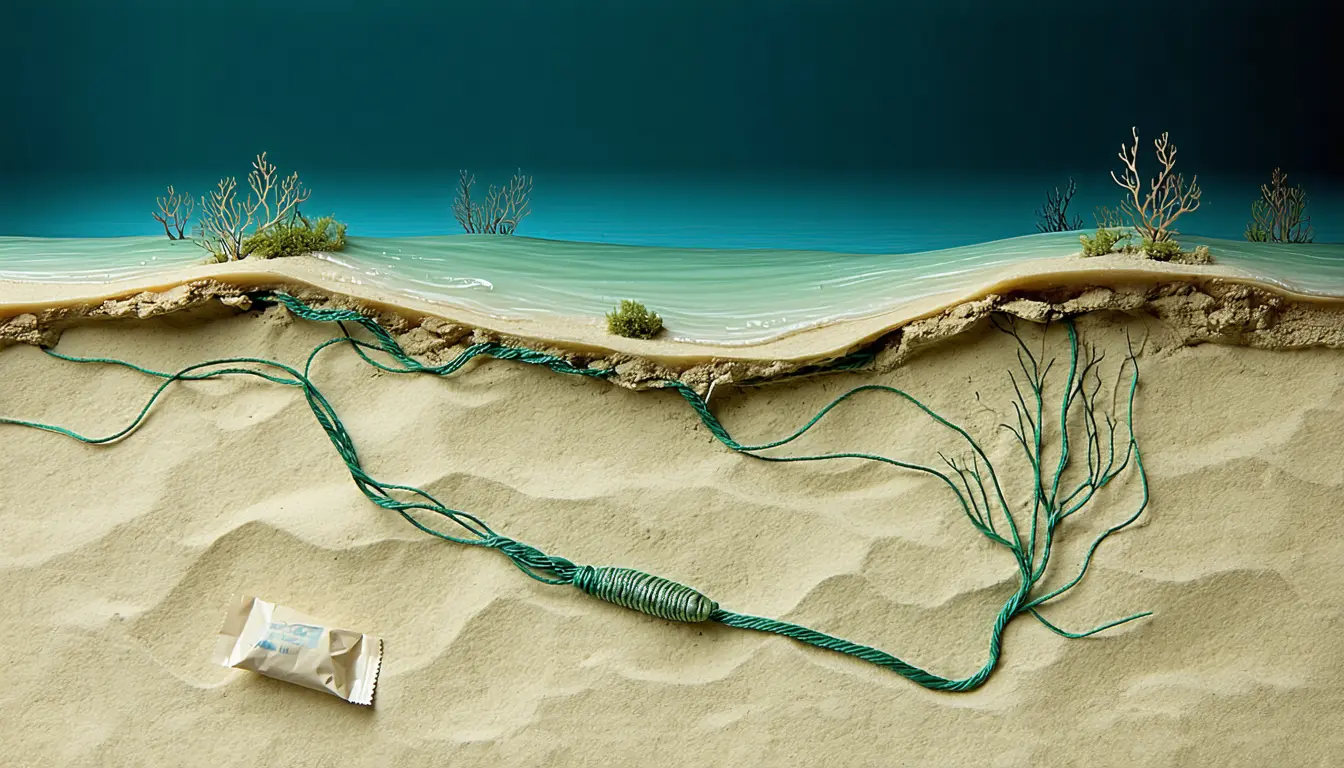
Sorbonne scientist François Michaud's team found plastic more than 3,900 m down off Ecuador, the first recorded in the eastern equatorial Pacific's abyss. Their six-year Salinas beach survey logged the same kinds of bags and fishing line, though the study traced no deep item back to the shore.
The Scientist · Science desk
Drafted by a language model from the sources cited here and checked against its claim ledger before publication. How we use AISend a correction
What happened
- From 2019 to 2025, François Michaud of Sorbonne University and colleagues collected more than 150 kg of debris from a 100-square-metre stretch of beach near Salinas.
- Fishing was the largest source of beach debris, with nets, lines and buoys making up more than half of the items collected.
- Debris rose sharply from 2021 and peaked in 2024, the year the team recovered its largest single item, a fishing net of around 50 kg.
- The deep survey was a crewed submersible dive in February 2024 that found plastic bags, food containers, packaging, nets and lines on the seafloor.
- At depth, some fishing gear was heavily degraded while plastic bags and food containers looked relatively intact.
Compiled by The ScientistSomething wrong?How this is made
Why it matters
- constraint Until individual items are traced, the Salinas counts cannot be scaled into an estimate of how much plastic reaches the abyss off Ecuador, so the deep problem is documented but still unsized.
- exposure Some deep debris lies near cold seeps and their distinctive communities, so those habitats sit beside plastic that appears to survive intact at depth for a long time.
- decision Fishing gear leads the beach counts and also turns up at depth, so gear loss and disposal is where a local effort to cut debris would start; the study did not test any such measure.
Set the 2024 net against the six-year haul and a single object accounts for up to a third of everything the team took off the site [1]. The weekly average of 566 g [3] spreads that weight over a record that varied considerably, including more than 10 visits with no visible plastic at all [4]. By weight, part of the 2024 peak is one net [7].
The breakdown by source counts items instead of grams. Add the tourism and recreation share of more than 45 percent [6] to fishing's majority [5] and, if the categories do not overlap, fewer than one item in 20 came from anything else [2]. That remainder would have to hold the syringes, medicine bottles and face masks that turned up mostly in 2021 [8]. Tourism items were most common after holiday periods, and the report links them to visitor numbers [6].
The seafloor evidence is of a different kind. The phys.org account of the study lists the February 2024 finds by type [9]; it does not include a count or a density for the dive. The authors attribute the intact bags and food containers to a deep floor that is cold and gets little sunlight, while on the beach sunlight, heat and waves speed up breakdown [11]. The beach samples fit that, with small pellets and fragments showing larger pieces coming apart [15].
Bags, food containers, bottles and nylon fishing line appear in both settings [12]. The researchers suggest currents along Ecuador's coast could carry debris offshore to sink [14]. By the report's account, the study did not directly track individual pieces or establish exactly where the deep items originated [14]. Packaging with foreign-language labels and trademarks also points to international shipping and regional trade, though the team could not establish any item's precise journey [13].
I think the shared inventory fits two explanations about equally well. Plastic could be leaving this coast and sinking. Or the same fishing and shipping activity could be dropping the same kinds of goods on the shore and over the abyss separately, and the foreign labels [13] suit that reading at least as well. Separating the two would take tracing items from their source to the seafloor.
What to watch
- Whether follow-up submersible dives off Ecuador count debris per area of seafloor, turning the February 2024 sightings into a density that can be compared over time.
- Tracing work that matches gear markings or labels to fleets and ports, which could show whether the deep items came from this coast or from passing traffic.
- Whether the Salinas series continues past 2025 and the post-2021 rise holds once one-off items like the 50 kg net are set aside.