Science1 publisher2 min readPublished
Surface tension holds back water in two minutes of simulated lunar gravity aboard New Shepard
Florida Tech's John Kiss and colleagues found surface tension slowed water at one-sixth of Earth's gravity, simulated on a suborbital flight. Kiss says lunar plant watering may need its own design, a view that so far rests on one brief test of liquids in containers.
The Scientist · Science desk
Drafted by a language model from the sources cited here and checked against its claim ledger before publication. How we use AISend a correction
What happened
- Blue Origin's New Shepard 29 flight in February 2025 rotated like a centrifuge as it descended, giving about two minutes of simulated lunar gravity in a flight of roughly 10 minutes.
- The team tested pure water, a 30% glycerol solution and a salt solution, watching how each liquid's meniscus responded to the reduced gravity.
- The glycerol solution showed signs of better flow, and the researchers see it as an opening for work on additives that help lunar soil take up water.
- The study, by Kiss, Karl Hasenstein and Christopher McKay working with 4SPACE LLC, appears in the journal Microgravity Science and Technology.
Compiled by The ScientistSomething wrong?How this is made
Why it matters
- constraint Without a reported effect size, the result cannot yet set a flow rate or a hardware specification for a lunar greenhouse.
- exposure Uneven watering can starve roots of oxygen and stunt growth, so a base counting on plants for food and oxygen carries any unsolved flow problem as a crop risk.
- capability New hardware that worked on its first flight gives the team a proven rig for the longer and on-moon repeats Kiss said they want to run.
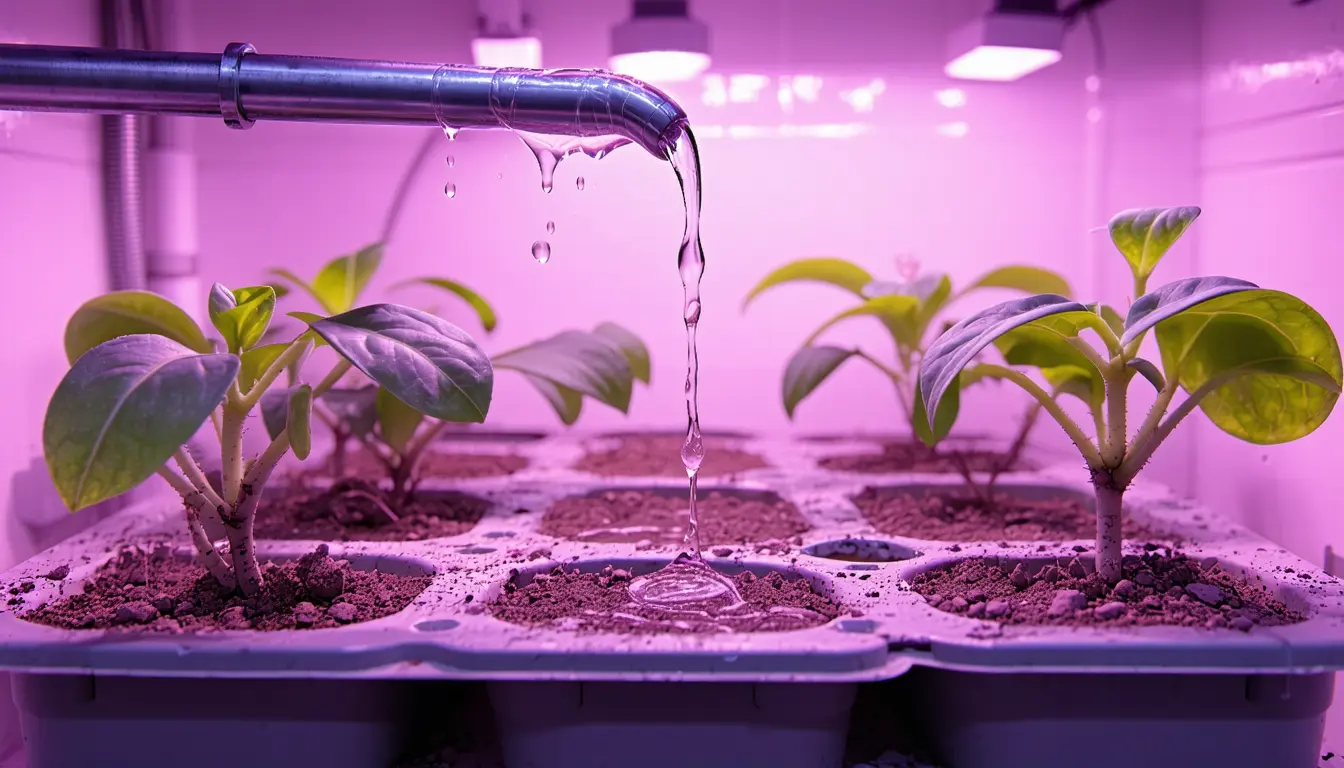
"The surface tension is more of a factor in how water flows. In essence, it doesn't flow as freely (in lunar gravity) because of the surface tension," said Kiss, who is Florida Tech's provost [5][14]. The observation behind that sentence is small and specific. A camera on board watched the meniscus, the curved surface a liquid forms inside its container, as the pull on it fell to about a sixth of Earth's [4][9][2].
The lunar gravity was simulated. The vehicle produced it by rotating as it came down [3], so only about a fifth of the flight ran at lunar level [1]. Because the gravity came from rotation, the team needed a record of what the liquids actually experienced. Kiss said the rig carried a camera and that "there's an accelerometer so we would know what the gravity levels were" [9]. It was his ninth experiment to fly, built from plans 4SPACE brought to him [16]. Hasenstein, of the University of Louisiana at Lafayette, was critical to conceiving and running it, and McKay, of NASA Ames Research Center, helped design it [15].
The denominator is one flight, three liquids and about two minutes of lunar gravity [3][4]. The report says the researchers found "clear differences" in how the liquids behaved under lunar gravity [17]. It does not give the size of those differences, or say what reference condition they were measured against.
The thing this doesn't tell you is how water moves through soil. The liquids sat in containers [4]. Lunar soil is very fine dust and rock fragments, and it absorbs water poorly [7]. Kiss said the combination of weak flow and poor absorption makes it hard to propagate plants [10]. That second half of the problem comes from what is known about the soil, not from the flight. Even the glycerol solution's "signs of better water flow" were seen in a liquid held in a container [11][4].
Kiss's own conclusion is measured. "If you're going to water plants on the moon, you might have to design the whole system a little bit differently than you would on Earth," he said [6]. I think that modest version is the one two minutes of meniscus data supports.
What to watch
- A follow-up that puts lunar soil simulant in the rig, linking meniscus behavior to how water actually spreads through a root zone.
- Additive trials that check whether the glycerol solution's better flow translates into better water uptake by lunar soil.