Science1 publisher2 min readPublished
XRISM finds 100 times the expected turbulent energy in one quasar's cluster core
A Tohoku University-led team used the XRISM satellite to read iron emission lines around the quasar H1821+643, and measured turbulent hot gas spanning about 300,000 light-years with roughly 100 times the energy earlier estimates allowed.
The Scientist · Science desk
What happened
- XRISM, the X-ray astronomy satellite, observed the quasar H1821+643 in the constellation Draco, about 3.4 billion light-years from Earth, where a rapidly growing supermassive black hole sits inside a galaxy cluster.
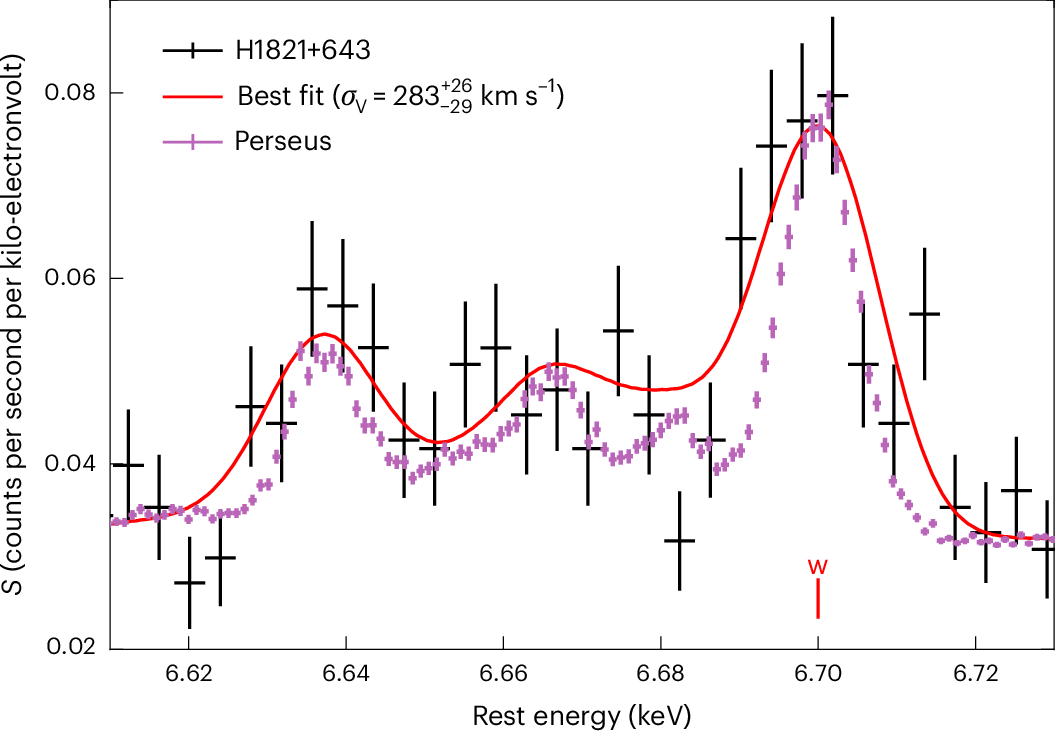
- Reading gas motion from the emission lines of iron ions, the team found turbulence spreading roughly 300,000 light-years, well past the boundary of the black hole's host galaxy.
- The energy contained in that turbulence came out about 100 times greater than previous estimates, which Tohoku University compares to the output of several billion supernova explosions.
- Satoshi Yamada of Tohoku University led the work with colleagues from Kanazawa University and Tokyo Metropolitan University, publishing it in Nature Astronomy as a study of quasar-mode feedback in a cluster core.
Compiled by The ScientistSomething wrong?How this is made
Why it matters
- constraint Feedback prescriptions in galaxy-formation models are normalised against populations of objects, so one cluster core measured this way can lift the ceiling on quasar-mode energy without giving modellers a new average to adopt.
- capability Turbulent energy read off iron emission lines is a measured quantity in an individual system. The next cluster-hosted quasars can be argued about on the same number.
- contradiction The release's figure for wind power and the figure the team measured are not the same physical quantity, and turbulent energy in the hot gas only becomes wind power if the wind is what stirred it.
The measurement is spectroscopic. Hot gas in the cluster core radiates X-rays, and the team read the motion of that gas off emission lines produced by iron ions [6]. Kinetic energy goes as the square of speed, so a hundredfold gap in energy is about a tenfold gap in velocity [1]. Tohoku University's release says XRISM's high-precision measurements showed the extremely hot gas is far from motionless, with turbulence spreading it violently across a broad region [17].
The light XRISM collected left that cluster about 3.4 billion years ago, so the energy budget described is the one that core had then [2].
"Black holes are largely known for sucking matter in, but they also eject gas in the form of powerful winds," Satoshi Yamada, an assistant professor at Tohoku University's Frontier Institute for Interdisciplinary Sciences, said in the release [8]. He also said the study showed "for the first time" that "black holes influence the broader cosmic environment through a shock wave of astonishing power" [10].
One quasar is the whole sample. H1821+643 holds a rapidly growing black hole sitting inside a galaxy cluster [6], and the published paper is titled "Vigorous turbulence driven by quasar-mode feedback in a cluster core" [11]. Feedback recipes in galaxy-evolution models are normalised against populations of objects, and a single core carrying a hundred times the expected turbulent energy raises the ceiling on what quasar-mode feedback can do to its surroundings without supplying a new average. The release does not state the earlier estimate this figure revises, or how that estimate was made [16].
The quantity the team reports is the energy contained in the turbulence, about 100 times previous estimates [7]. The release's own headline instead describes the winds as 100 times more powerful than scientists thought [1], and that translation holds only if the wind is what stirred the gas. Tohoku's framing of the consequence stays conditional: black holes can send energy and gas far into surrounding space, "potentially helping shape the environments around galaxies and galaxy clusters" [13].
Where that energy ends up is a second open question. Turbulent motion in a cluster core can heat the gas, or drive it outward, or decay; the released summary reports the energy present and leaves its fate open [17]. Yamada's team expects future observations to give a clearer picture of how black holes affect their surroundings and how matter and elements move between regions [14].
What to watch
- Whether the same iron-line method applied to other cluster-hosted quasars finds comparable turbulent energy, or shows H1821+643 to be unusual.
- A duty cycle for the wind: how often a quasar in a cluster core does this would convert a one-time energy figure into a feedback rate.
- Whether cluster simulations can reproduce this much turbulent energy in a quasar-mode system without breaking their star-formation histories.