Science1 publisher3 min readPublished
MatBrain splits crystal discovery between a 30B reasoner and a 14B tool-caller
Its authors report 30,000 candidate structures and 38 leads in 48 hours from models small enough to run locally, though the comparison with frontier systems arrives in the abstract without a named baseline.
The Scientist · Science desk
What happened
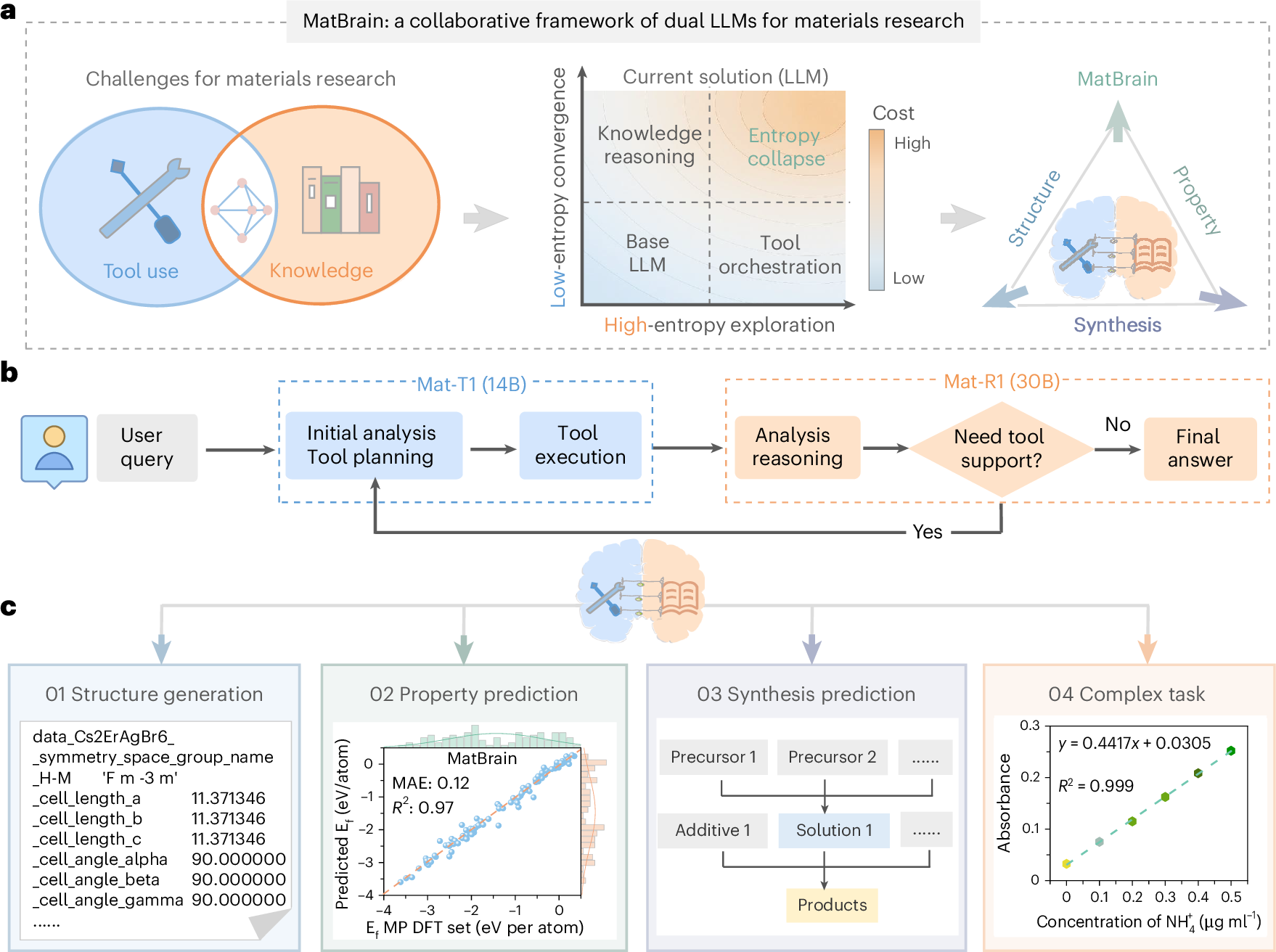
- MatBrain pairs Mat-R1, a 30-billion-parameter analytical model doing the domain reasoning, with Mat-T1, a 14-billion-parameter executive model that orchestrates the tool calls.
- Applied to catalyst design, the system generated 30,000 candidate crystal structures and identified 38 promising materials within 48 hours.
- The authors report that this pairing is competitive with frontier large language models while remaining lightweight enough to deploy locally.
Compiled by The ScientistSomething wrong?How this is made
Why it matters
- capability A screening loop that runs on hardware you own is bounded by GPU availability rather than by per-token spend, which changes who can afford to leave a design agent running for two days.
- constraint Because the competitiveness claim carries no named baseline in the abstract, it cannot yet be used to size a cluster purchase or to predict how a local pair would behave on a lab's own task mix.
- precedent Shipping leakage-controlled splits and audit results alongside the weights recipe raises the floor for materials-LLM papers, where evaluation items and training corpora are drawn from the same public databases.
- decision Someone still has to fund the confirmation queue for the 38 leads, and the abstract leaves open whether that means density-functional calculations, a furnace, or both.
The entropy analysis is the part worth arguing about. MatBrain's authors report that tool planning and analytical reasoning show distinct output-distribution profiles, which they describe as a diagnostic signal consistent with the functional specialization of the two modules [5]. That phrasing is honest, and it is also the ceiling of the evidence: distinct entropy profiles show that the two jobs look different when the model writes, while the source of the performance gain remains an open question. The test that would tell those readings apart is an ablation, one model carrying both roles with the same tool access, and the abstract reports none [19].
Two of the reported numbers are more useful once converted. Generating 30,000 candidate structures in 48 hours is roughly 625 structures an hour [15]. Keeping 38 of 30,000 is a survival rate of about 0.13% [14]. That second figure is a filter-survival rate: the abstract calls the 38 promising without stating the criterion, and does not say whether any were synthesized [17]. The data availability statement does list experimental and computational source data behind figures 2 to 4 and 6 [9], so measurements exist inside the paper; which of the 38 they attach to is not something the abstract settles, and the article is priced at USD 39.95 [11].
On the parameter argument the arithmetic is simple. Mat-R1 at 30B and Mat-T1 at 14B come to 44B parameters between them [13], against the paper's opening premise that current large models need hundreds of billions and still struggle with domain reasoning and tool coordination [3]. The load-bearing phrase in the claim is locally deployable [4], and the abstract attaches no memory footprint, GPU count or throughput ceiling to it [16]. A group choosing between buying hardware and paying for API calls needs that number, and the competitiveness sentence names no comparison model, benchmark or score to size it against [12]. The claimed range also covers structure generation, property prediction and synthesis planning [8], which are three different failure modes under one label.
What holds up best is the release. The team published the Mat-252K-SFT instruction-tuning set and the Mat-20K-RL reinforcement-learning set on HuggingFace, along with leakage-controlled benchmark splits, audit results and the generated structures [9], plus an archived copy of the code on Zenodo [10]. Leakage control matters here: the paper's own reference list runs through the Materials Project and the Open Quantum Materials Database [18], the same sources that supply both training corpora and evaluation items, and a model that has already seen a formation energy is not predicting it. Publishing the splits and the audit is how that suspicion gets checked by someone with no stake in the answer.
So the defensible reading is narrower than parameter-count parity. A 44B pair, trained on data anyone can download, ran a 48-hour catalyst screen and returned 38 candidates worth someone's furnace time, with human-active time reported as significantly reduced but neither baselined nor quantified in the abstract [7]. That is a real result at a size a university cluster can hold.
What to watch
- The full paper's comparison tables: which frontier models MatBrain was tested against, on which benchmarks, and at what scores.
- Whether any of the 38 catalyst candidates are synthesized and measured by a group outside the authors' collaboration.
- An independent reproduction from the released HuggingFace datasets and Zenodo code, including a hardware footprint for local deployment.