Science1 publisher2 min readPublished
Argon cold plasma turned a rice bran protein film into a 24-hour antibacterial surface
Arkansas researchers report that plasma etching held E. coli, Staphylococcus aureus and Pseudomonas aeruginosa down for 24 hours on films made from the protein fraction, while whole-bran films barely etched at all.
The Scientist · Science desk
What happened
- A team at the Arkansas Agricultural Experiment Station led by food scientist Mahfuzur Rahman treated clear rice bran protein films with argon-generated cold plasma and exposed them to three foodborne pathogens.
- Populations of E. coli, Staphylococcus aureus and Pseudomonas aeruginosa fell within eight hours on the treated films and had not regrown at 24 hours, while untreated films showed marked growth.
- The manuscript describing the work has been submitted to a scientific journal for peer review.
Compiled by The ScientistSomething wrong?How this is made
Why it matters
- capability The antimicrobial property comes from treating the film itself, so a packaging maker has no nanoparticle or antibiotic loading to defend to a food safety reviewer. Rahman says migration of those additives into food is the concern with existing antimicrobial films.
- constraint Only the protein fraction responded to the plasma, so anyone costing this route has to price a protein separation step on top of the treatment itself.
- decision A processor weighing whether to pilot the material would be deciding on one unrefereed study from a single team, and the published version may carry different numbers.
- precedent Rahman says this antibacterial effect had not been reported in rice bran-based biopolymer films before. Other protein residues from food processing are the obvious next candidates for the same one-step treatment.
The two films did not respond the same way. Argon-generated cold plasma raised surface roughness 3.3-fold in films made from rice bran protein and 1.06-fold in films made from whole rice bran [10]. That is a 230 percent increase against a 6 percent one, about 3.1 times the change [11]. The protein films also showed more etches and higher hydrogen peroxide concentrations [9].
Rice bran is a plentiful byproduct that often goes underused [19]. The antibacterial result reported here belongs to the protein fraction, and that protein has to be separated out before the plasma does much of anything: whole-bran films came out of the chamber close to where they went in [10].
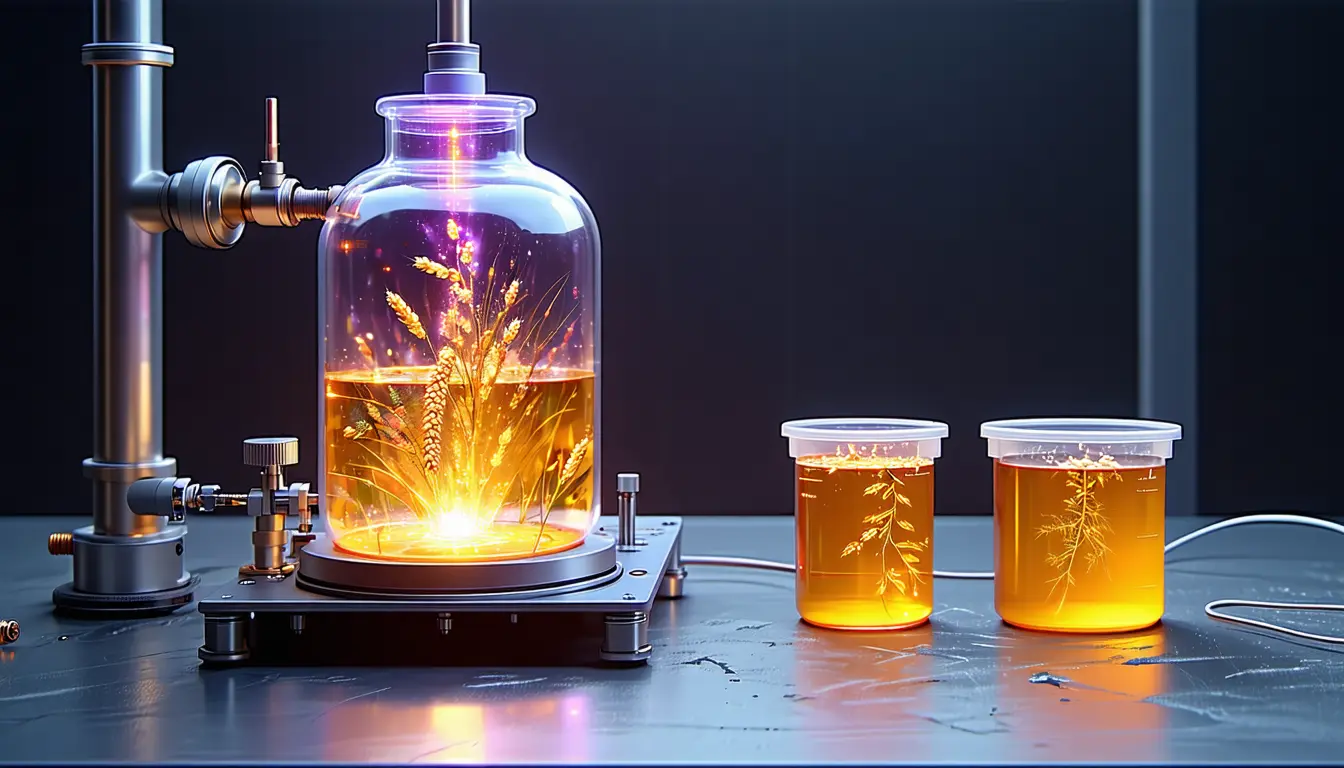
The etch leaves microscopic spikes on the treated surface, and the plasma triggers a chemical reaction that produces and releases hydrogen peroxide, a strong oxidizing agent [6]. The team attributes the antibacterial effect to the "combined influence of retained reactive species, enhanced wettability, increased surface roughness and changes in surface chemistry" [14].
"This idea actually came from the microchip industry," Rahman said. "They use the plasma for what's called etching to assemble semiconductor layers, and we transferred that idea to the rice bran films." [8] Cold plasma's effects on synthetic polymer films were already known, Rahman said, but its antibacterial effect in rice bran-based biopolymer films had not been reported before [12].
Counts on the treated films fell within eight hours and the bacteria had not regrown at 24 hours, while untreated films grew markedly [7]. Twenty-four hours is the last timepoint in the account, and a wrapped tray of chicken sits in a cold case longer than a day. The team also measured water vapor transmission rate, tensile strength and thermal stability. The values are not reported [13].
The frame around this work is antimicrobial resistance. The Centers for Disease Control and Prevention counts more than 2.8 million antimicrobial-resistant infections in the United States each year [2], and Pseudomonas aeruginosa was among the three pathogens tested because it is known for antibiotic resistance [5]. What the team measured was laboratory pathogen counts on a film surface over one day [7].
Rahman said conventional antimicrobial films often add nanoparticles or antibiotics, and that those additives can migrate out of the packaging into food and potentially into the body [16]. The plasma route adds no such ingredient; the peroxide comes from the treated protein itself. It is still released from the film [6], so a food-contact reviewer would have something to measure. The team plans to submit a proposal for further studies on a potential medical application [15].
What to watch
- Whether the peer-reviewed version reports bacterial counts at any timepoint beyond 24 hours after application.
- Whether anyone tests the film in contact with food, since the reported work is bacteria on bare film.
- What separating rice bran protein costs at mill scale, given that only the protein films etched.