Science1 publisher2 min readPublished
Spin rephasing lets an ICFO crystal memory store single photons for 180 microseconds
ICFO physicists used spin rephasing to store single photons in a praseodymium-doped crystal for up to 180 microseconds. The photons stayed quantum-correlated through the wait, which the team equates with more than 30 km of optical fibre.
The Scientist · Science desk
What happened
- ICFO researchers led by Hugues de Riedmatten stored single photons in a praseodymium-doped crystal memory for up to 180 microseconds, reporting the work in Physical Review Letters.
- Each stored photon was one half of an entangled pair whose partner had a telecom wavelength suited to long-distance optical fibre.
- Radio-frequency pulses flipped the phase each ion had drifted through, so an equal second wait cancelled the drift and restored the collective excitation before readout.
- The team found quantum correlations between the photon read out of the rephased memory and its telecom partner.
- The researchers equate 180 microseconds of storage with a fibre link of more than 30 km.
Compiled by The ScientistSomething wrong?How this is made
Why it matters
- constraint A repeater has to hold each quantum state until measurements on separate segments line up, so storage time sets how much fibre a memory like this one can wait out.
- capability Rephasing is now an option for memories that must hold entangled photons, since correlations have been shown to survive the pulses, where earlier tests used classical light.
- decision Ranking memory platforms on this result is premature, because the published account gives a storage time without the retrieval efficiency that would say what that time costs in lost photons.
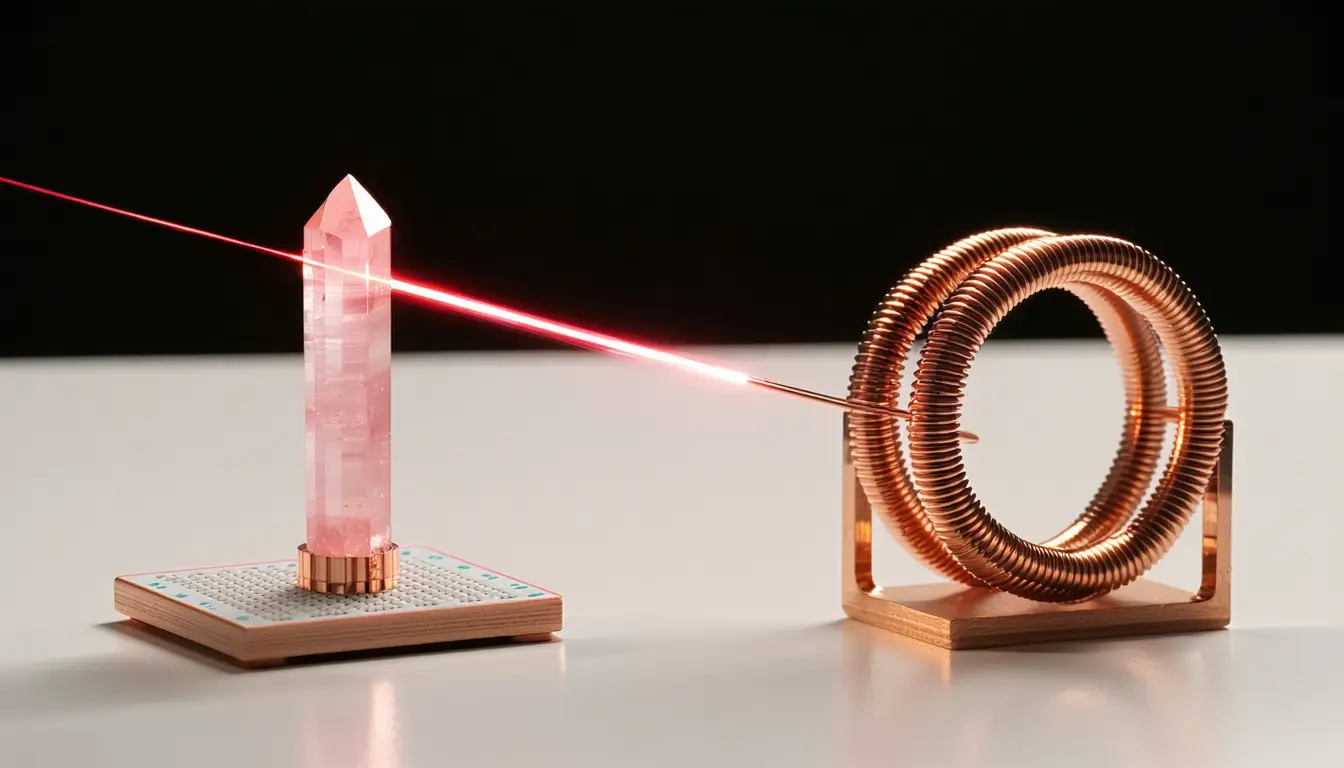
Dephasing limits how long this memory can hold a photon. In the atomic frequency comb protocol, an optical control pulse moves the absorbed photon's shared excitation into a spin state that emits no light. A second pulse later turns it back into a photon carrying the same information [3]. The crystal's environment differs slightly from one ion to the next, so during that pause the ions' phases drift apart [5]. If the pause runs too long, the emitted photon's quantum properties degrade and information is lost [5].
Rephasing had already been shown to work on classical light. "Spin rephasing had been demonstrated in the past with classical input states, but our results show that it can be extended to quantum light," said Hugues de Riedmatten, the study's senior researcher [13]. The entangled pair makes that claim testable. Its telecom photon never enters the crystal [4]. That gives the experiment a fixed reference: the team could check whether the stored photon's quantum correlations with it survived the radio-frequency pulses [9].
The phys.org account does not report what fraction of photons came back out at 180 microseconds, how strong the correlations were, or the previous best storage time. That 180 microseconds is the longest reported for this type of memory is the ICFO team's claim [8].
By the team's conversion, each microsecond of storage corresponds to at least about 170 metres of fibre [1]. The ICFO account calls solid-state memories promising candidates for quantum networks, citing their proven high efficiency, their capacity to store entanglement and their multiplexing features [12].
The thing this doesn't tell you is how the crystal behaves as one node among several. The experiment as described involves one memory, cooled to 3 kelvin in a cryostat, and one telecom photon [2][4]. It was carried out within the Quantum Internet Alliance [15].
The team expects to go further. "In the future, longer storage times will be available by applying small magnetic fields to the quantum memory," said Alberto Rodriguez Moldes, the first author [14].
What to watch
- Retrieval efficiency and correlation strength at 180 microseconds, as reported in the Physical Review Letters paper itself.
- Whether small magnetic fields push storage beyond 180 microseconds, as Rodriguez Moldes expects.
- A Quantum Internet Alliance test that places such a memory inside a fibre segment with a second node.