Science1 publisher3 min readPublished Updated
A portability rule put 1,775 megawatts of gas turbines next to a Southaven neighborhood
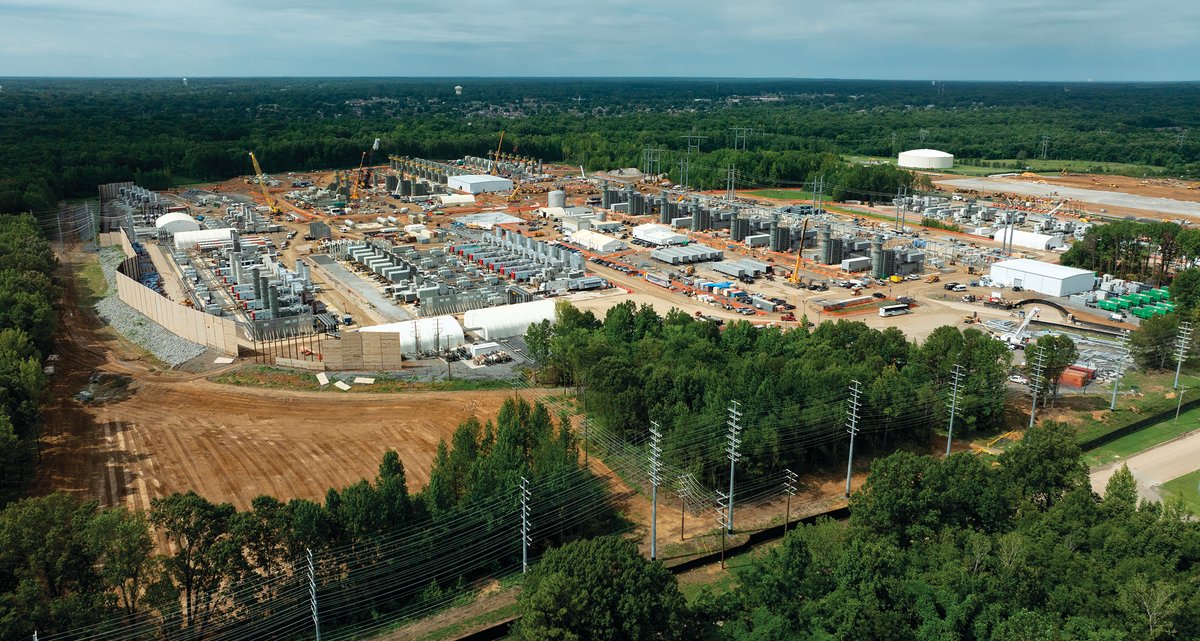
The turbines feeding SpaceXAI's Colossus 2 went in under a Mississippi rule that asks whether equipment is portable rather than what it emits, which is why the fight is over a legal category and not over anyone's measurements.
The Scientist · Science desk
What happened
- Portable gas turbines in Southaven, Mississippi, burn to power the Colossus 2 data center across the state line in Memphis's Whitehaven neighborhood, so the exhaust and the computing sit in different states.
- The units went in under Mississippi's determination that portable equipment can operate for up to a year without air permits.
- The NAACP sued in April, calling the operation an unpermitted power plant, and state records later showed the fleet had grown to dozens of machines.
- By July the site's capacity reached about 1,775 megawatts, rivaling Mississippi's largest power plants and enough to electrify more than 1.4 million homes.
- The Department of Justice moved to intervene on xAI's side and asked the court to dismiss the suit, arguing that cutting Colossus 2's power would threaten AI innovation and national security.
Compiled by The ScientistSomething wrong?How this is made
Why it matters
- constraint With no permit there is no required instrument record, so the litigation can only argue about what the fleet legally is, and no party can put a measured concentration or a decibel level in front of the judge.
- decision Regulators in other states now have to decide whether portability survives as a permit category once dozens of exempt units aggregate to the scale of a conventional plant.
- precedent A sworn frontier-model capability declaration makes national security a usable answer to a local air-quality complaint, which is a defense any large compute site with a federal customer can now attempt.
- exposure The households absorbing the noise have the least capacity to leave it: on a $500 monthly mortgage and a landscaper's $21 an hour, Logsdon does not think moving is possible, so siting faces no discipline from exit.
A $7 million sound wall is the visible mitigation at Southaven, and Scientific American's reporter, in a driveway in the Colonial Hills neighborhood, describes it doing little: a constant drone like a plane taking off and never leaving, audible through the walls of nearby homes [3]. Set that spend against what the site exists to earn. Cleanview, an energy-data firm tracking the industry, estimates AI data centers can produce $10 million to $12 million a year per megawatt [12]. Applied to 1,775 megawatts, that is about $17.8 billion to $21.3 billion a year [19], or roughly $2.0 million to $2.4 million an hour, which makes the sound wall the equivalent of about three hours of output [20]. Two caveats, and they matter. Cleanview's figure is an industry estimate per megawatt of data center capacity, and turbine nameplate capacity is not the same thing as revenue-earning computing capacity, so treat the total as a ceiling rather than a line in anyone's accounts. The ratio would have to be wrong by three orders of magnitude before the conclusion about relative size moved. Capital is not the constraint either: the same reporting has SpaceX, which acquired xAI and folded it into SpaceXAI, raising $75 billion in an initial public offering, briefly pushing Elon Musk's estimated net worth above $1 trillion [13].
The test Mississippi applied asks what the machine can do rather than what leaves it. Portability, not emissions rate, is the qualifying property, and it buys up to a year of operation [7]. Adding units does not change the category, and the fleet grew to dozens of units [8].
What the reporting does not contain is a measurement. No decibel readings, no stack emissions rates, no ambient air monitoring, no health data for Colonial Hills or Whitehaven [22]. The site is screened by black privacy fabric on the fence, with metal stacks and shimmering exhaust visible above it [18], which is roughly the epistemic position everyone outside is in. The noise is documented the way a reporter can document noise, by hearing it indoors [3]. That is evidence of a kind, though not the kind a court can weigh against a numerical standard, and the case as filed asks whether the operation is an unpermitted power plant [8] rather than what any instrument recorded.
Colossus 2, where SpaceXAI trains Grok, is one of the densest concentrations of computing power in the country [4]. The grid could not deliver enough electricity on the company's timeline, so it generated onsite instead of waiting for a conventional plant or a utility upgrade [6]. Nothing in the reporting describes ratepayers funding transmission here [23]; what moved was the combustion, and it moved across a state line. The gas burns in Mississippi and the electricity crosses to Tennessee [5], so the jurisdiction that granted the exemption is not the jurisdiction hosting the machines. Data centers now use around 4 to 5 percent of US electricity, and the Electric Power Research Institute projects 9 to 17 percent by 2030 [10], two to nearly four times the current share [21].
The federal intervention shifted the terms of the dispute onto ground where air quality is not the question. The Pentagon's chief digital and artificial-intelligence officer told the court in a sworn declaration that Grok is one of only four proprietary frontier models currently capable of supporting national-security applications [15]; the department had already awarded xAI a contract worth up to $200 million, and Grok for Government launched the same day [16]. Costa Samaras of Carnegie Mellon gives the commercial logic: firms go as fast as possible because every day offline is potential revenue lost [11]. The next site built this way will be argued over the same two things, a permitting category and a capability declaration, unless a permit obliges someone to produce a number.
What to watch
- Whether the court rules on the NAACP's unpermitted-power-plant claim or dismisses it on the national-security grounds the Justice Department raised.
- Whether Mississippi requires permits, and with them monitoring, as the one-year portable window lapses on individual units.
- Any published stack emissions or ambient monitoring data for Southaven, which would move the noise and air dispute from observation to measurement.