Science1 publisher3 min readPublished
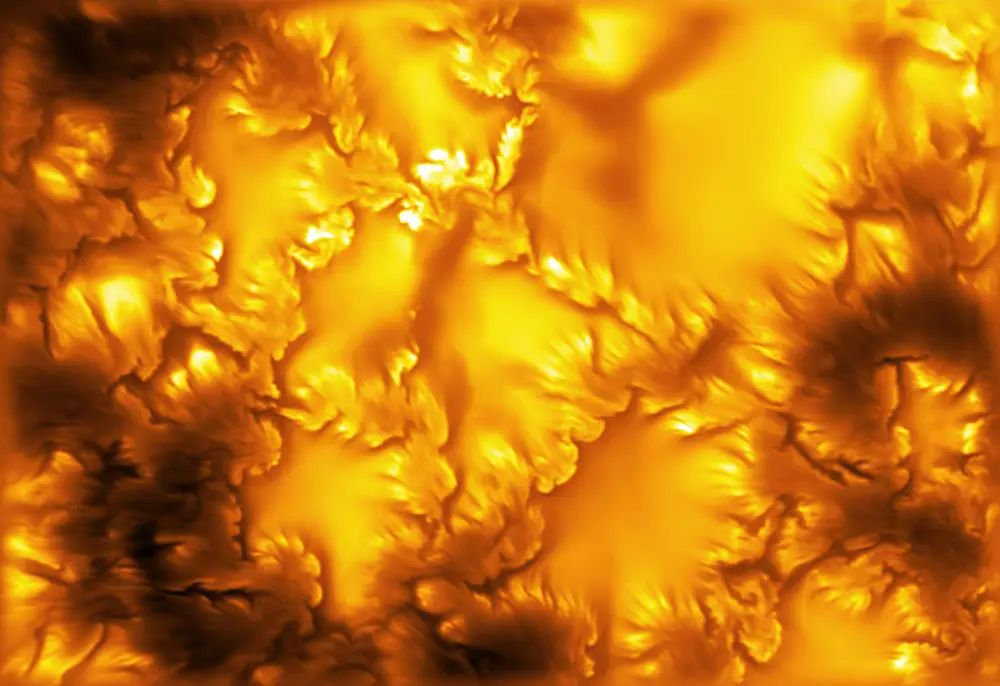
DKIST resolves Kelvin-Helmholtz swirls across the Sun's photosphere
The instability that ruffles estuaries and Jupiter's cloud decks has now been imaged in the Sun's own plasma. The matched simulations backing that reading leave the energy question it was invoked to answer still open.
The Scientist · Science desk
What happened
- A team using the Daniel K. Inouye Solar Telescope reported the signature of Kelvin-Helmholtz instability in the solar photosphere, publishing the identification in Nature in August.
- The observations suggest the swirls are not rare occurrences but might be ubiquitous across the Sun's surface, appearing wherever the imaging was sharp enough to show them.
- Earlier solar telescopes could not pick out vortices this small in the plasma; DKIST's 4-metre mirror, observing since 2019, brought those scales within reach at several wavelengths.
- Woger put the unresolved question as how much energy the vortices create and transport into the Sun's outer atmosphere, and whether that is enough to heat it to millions of degrees kelvin.
Compiled by The ScientistSomething wrong?How this is made
Why it matters
- capability Coronal-heating theorists now have a stirring process they can point a telescope at, where previously it appeared as indications inside simulations, so competing models can be scored against observed shapes and prevalence.
- cost The check on such observations is paid in supercomputer time, and by Woger's account those matched-detail runs would probably not have been attempted without images to justify the allocation.
- constraint Prevalence puts no number on the watts reaching the corona, so imaging alone constrains the heating models without closing the budget; that will take velocity and magnetic-field diagnostics.
- precedent Because the result needs no data inversions, other groups can attempt to break it with ordinary imaging rather than a bespoke instrument campaign, which shortens the path to a second opinion.
The mechanism is old and undramatic. Where two streams of fluid slide past each other at different speeds, the boundary between them rolls up into a train of vortices [1], which is why the same shape turns up in estuaries and in the cloud decks of Jupiter [2]. The photosphere was expected to do this as well, being a fluidlike plasma, with the caveat that a magnetic field threads the shear layer and complicates the accounting [3]. Kuridze's framing is that the instability is an efficient way to twist and bend magnetic structures and generate magnetic energy [4].
The team recognised the signature in the imaging movies [7], then asked modelling partners to run magnetohydrodynamic simulations at comparable resolution, and those runs supported the reading that the imaged vortices were produced by the instability [8]. The claim therefore rests on agreement in form and motion between images and physics-based models [19], with a measured growth rate or a measured energy flux still to come. For a first detection at these scales, that is a defensible design.
Mathioudakis, at Queen's University Belfast and not part of the work, points at the same result from the instrument side: the setup was relatively simple imaging, with no complex instrumentation, calibration problems or data inversions, which is why he expects it to stand [17]. I would weight it the same way. Fewer processing steps between the photons and the claim is worth more than a cleverer pipeline.
For coronal heating, what this supplies is an object to measure. Models of the solar atmosphere had shown indications of the instability; the paper puts the physical process on the observational record at some of the smallest astrophysical scales, in Mathioudakis's assessment [16]. Foullon, at the University of Exeter and also outside the work, describes the images as showing the scales at which the magnetic foot-points of the corona are continually stirred and restructured [14]. Stirring is confirmed; putting a number on the energy budget is a separate task. Woger's question is unchanged: whether the energy these vortices create and carry into the outer atmosphere is enough to hold it at millions of kelvin [15].
The observations are reported as showing that the instability might be ubiquitous across the surface [11], and Foullon reads them as suggesting something basic to the small-scale dynamics of the magnetised photosphere rather than an occasional event [13]. What is not reported is a rate: no fraction of the observed field showing swirls, no count per unit area or per hour. That denominator is what converts a detection into an energy term, and without it the instability stands as a process now seen at these scales; sizing its contribution to the ultrahot corona it has long been invoked to explain remains future work [18].
What to watch
- A follow-up that reports energy flux per vortex from spectropolarimetric data, which is the number the coronal heating argument actually needs.
- An independent group repeating the detection with straightforward DKIST imaging, which Mathioudakis's account suggests is feasible without bespoke instrumentation.
- Whether higher-resolution magnetohydrodynamic runs reproduce the observed prevalence of the swirls, or over- and under-produce them.