Science1 publisher2 min readPublished
Nine-residue peptides tile into a honeycomb lattice with 5-nanometre water channels
A nine-amino-acid peptide assembles into hexagonal pores and tiles them into a honeycomb lattice, with water-accessible channels about 5 nanometres wide. Cryo-EM found the same pore geometry in every variant.
The Scientist · Science desk
What happened
- Nine-residue peptides were designed to carry discrete lateral interaction motifs that direct how the molecules organise into larger structures as well as how they elongate.
- Those motifs generate hexagonal pores that tile hierarchically into multichannel nanofibrils with a defined topology.
- The resulting honeycomb lattices carry continuous solvent-accessible nanochannels roughly 5 nanometres across.
- Molecular dynamics simulations and vibrational spectroscopy indicate the channels stay water accessible, with hydration that varies between sequences.
Compiled by The ScientistSomething wrong?How this is made
Why it matters
- capability A linear nonapeptide is straightforward to synthesise and to vary, so a short linear chain now stands in for the covalent pre-organisation that cyclic scaffolds supplied.
- constraint What sequence changes moved here was hydration, so a designer who needs a specific channel diameter still has no parameter to set.
- decision Any group costing a separation membrane on this chemistry has to pay for its own permeation and selectivity data before the number means anything to a process engineer.
- precedent The polymorphic side interface is what has kept short peptides from being tiled deliberately, and positional rules of this kind would change that if they hold for other short beta-sheet sequences.
Lateral growth is the part that has resisted design. Short peptides elongate readily into one-dimensional fibrils, but their side interfaces are polymorphic, which has prevented controlled tiling into higher-dimensional lattices [8]. Controlled two- or three-dimensional lattices built from minimal linear beta-sheet peptides are rare [15]. The routes that did work leaned on more scaffolding: coiled-coil proteins and collagen mimetics with large pre-organised interfaces [9], and peptide nanochannels from cyclic scaffolds held in shape by covalent backbone pre-organisation [10].
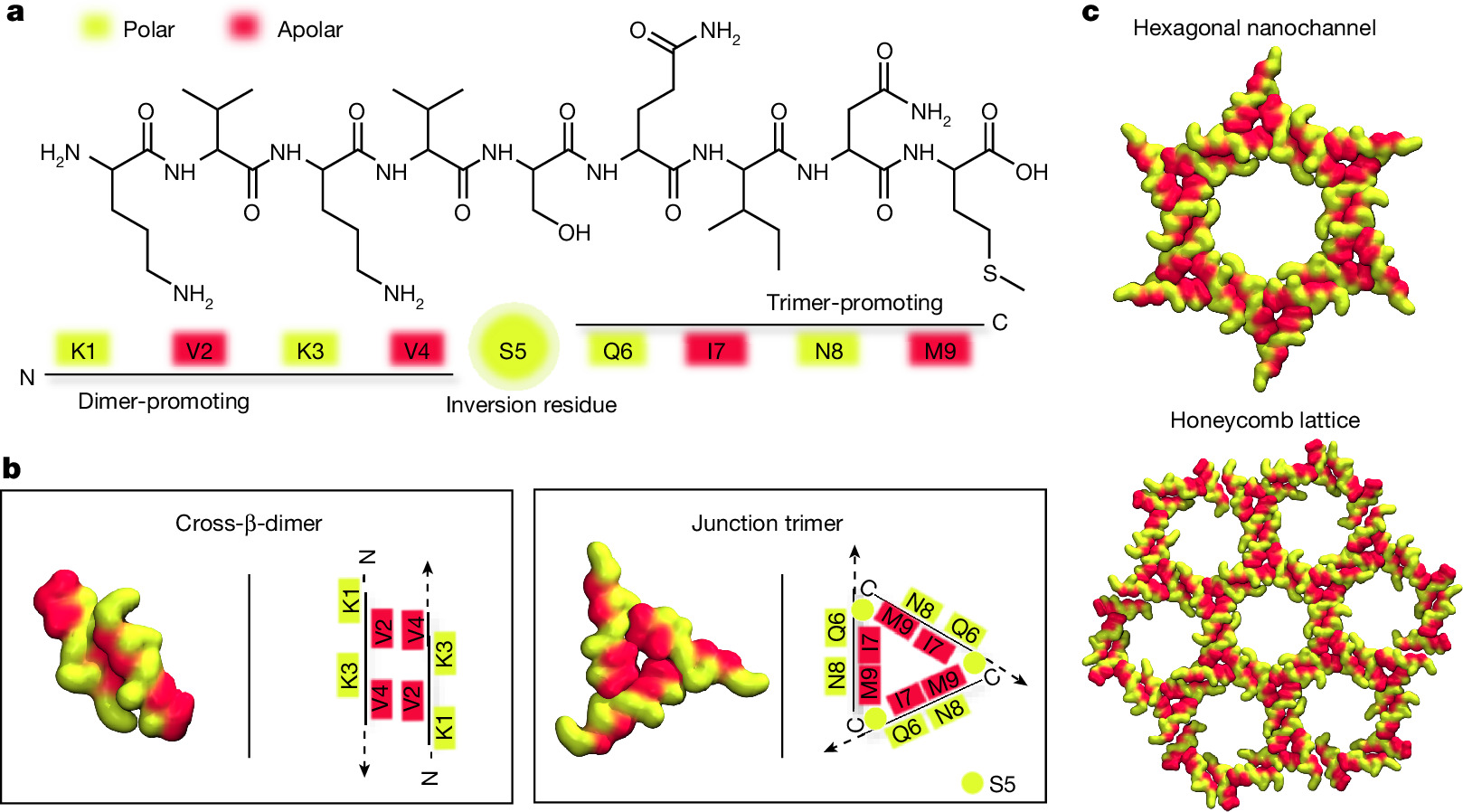
DILT1 gets both interfaces out of one short chain. The N-terminal K1-V2-K3-V4 stretch pairs face to face into a cross-beta dimer with hydrophobic packing, which sets the hydrophobic contact surface for lateral organisation and, through backbone hydrogen bonding, the axial stacking interface [11]. A trimeric junction at the other end encodes lateral connectivity and symmetry, and a central inversion residue orients the two motifs relative to each other [17]. The prototype sequence is K1-V2-K3-V4-S5-Q6-I7-N8-M9, and the family name stands for dimer-inversion-lock trimer [12]. Four residues to the dimer, one to the inversion, four to the junction [13]. The cross-beta segment was inspired by the MAX1 oligopeptide family [14].
The rules come from the perturbation series. Changing positions one at a time let the authors tie residue position to lattice symmetry, to lattice propagation and to channel topology [6]. Cryo-EM resolved the assemblies and found symmetry and pore geometry conserved across the variants [5]. Those two results point in slightly different directions: the sequence governs whether and how the honeycomb propagates, and the channel it leaves behind comes out around 5 nm across each time [4].
The water in those channels was established by molecular dynamics simulation and by vibrational spectroscopy [7]. Both speak to whether water occupies the pore; a permeation or rejection measurement is a different experiment.
In my view the work establishes the first half of a design cycle: a nine-residue family whose supramolecular symmetry and connectivity follow from stated residue positions, checked in the hydrated state by cryo-EM [5][6]. Writing a chosen channel width into that sequence is a second claim, and the variants reported here all came out with the same pore [5].
What to watch
- A permeation or rejection measurement on an assembled lattice, which would test the channels as conduits.
- A DILT variant published with a pore diameter different from about 5 nm, resolved by cryo-EM.
- Whether the positional rules transfer to a short beta-sheet sequence family outside DILT, in another group's hands.