Science1 publisher2 min readPublished
A phosphate group steps along a glycerol track for hours on carbodiimide fuel alone
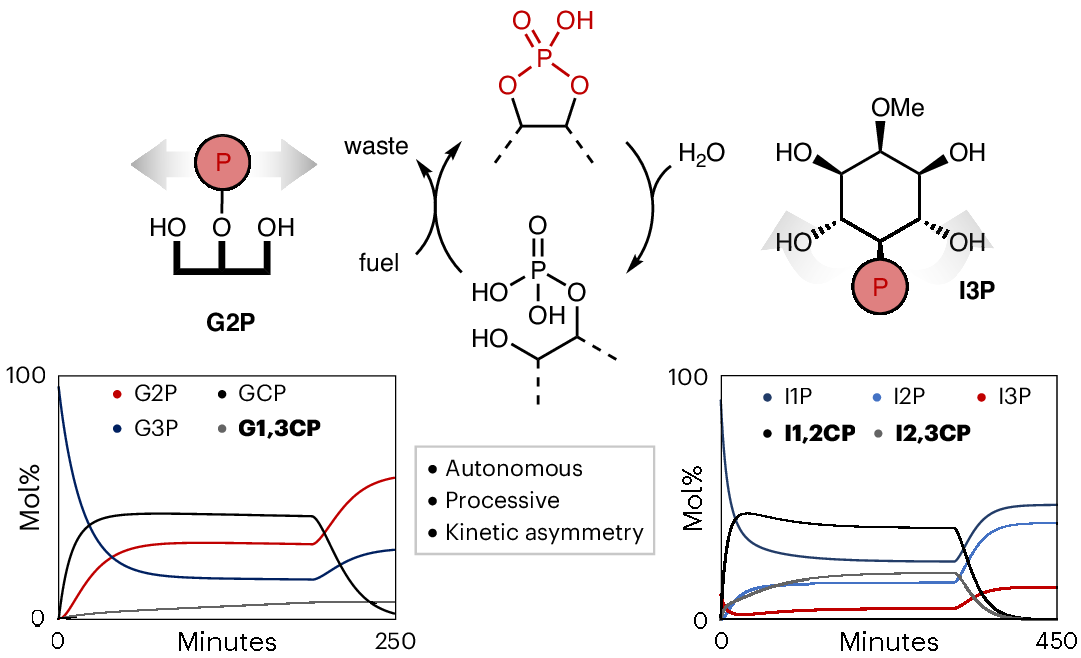
The cycle turns on a five-membered cyclic phosphate that hydrolyses far faster than the ordinary kind. That speed is what lets a carbodiimide fuel push a phosphate from one hydroxyl foothold to the next, with no enzyme present.
The Scientist · Science desk
What happened
- A carbodiimide fuel drives a non-enzymatic phosphodiester cycle that moves a phosphate group from one hydroxy foothold to the next along a polyol track, with no enzyme in the flask and no reagent added between steps.
- On a glycerol track, the phosphate distribution reached a non-equilibrium steady state and stayed there for several hours.
- On a larger inositol scaffold, the same chemistry carried the phosphate across five alcohol sites autonomously.
- Kinetic modelling in the paper indicates the walker can distinguish the centre of the track from its ends.
- Small-molecule walkers have been reported since 2010, but earlier ones moved directionally only when a chemist added different chemicals in sequence or applied an external electric field.
Compiled by The ScientistSomething wrong?How this is made
Why it matters
- capability A small-molecule walker can now run off a batch of fuel instead of off a chemist's schedule. That takes the operator out of the middle of every step and puts the design in the same category as autonomous DNA walkers.
- constraint The word motor needs more than a held distribution and a modelled positional bias. Net directional flux along the track has to be measured before this system can be compared with the net directional transport kinesin produces.
- precedent Running the cycle on glycerol and inositol puts the next round of claims in front of prebiotic and systems chemists, who have already spent years on non-enzymatic phosphodiester formation for phospholipids and RNA.
The walker here is a phosphate group, and the track is a polyol whose hydroxy groups are the footholds [1]. Activation was never the hard part. EDC, a water-soluble carbodiimide, has been used for years to activate organophosphates [11]. Getting the bond open again was the obstacle, because the P-O bonds in an ordinary phosphodiester are too inert to hydrolyse under either acidic or basic conditions [12]. Without hydrolysis the fuel leaves the phosphate wherever it landed, and there is no cycle [12].
The fix is a five-membered cyclic phosphate as the activated species [13]. RNA does this to itself. The 2' hydroxy group on ribose closes onto the phosphate, and the resulting transient five-membered ring hydrolyses many orders of magnitude faster than a linear phosphodiester such as dimethyl phosphate [14]. That same ring keeps the phosphate on the track. Earlier small-molecule walkers depended on carefully chosen reversible covalent reactions to ensure one foot could come off the track and not both [22][16]. Here the cyclic diester spans two footholds while selective hydrolytic ring opening leaves the phosphate on one of them [2], so processivity comes from the intermediate itself [15].
Autonomy in this system means the fuel drives the stepping with nobody adding reagents between steps, and that is the attribute small-molecule walkers had been missing [8]. A motor is a stronger claim. Motor proteins catalyse the exergonic conversion of ATP to ADP and use kinetic asymmetry in the cycle to produce net directional motion along helically chiral tracks [10]. The evidence for asymmetry in this work is a kinetic model [5], and what the abstract reports is a phosphate distribution held away from equilibrium for hours, stopping short of cargo moved or work done against a load [3].
Non-enzymatic cycles that hold a system away from equilibrium have been studied for about a decade, producing oscillations and liposome division among other behaviour [19]. None had been used to run a small-molecule walker [18]. DNA walkers had already reached autonomy [9].
Non-enzymatic phosphodiester formation has been studied in the context of phospholipids and RNA oligomerization [21], and the group's earlier cycles used phosphoramidates and acylphosphates as the activated species; the phosphodiester version had stayed out of reach [17]. The authors describe what they have added as "migratory endergonic synthesis" on biologically relevant phosphate scaffolds [20].
What to watch
- A follow-up that measures net flux along the track, going beyond the modelled centre-versus-end bias, would settle whether the word motor applies.
- Whether the steady state can be extended past a single batch of carbodiimide, by replenishment or flow.
- Whether the same cycle runs on nucleotide-like scaffolds, where the prebiotic reading of the result would be tested.