Science1 distinct publisher2 min readPublished
A team calibrated infrared spectra against beads of known silica content, checked the method on the Moon where returned rocks can grade it, and now reads Mercury's surface as up to 25 percent poorer in silica than assumed.
The Scientist · Science desk

Compiled by The ScientistSomething wrong?How this is made
The beads are standards in the strict sense: the composition is fixed in the lab before anything is measured, and the infrared response is measured rather than modelled [1]. Iris Weber of the University of Muenster compares them to calibration weights, whose known mass is what lets you trust a balance [2]. A standard can be exactly right in the lab and still misread a real planetary surface, which is why the lunar step carries more weight than it first appears: the Moon is the one body where a silica map made this way can be graded against rock in hand [4]. Renggli's word for that is touchstone [5]. In experimental terms it is the control, and it is doing at least as much work in this result as Mercury is.
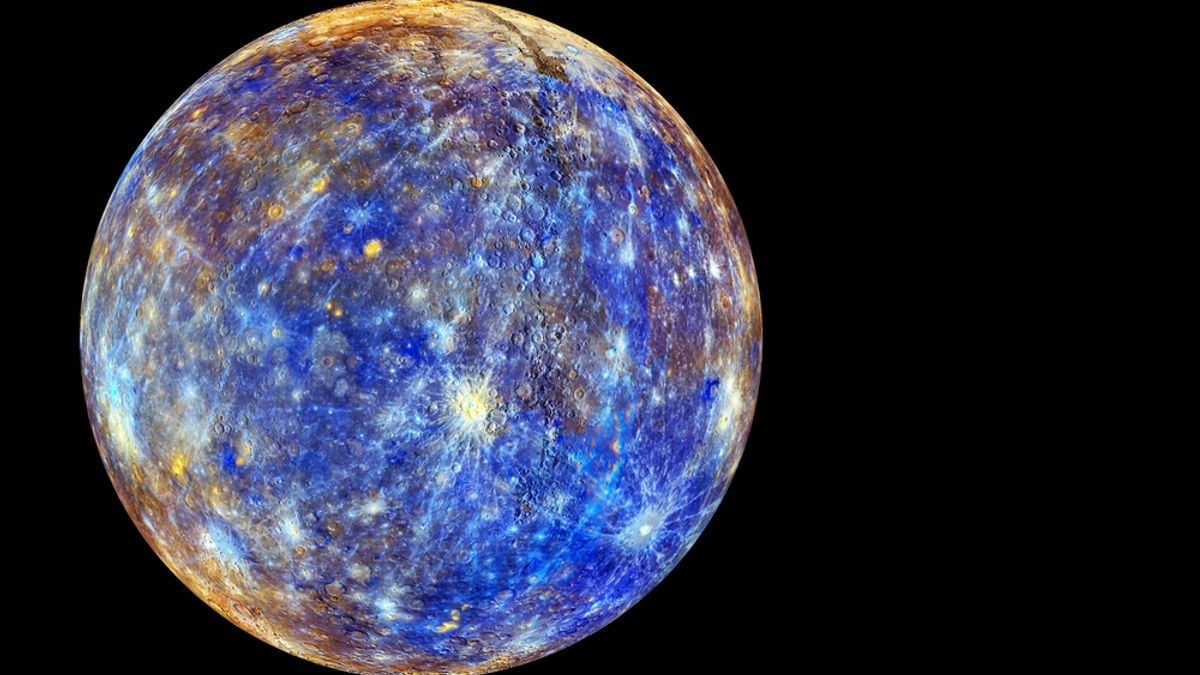
Mercury allows none of that. Nothing has landed there and no sample has ever been collected, so the infrared route is the only route [3]. The reported shortfall, up to 25 percent less silica than previously thought [6], leaves two things open. "Up to" is a ceiling rather than an average, and no absolute value is quoted, so it is not possible to say whether the figure is relative, leaving three quarters of the earlier number [17], or a drop measured in weight percent. That distinction sets how far the petrology has to move. Discover Magazine names the venue as the journal Planetary Research [8].
The step from a silica number to a melting depth [7] passes through melt composition, and the popular account does not show those links; that is the part to read closely when the paper is open. The setting around it is better established. Mercury has been contracting since it formed 4.5 billion years ago as its interior cools [9], young scarps are taken as evidence that it still is, according to the Smithsonian Institution [10], and that contraction is thought to have ended surface volcanism about 3.5 billion years ago, per North Carolina State University [11], much as the Moon's volcanism went dormant [12]. About 78 percent of the planet's existence has passed since then [16], so these rocks are a very old melt record, and Earth's silica-rich volcanoes are a poor template for reading them [15].
One structural note before the spacecraft arrives. The lunar map and the Mercury figure now rest on the same measured relation between silica content and infrared radiation [4] [6]. That is efficient, and it also means a single calibration error would move both numbers in the same direction at once.
Ranked by verification strength, evidence, and original report placement.
To determine the silica content of Mercury's surface, the researchers created tiny glass beads only about half a millimetre in size with precisely defined proportions of silica, and determined the exact properties of their infrared radiation.
Study author Iris Weber, a professor of geological planetology at the University of Muenster, said the glass beads serve a similar function to calibration weights on a scale: their weight is known precisely, which allows the scale's reading to be interpreted correctly, and similarly the beads allow correct conclusions to be drawn from the properties of the infrared radiation.
No landers have touched down on Mercury and no rock samples have ever been collected from it, so the researchers relied on an indirect approach based on infrared radiation to assess the surface's silica content.
The researchers tested the relationship between silica and infrared radiation on the Moon using NASA's Lunar Reconnaissance Orbiter, which has measured lunar infrared radiation since 2009, creating the first complete map of the silica content of the Moon's surface, which was verified through rock samples brought back to Earth.
Renggli said the Moon is a kind of touchstone for the team and an important conceptual stepping stone on the way to Mercury.
Applying the same approach to Mercury's infrared radiation, the researchers found that silica is up to 25 percent less abundant on Mercury's surface than previously thought.
Distinct publishers with included, body-backed reporting in this cluster.
Follow any of these and your For You feed starts watching them — no settings page required.
science
Remeasured silica at 37% pushes Mercury's extinct volcanism deeper into the mantle1 distinct publisher
invest
PLD Space stacked 59% of its lifetime funding into a single Series C1 distinct publisher
science
Saarland's metallic-glass team buys five days of weightlessness to measure a melt1 distinct publisher
science
Webb splits Hephaistos's two newest Dyson sphere candidates into M dwarfs and background galaxies1 distinct publisher
Evidence-backed comparisons of source perspectives and observed adoption signals. Read the methodology
Which Builder, Operator, and Investor concerns the observed source mix emphasized—not a truth score.
Evidence, demonstrated adoption, hype gap, incentives, and confidence are assessed independently, each on its own current evidence. How these are measured.
Sound method, single retelling
The methodological spine is unusually satisfying for a planetary result: synthetic standards of known composition, then a dress rehearsal on the one body where returned rocks can settle whether the technique works. But the whole chain reaches us through Discover Magazine's summary of one paper, with quotes lifted from an institutional statement, and the quantitative core — what the earlier silica estimate was, how much it moved, with what uncertainty — is simply absent.
No uptake to observe yet
Nothing in this reporting shows anyone beyond the author team using the calibration — no other group applying it, no dataset release, no instrument team adopting it. The lunar silica map is presented as the authors' own output, and BepiColombo's test is still more than a year out.
A hedged number travelling unhedged
'Up to 25 percent less than previously thought' is the kind of phrasing that shrinks the moment you ask what the previous number was, and this reporting never says. The interpretation stacked on top — magma from deeper in the mantle — is a quoted inference, not a measurement, and the team's own expectation of confirmation is presented as reassurance rather than as the open question it is. The overstatement is mild and mostly a matter of missing context, not exaggeration.
Authors' own statement, one remove away
Both quotes are flagged as coming from a statement, which means the framing a reader receives was written by the institutions with a stake in the finding — Max Planck and Münster — and passed through without an outside voice. The team also has a public prediction riding on a mission that arrives next year, which is a reputational bet as much as a scientific one. This is ordinary science-PR flow rather than anything hidden, and Discover Magazine's own interest is straightforwardly traffic.
Believable, unverified, and testable soon
The method is the sort that tends to hold up, and the lunar cross-check gives it a real spine — but with one outlet, no second reading of the paper, and no numbers to recompute, our confidence sits below the halfway mark. It should move sharply in one direction or the other once BepiColombo is in orbit.