Science1 publisher3 min readPublished
Removing NUDT5 made cells resistant to a 70-year-old leukemia drug
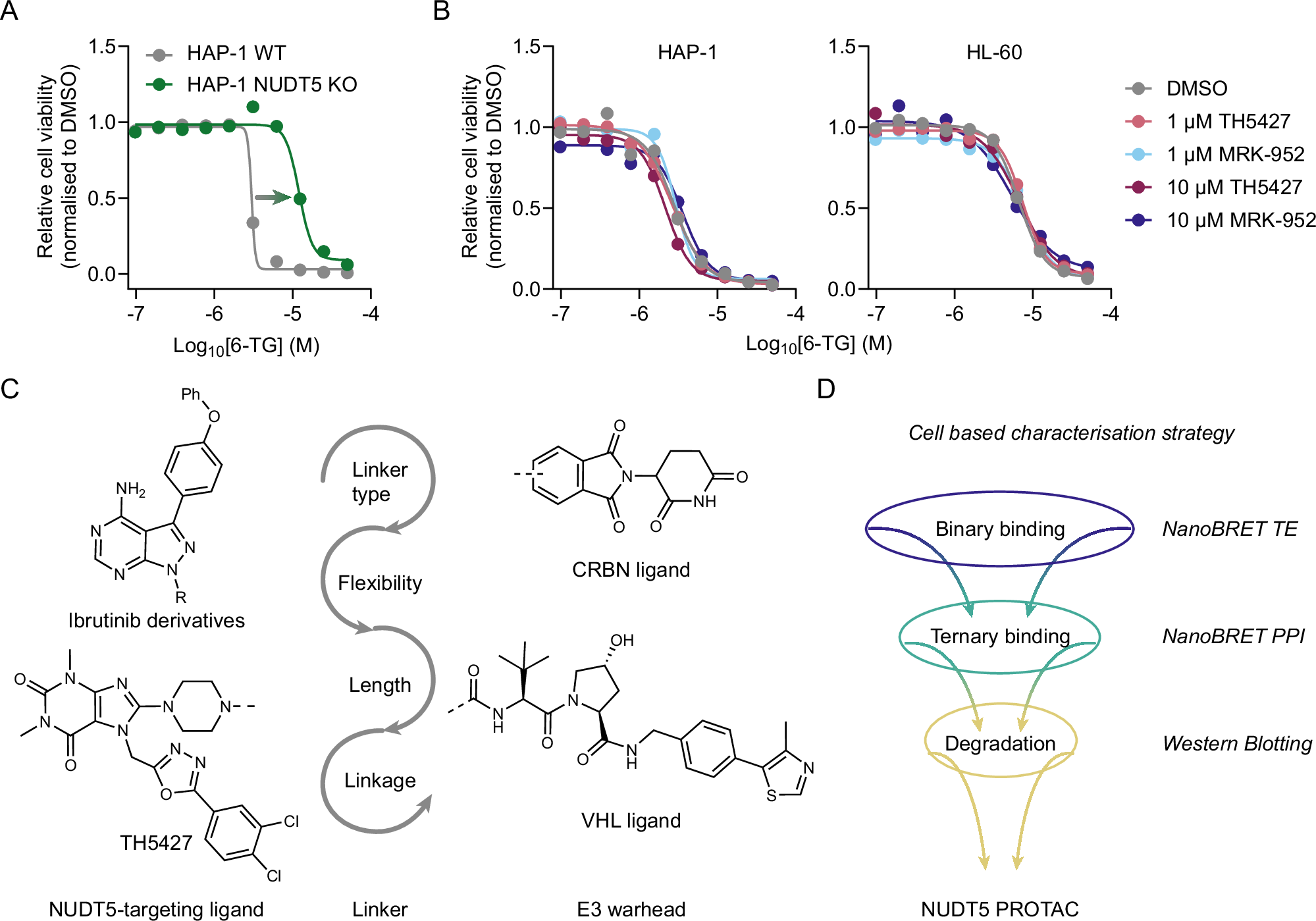
CeMM and Oxford researchers degraded the protein NUDT5 in cells and made them resistant to 6-thioguanine, while inhibiting the same enzyme had little effect. The split separates what the protein catalyses from what it does by being present.
The Scientist · Science desk
What happened
- Blocking NUDT5's enzymatic activity did not meaningfully change how cells responded to 6-thioguanine, while removing the protein from the cells protected them from the drug's toxicity.
- A medicinal chemistry program at Oxford produced selective NUDT5 degraders, including the most active one, dNUDT5, plus matched compounds that bind NUDT5 without destroying it.
- Genetic removal of NUDT5 pointed to the same conclusion as the chemical degraders, giving two independent routes to the protective effect.
- The work builds on a 2025 Science paper from the Kubicek and Huber laboratories showing NUDT5 acts as a scaffold organizing cellular metabolism, independent of its enzyme activity.
Compiled by The ScientistSomething wrong?How this is made
Why it matters
- constraint A target that looks inert when you inhibit it can still be doing something, so a chemical inhibition screen and a knockout or degrader screen are not substitutes for each other when the question is whether a protein matters.
- capability With a degrader and a matched non-degrading binder in hand, the same experiment becomes available for other enzymes whose knockout phenotypes have never matched their inhibitor phenotypes.
- decision Thiopurine dosing already takes NUDT15 into account; a second protein pulling the other way would have to be measured in patient samples before it could enter that calculation.
- precedent If catalysis is the wrong readout for NUDT5, drug programs aimed at it have to decide whether they are buying occupancy or removal, because the two now have different expected effects on thiopurine sensitivity.
An inhibitor and a degrader ask different questions of the same protein. The inhibitor plugs the active site and stops the reaction, and the protein stays where it was, still touching whatever it touched. A degrader hands it to the cell's own disposal machinery and it is gone [4]. The Oxford chemistry program also made compounds that bind NUDT5 without triggering its destruction [6].
Those matched binders are the control that makes the comparison readable. Without them, nobody could tell whether the protection came from taking NUDT5 out of the cell or from merely sitting on it.
"We initially expected that NUDT5 would influence 6-TG through its enzymatic activity," said Tuan-Anh Nguyen of CeMM. "Instead, we found that inhibiting the enzyme had little effect. What mattered was whether the protein itself was present" [9]. Kilian Huber of the Centre for Medicines Discovery at Oxford, a co-corresponding author, put the method the same way: "Chemical degraders give us a way to separate what a protein does as an enzyme from what it does as a physical presence in the cell" [10].
The result is harder to dismiss as a quirk of one compound because genetic removal of NUDT5 agreed with the chemical removal [8], and the chemical effect scaled with dose. "As the results came in, it became immediately clear that the dNUDT5 was protecting cells from 6-thioguanine toxicity in a dose-dependent manner," said Ludwig Bauer, a first author [11]. The degrader series itself came out of a screening platform built for the purpose, which Anne-Sophie Marques said "helped guide the medicinal chemistry efforts that ultimately produced dNUDT5, our most active degrader" [5].
The CeMM announcement, dated September 24, 2026, does not name the journal, the cell lines, or the size of the protection [16]. So what the result offers is a direction: two ways of suppressing the same protein disagree, measured in cultured cells [7].
6-thioguanine has been in clinical use for more than seven decades [1], which puts its introduction in the mid-1950s or earlier [17]. The scaffolding role that appears to govern this response was described in 2025 [3]. The cell work does not say whether patients differ in how much NUDT5 they have. Going from a resistant cell line to a patient who under-responds requires that measurement in patient samples.
The NUDT15 comparison is the part with a clinical foothold. NUDT15 is already known to affect how patients respond to thiopurines, and its loss makes cells more sensitive to 6-thioguanine, while reducing NUDT5 does the opposite [13][14]. CeMM describes the finding as pointing to a hidden cellular role that could help explain why people respond differently to certain leukemia treatments [15].
What to watch
- The peer-reviewed paper, which would supply the journal, the cell lines, and the dose-response curves for dNUDT5 against the matched non-degrading binders.
- Whether NUDT5 protein abundance varies across patient leukemia samples and tracks with thiopurine response alongside NUDT15 status.
- Whether other NUDT5-directed programs report the same inhibitor-versus-degrader disagreement in phenotypes unrelated to thiopurines.