Science1 publisher2 min readPublished
Cellulose and beeswax give an ingestible battery a three-day lifetime in pigs
Tested in pigs, the battery held about 1.8 volts and faded to 1.45 by the third day. Its 3.5 milliampere-hour ceiling is roughly a tenth of what one uninvolved engineer says the technology needs.
The Scientist · Science desk
What happened
- The battery is built in layers: a magnesium alloy anode, a cathode of molybdenum trioxide and activated carbon, and a biodegradable electrolyte between them that lets the cell generate current.
- It has been tested only in pigs so far, where it powered devices for up to three days.
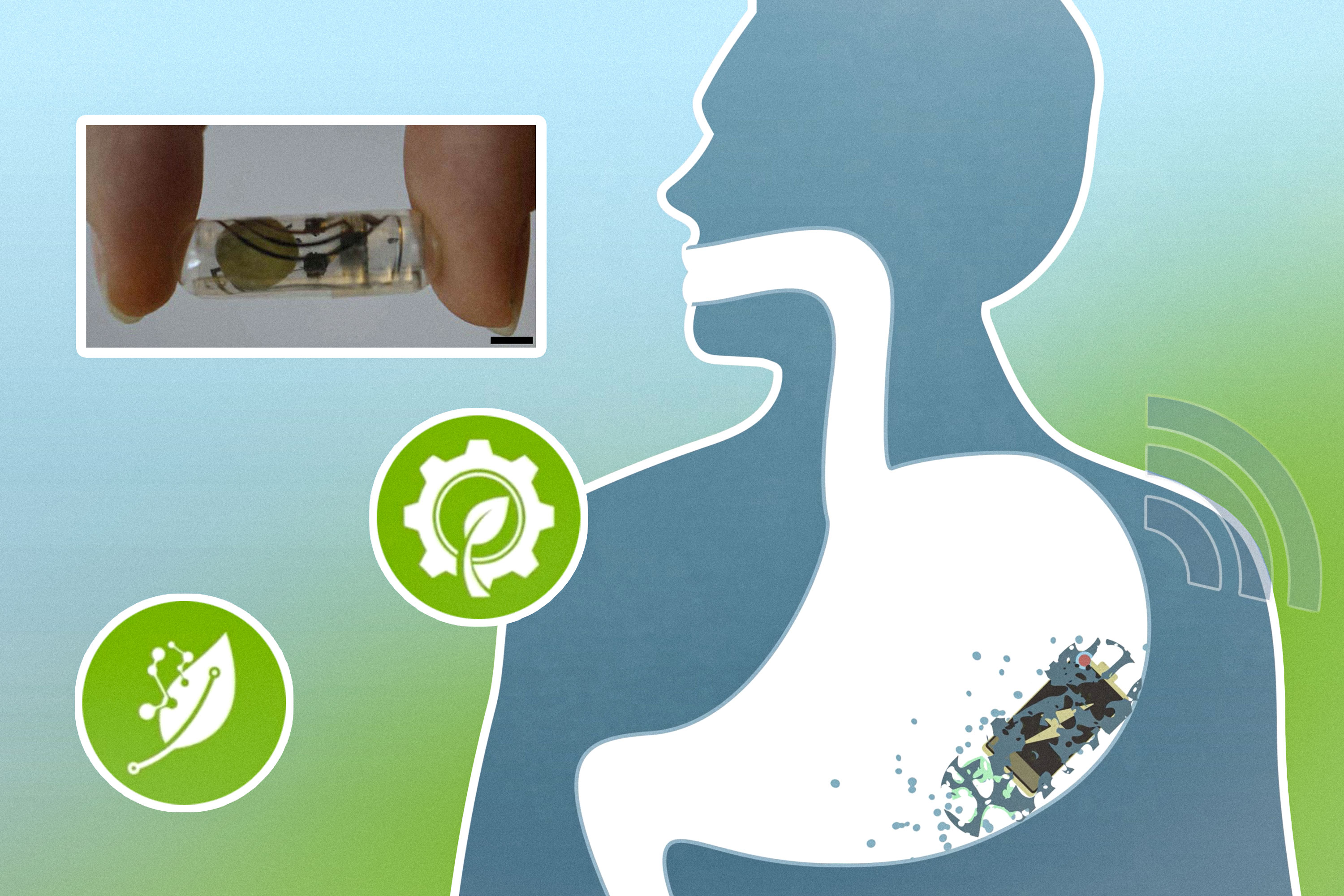
- The materials are designed to dissolve gradually in the acidic gastrointestinal tract and then be absorbed without leaving harmful fragments or toxic byproducts behind.
- The smaller cell ran an experimental RFID tag in the pig esophagus, which reached a receiver 1.5 metres away and let researchers detect when the animal swallowed a medication.
- The larger cell powered a swallowable capsule that electrically stimulated the stomach.
Compiled by The ScientistSomething wrong?How this is made
Why it matters
- capability A power source that dissolves would let a temporary gut device be abandoned in place, taking the retrieval procedure out of the treatment plan if human safety and efficacy hold up.
- constraint Sealing a conventional cell against leakage is part of what makes ingestible capsules bulky; a designer who adopts a dissolving cell trades that housing requirement for a degradation schedule that has to be validated inside the body.
- contradiction The only uninvolved engineer quoted in the study coverage endorses the approach and at the same time says the capacity has to rise tenfold.
The three-day lifetime is also a current budget. A ceiling of 3.5 milliampere-hours [12] spread across 72 hours [2] leaves an average draw of about 49 microamperes [1]. At the larger cell's opening 1.84 volts, the pack holds roughly 6.4 milliwatt-hours of energy [12][2]. The smaller version, which fits inside a standard gelatin capsule, delivers about 1.77 volts and 2 milliampere-hours per square centimetre, enough for low-power electronics [11].
The supply slides while it works. In the pigs, the larger battery went from about 1.8 volts to 1.6 after one day and to about 1.45 by the third [15], and the smaller one fell from 1.7 to 1.35 over the same period [16]. Those are declines of roughly 19% and 21% [3][4]. Capacity dropped alongside voltage as the batteries degraded [14].
Beeswax slows the breakdown in stomach acid, and some versions add a layer of candelilla wax, derived from the desert shrub Euphorbia antisyphilitica, for longer protection [9]. Giovanni Traverso, a co-author of the study and director of the Laboratory for Translational Engineering at MIT, said the wax coating is more than packaging: it is a key design element that controls the functional lifetime [10][8].
The paper structure itself comes from cellulose nanofibrils used as a binder, where earlier biodegradable prototypes used larger binders [6]. "The paper structure improves the battery's strength and control over degradation while still allowing it to produce electricity," Traverso told Live Science in an email [7].
The work was published on Sept. 21 in Nature Chemical Engineering [3]. In the animal experiments the prototypes sat in 3D-printed capsules that researchers placed orally with an endoscope [13]. That controls position, and it means the study did not test how a capsule swallowed in the ordinary way travels and degrades.
Conventional ingestible batteries are bulky and have to stay sealed, because their internal materials can leak into surrounding tissue and cause damage [23]. Reza Ghodssi, a professor of electrical and computer engineering at the University of Maryland who was not involved in the study, put the size problem this way: "The battery is one component that takes up most of the space in an ingestible device, so anything that can provide the required power while reducing the size of the capsule is very promising," he said [19][21]. An order of magnitude above 3.5 milliampere-hours is about 35 [5]. "They need to have an order of magnitude higher capacity for this technology to be even more promising," Ghodssi said [22].
What to watch
- Whether a version reaches the roughly 35 milliampere-hours Ghodssi named while still fitting inside a standard gelatin capsule.
- Data from a capsule that is swallowed normally rather than placed by endoscope, including where it degrades and what the byproducts do.
- Whether thicker candelilla wax buys runtime past three days without pushing voltage below what the electronics tolerate.