Science1 publisher2 min readPublished
Cells that triggered their own death program rebuilt nearly half a fly's irradiated tissue
A Weizmann team built a delayed sensor to catch fruit fly cells that begin apoptosis and survive it. Those cells, which the group named DARE, replenished nearly half the damaged epithelium within 48 hours.
The Scientist · Science desk
What happened
- Compensatory proliferation dates to the 1970s, when fly larvae given high doses of radiation still grew fully functional wings despite heavy damage to their epithelial tissue.
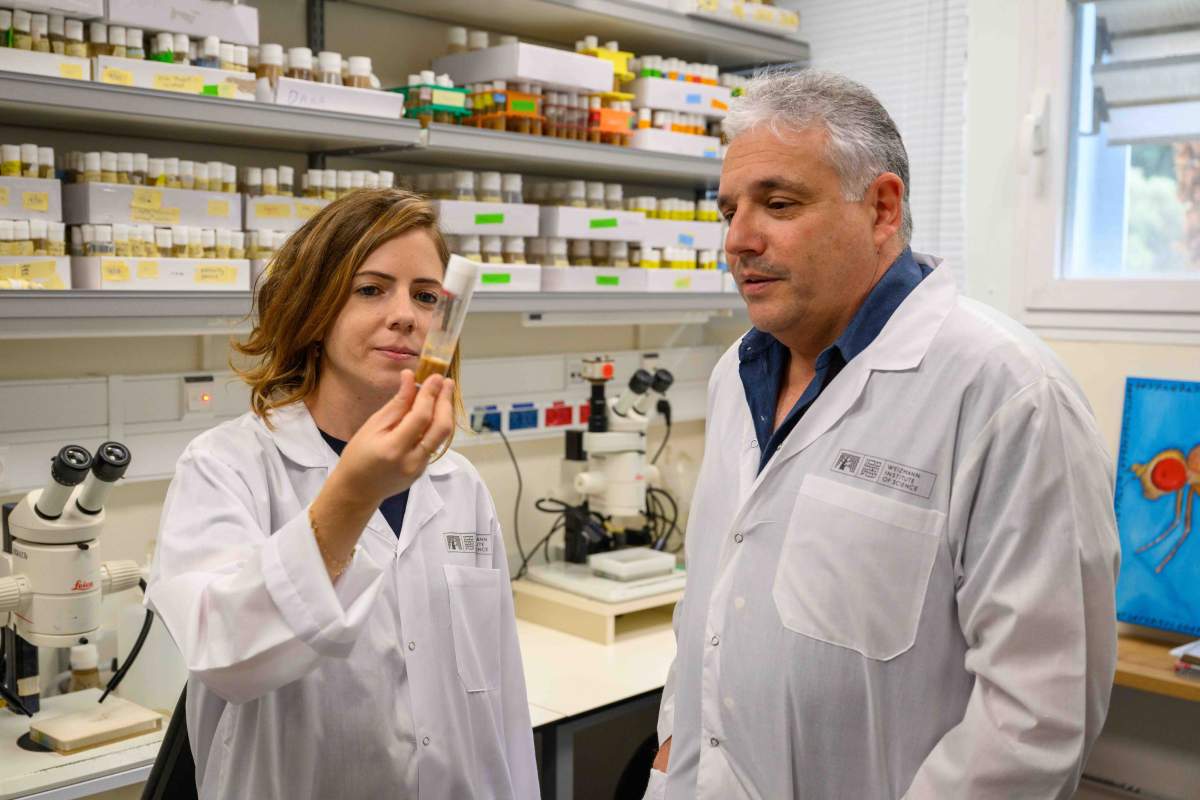
- A Weizmann team led by Tslil Braun, in Eli Arama's lab, rebuilt that experiment in fruit fly larvae with modern genetic tools to follow epithelial regeneration cell by cell.
- A second death-resistant population, named NARE cells, showed no activation of the initiator caspase at all.
Compiled by The ScientistSomething wrong?How this is made
Why it matters
- contradiction The announcement's summary says descendants become far more resistant to future damage, while its own body text says they may become better equipped. A reader weighing how strong the regeneration finding is has to choose between those two sentences.
- constraint The measured system is a fruit fly epithelium after ionizing radiation, so nothing here sets a tissue, a dose or a timescale for a patient after cytotoxic therapy.
- capability A cell that starts apoptosis and survives has been an inference from tissue regrowth, and a delayed caspase reporter turns it into a population that can be sorted and tested.
- decision Anyone designing a drug against the recurrence half of this mechanism has to decide what it does to the repair half, because the Weizmann release names both as the goal.
Nearly half means that more than half of the rebuilt epithelium came from somewhere other than DARE cells [8][17]. The team asked where the rest came from and found a second death-resistant population, NARE cells, whose initiator caspase had never been switched on [18][10].
Such a cell is findable only because of the way the sensor was built. Braun's group used a delayed sensor that reported on cells in which the initiator caspase had been activated but that nevertheless survived the irradiation [6]. A readout taken during the damage itself would mark the dying alongside the survivors.
"We set out to identify cells that push the self-destruct button but survive anyway," Braun said [9]. The cells, he said, "multiplied, repaired the damaged tissue and replenished nearly half of it within 48 hours" [8].
Apoptosis runs through an initiator caspase that opens the pathway and effector caspases that break apart proteins inside the doomed cell [11]. Over the past two decades those same enzymes have turned up in processes essential for life, work that includes Arama's own lab, and Arama suspected they had a hand in compensatory proliferation [12].
Cancer cells "may" exploit this survival mechanism, the Weizmann announcement says, potentially contributing to tumors that return in a more aggressive and treatment-resistant form [15]. The experiments described are in irradiated fruit fly larvae [5][19].
Weizmann's summary and its body text also describe the descendants with different force. The summary says their descendants "become far more resistant to future damage" [13]. Lower down, the text says survivors "may even become better equipped to withstand future injury" [14]. The announcement's stated ambition is to encourage healthy tissue repair while reducing the risk of cancer recurrence [16]. Both halves of that would run through the same initiator caspase [11].
This does not say whether an equivalent cell exists in a human epithelium after radiotherapy, or how long a DARE descendant's extra resistance lasts. It does give a labeling trick: a cell that started to die and stopped can now be marked and followed [6][7]. Marking such a cell is the prerequisite for asking either question.
What to watch
- Whether the Nature Communications paper quantifies the descendants' resistance with a dose-response, instead of describing it in words.
- Whether any group finds a caspase-activated-and-survived population in mammalian epithelium after radiation.
- Whether blocking the initiator caspase in the same fly assay slows regrowth, which would separate the survival arm from the repair arm.