Science1 publisher3 min readPublished
Scripps finds transthyretin can unfold by a second route that skips the dimer step
The four-unit protein can come apart directly when conditions turn acidic, and a screen of more than 100 variants suggests some brain-amyloidosis mutations reach that route at normal blood pH. Whether tafamidis blocks it was not tested.
The Scientist · Science desk
What happened
- The team timed unfolding for more than 100 TTR variants across a range of urea concentrations and acidity levels, then checked the structures with cryo-electron microscopy and published X-ray crystallography.
- The alternative route is favored under acidic conditions, matching the interior of lysosomes, where cells break down and recycle proteins at the end of their life cycle.
- Certain disease-associated mutations appear to make the new route accessible even at the normal acidity of blood, while in the most common forms of the disease it looks too slow to compete.
Compiled by The ScientistSomething wrong?How this is made
Why it matters
- constraint The readout is how fast purified protein comes apart in solution, so it cannot tell a clinician whether a stabilizer still holds the tetramer shut on a route that never forms dimers.
- exposure The carriers this touches are people with rare hereditary variants linked to amyloid in the brain, a much smaller group than the patients with the common cardiac form.
- capability Drug programs get a second kinetic target and a condition, low pH, under which a candidate can be screened for whether it blocks that target.
- precedent Protein folding theory gains a solution-phase system for testing multiplicity, which had mostly been argued from models and from pulling experiments.
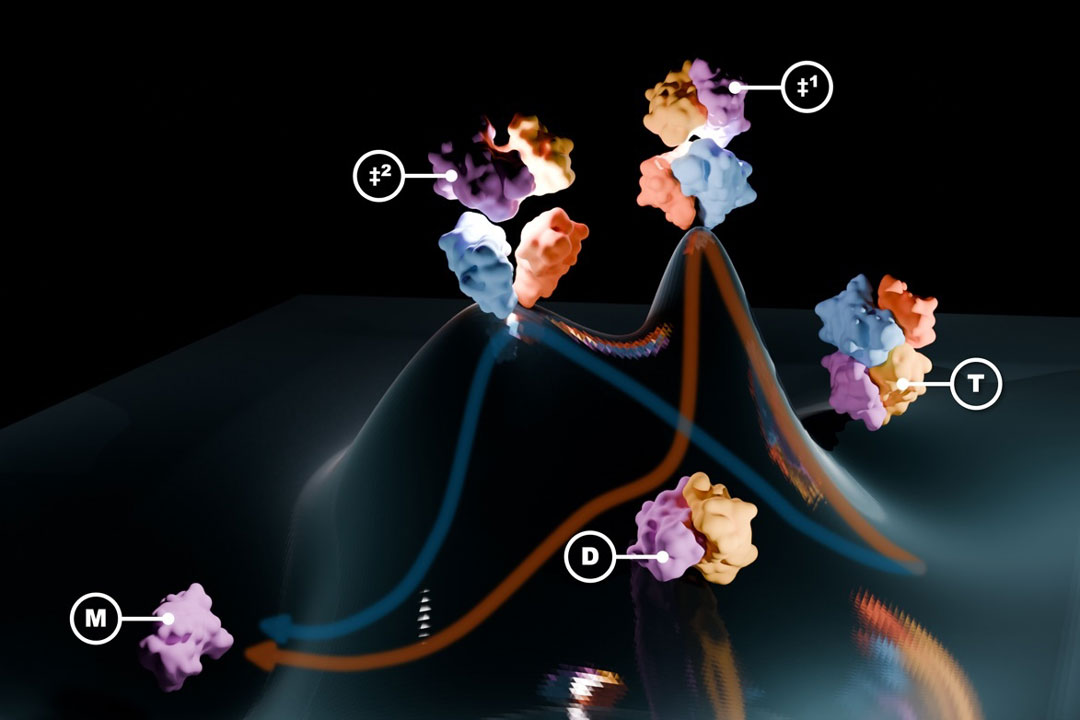
The measurement behind this is a screen. Scripps Research tested more than 100 transthyretin variants, timing how fast each one unfolded across a range of urea concentrations and acidity levels, and checked the structural picture against cryogenic-electron microscopy and previously published X-ray crystal structures [4]. The known route is stepwise: the four-unit protein splits into two-unit pieces, which separate into single units that misfold and clump, most often in the heart and nervous system [3]. The second route skips the two-unit stage and the tetramer comes apart more directly [5].
Acid is what opens it. The alternative route is favored under acidic conditions, the environment inside lysosomes, where cells break down and recycle proteins at the end of their life cycle [8].
"This route probably evolved so TTR can be degraded, which is important, but can also have side effects," said Martin Gruebele, a co-author and professor emeritus of chemistry at the University of Illinois Urbana-Champaign [9].
For the most common forms of the disease, the second route looks too slow under normal conditions to compete with the familiar one [10]. Some disease-associated mutations appear to make it accessible even at the normal acidity of blood, and the variants that reach it are particularly those that cause amyloidosis in the brain [6][11]. ATTR affects tens of thousands of people in the United States [12].
Tafamidis works by holding transthyretin together, slowing the unfolding and aggregation of the known pathway [2]. How a stabilizer behaves on a route that skips the dimer step is a separate question, and this paper leaves it open. Jeffery Kelly, the senior author and one of the drug's co-developers, put it as a question: "We need to understand whether this alternative pathway can lead to TTR aggregation in the cerebrospinal fluid, which could potentially translate into worse outcomes for patients carrying these rare mutations who take the current medications" [7][13]. The reported work measures unfolding kinetics of protein in solution. That leaves out aggregation in cerebrospinal fluid, drug binding on the alternative route, and outcomes in any patient [14].
The firmer result is in protein science. Folding by more than one pathway has been proposed by theorists and has been hard to show experimentally [15].
"Transthyretin is the first oligomeric protein for which pathway multiplicity has been shown in solution, and without mechanical pulling," said first author Marcus Jager, whose paper appears in the Proceedings of the National Academy of Sciences [16][1].
"More research is needed, but this opens up a new direction in the field of drugs targeting specific amyloidosis pathways," Gruebele said. "At least we have one of several possible smoking guns to look at" [17].
What to watch
- A binding or kinetics experiment showing whether tafamidis, or any other stabilizer, slows the dimer-skipping route in the brain-amyloidosis variants.
- Any measurement of TTR aggregation in the cerebrospinal fluid of carriers of those rare variants who are taking current medications.
- Whether the same urea-plus-pH screen turns up pathway multiplicity in other oligomeric proteins.