Science1 publisher3 min readPublished
Researchers urge the UK to itemise the disposable cup charge on every receipt
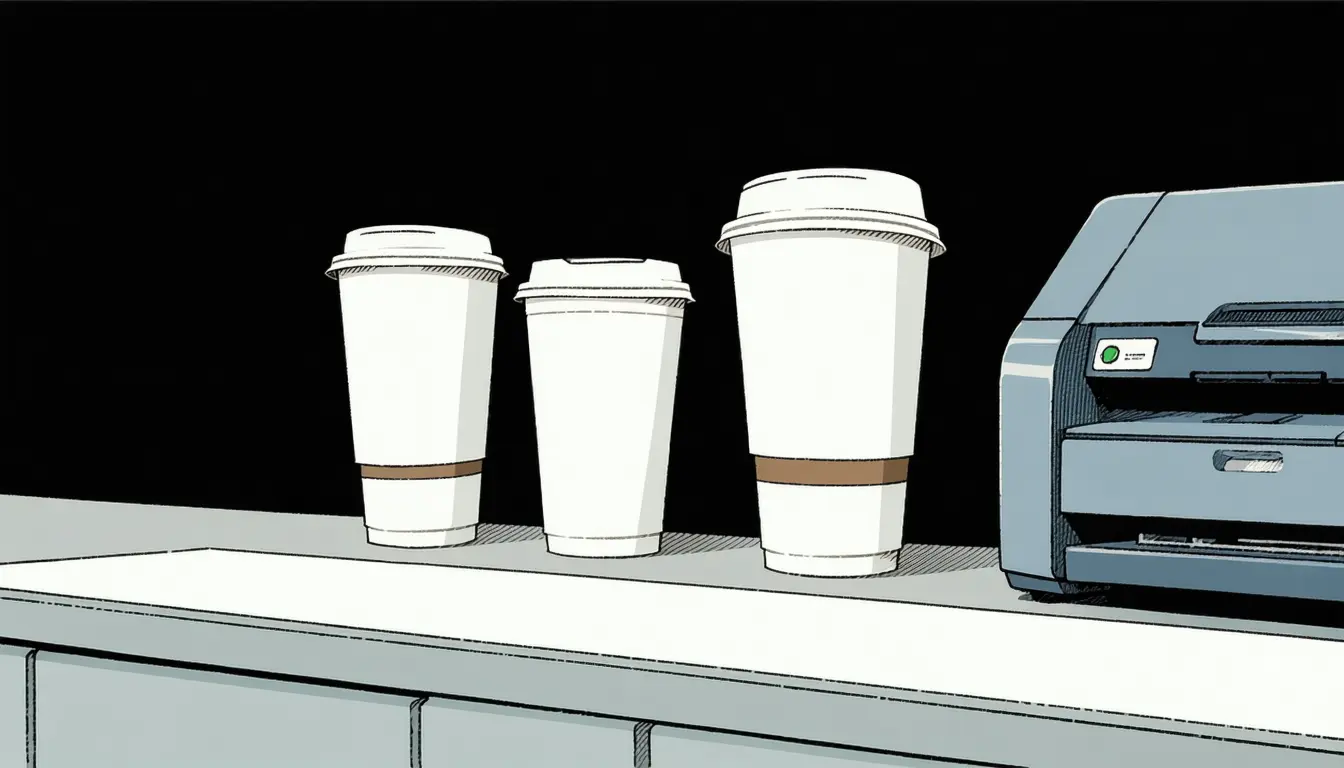
Ninety-two percent of cafe customers surveyed could not tell whether a cup was already costing them money, and the behavioural case for a mandated charge rests on a field experiment in three university cafes.
The Scientist · Science desk
What happened
- Around 2.5 billion single-use cups are used in the UK each year and fewer than 1 percent of them are recycled, according to the policy brief behind the charge recommendation.
- Work by the Revolution Plastics Institute with the universities of Bath, Sheffield and Oxford Brookes found 92 percent of cafe customers unsure whether a disposable cup was already being charged for.
- The brief asks that any charge be displayed when the drink is bought and itemised separately on receipts and digital orders, with china or a reusable cup as the way to avoid paying it.
Compiled by The ScientistSomething wrong?How this is made
Why it matters
- constraint A national charge would be rolled out mainly into high street, station and drive-through trade, while the causal evidence comes from three campus counters.
- decision An itemised line on the receipt takes the design choice away from each retailer's discount policy and hands it to a single rule chains would have to apply the same way everywhere.
- cost While cups stay roughly 8 percent of England's litter by volume, councils and taxpayers pay to clear them.
- precedent With Scotland committed and EU packaging rules tightening, a Westminster charge is the option that leaves cross-border retailers with one set of instructions.
Uncertainty at the till is what the survey measured. Customers could not say whether the price of a coffee already included the cup [3]. Whether they would buy differently if they could see the cost is a separate question, and the brief answers that one with a different study.
That evidence is a field experiment across three university cafes, run alongside the customer surveys, interviews with consumers and discussions with policy, retail and behavioural science experts [6]. The phys.org account does not say what charge was tested or how far purchasing moved [19]. The researchers report that making the cost of a single-use cup explicit can influence greener purchasing decisions [7].
A cafe experiment is the right kind of test here, because it records what people actually bought. Whether the same holds at a station kiosk is untested; the result describes purchasing at those three campus counters [6]. Three sites is a small sample.
Kate Whitman of the Revolution Plastics Institute at the University of Portsmouth [16] said: "The default choice is often a disposable cup, and a clear, memorable charge will help to change that" [8].
Her comparison is to carrier bags. "We already know that a small, visible charge can change behavior through the experience of single-use shopping bag charges," Whitman said [13]. The two cases differ in what the avoidance step costs the customer. A shopper avoids the bag charge with a bag they already own, while the brief's route around a cup charge is china in the cafe or a clean reusable cup in hand [5], and the brief lists shared collection and washing systems across multiple retailers among the reuse arrangements a national framework could help bring about [9].
The waste figures behind the recommendation are large. At fewer than 1% recycled, more than 2.47 billion of the 2.5 billion cups the UK uses each year are not recycled [1][17]. Cups account for around 8% of litter by volume in England [10], and street cleaning and waste management for that litter is paid for by local authorities and taxpayers [2]. "Customers tend to believe they are recyclable, but the truth is that they very rarely are," Whitman said [18].
Existing charges already vary between cafes and retailers and are often not communicated at the point of sale [4]. Scotland has committed to a charge on single-use beverage cups, and the European Union's Packaging and Packaging Waste Regulation puts more weight on reuse and refill [11]. The researchers argue a consistent UK approach would reduce complexity for businesses operating across national borders and give them more confidence to invest in reusable cup products and washing facilities [12]. The brief is published as Whitman, March, Pearson, Nash, Greenwood and Bowyer (2026), "A fair and transparent approach to single-use cup charges in the UK" [15].
What to watch
- Publication of the field experiment's charge level and effect size, which would show how much of the 92% awareness gap converts into different purchases.
- Whether Westminster legislates or Scotland proceeds alone, leaving chains with two rules for the same coffee.
- Whether returnable schemes and shared washing facilities appear, since the charge is only avoidable where a clean cup is available.