Science1 distinct publisher3 min readPublished
The measured part was Van Allen belt protons, not a storm. The 60% and 40% dose cuts are model output, and StemRad's own arithmetic implies a Mars cruise worse than 600 mSv.
The Scientist · Science desk

Compiled by The ScientistSomething wrong?How this is made
Run the two headline figures backwards and they land in the same place. A 60% cut worth 193 cruise days implies an unshielded August 1972-type event of about 322 days; an almost 40% cut worth 131 days implies about 328 [14][15][1]. Behind Orion's hull the two historic storms deliver close to the same total effective dose, and the vest is still half again as useful against one as against the other. Event size cannot be the variable; the energy distribution of the protons is, and that is the parameter a garment designer never gets to pick.
StemRad's own framing supplies the conversion into dose. If a three-year Mars round trip equals or exceeds the 600 mSv career limit [4], the cruise floor is about 0.55 mSv per day, which makes the vest worth at least roughly 106 mSv in a 1972-type event and 72 mSv in a 1989-type one, or 18% and 12% of a career [3]. Set that against Oren Milstein's other number, that one major solar particle event can deliver more than a third of the 600 mSv limit, and therefore more than 200 mSv [3][2]. The two statements only reconcile if the cruise is worse than the limit: about 0.62 mSv per day, or roughly 680 mSv over three years [4]. The uncertainty runs the wrong way.
None of this was measured in a storm. Artemis I met no solar particle event, and what Orion actually flew through was the inner Van Allen belt, whose protons cover a similar energy range [12]. The team built digital twins of both phantoms, the vest, the detectors and the spacecraft shielding, generated hundreds of billions of virtual particles and found close agreement with the flown dosimeters [13]. So the demonstrated result is that the model reproduces a real belt exposure. The 60% and 40% are that model's answers about two events no phantom has ever worn a vest through [14].
The operational claim is a separate thing, and it comes from one party. Jordan Houri of StemRad says the vest matches the most robust shelter configuration while letting the wearer move around the cabin and keep working [10], against a status quo of barricaded supplies or standing where the hardware is thickest [9]. That is the comparison that decides whether a vest is manifested, and it has not been published by anyone outside the company.
Which raises mass. The team is working to reduce it and is looking at flying lighter empty vests to be filled with recycled polyethylene after launch [16]. That idea is worth more than the percentages, because high-density polyethylene earns its place through hydrogen content [11] and this version moves shielding mass off the launch manifest onto material already aboard, assuming the feedstock inventory is really there. Milstein's stated payoff is longer careers [17]; the organ-by-organ thickness map [6] and the choice of female phantoms, made because women carry the higher predicted cancer risk [8], are what give that argument sex-specific flight data instead of an assertion.
Ranked by verification strength, evidence, and original report placement.
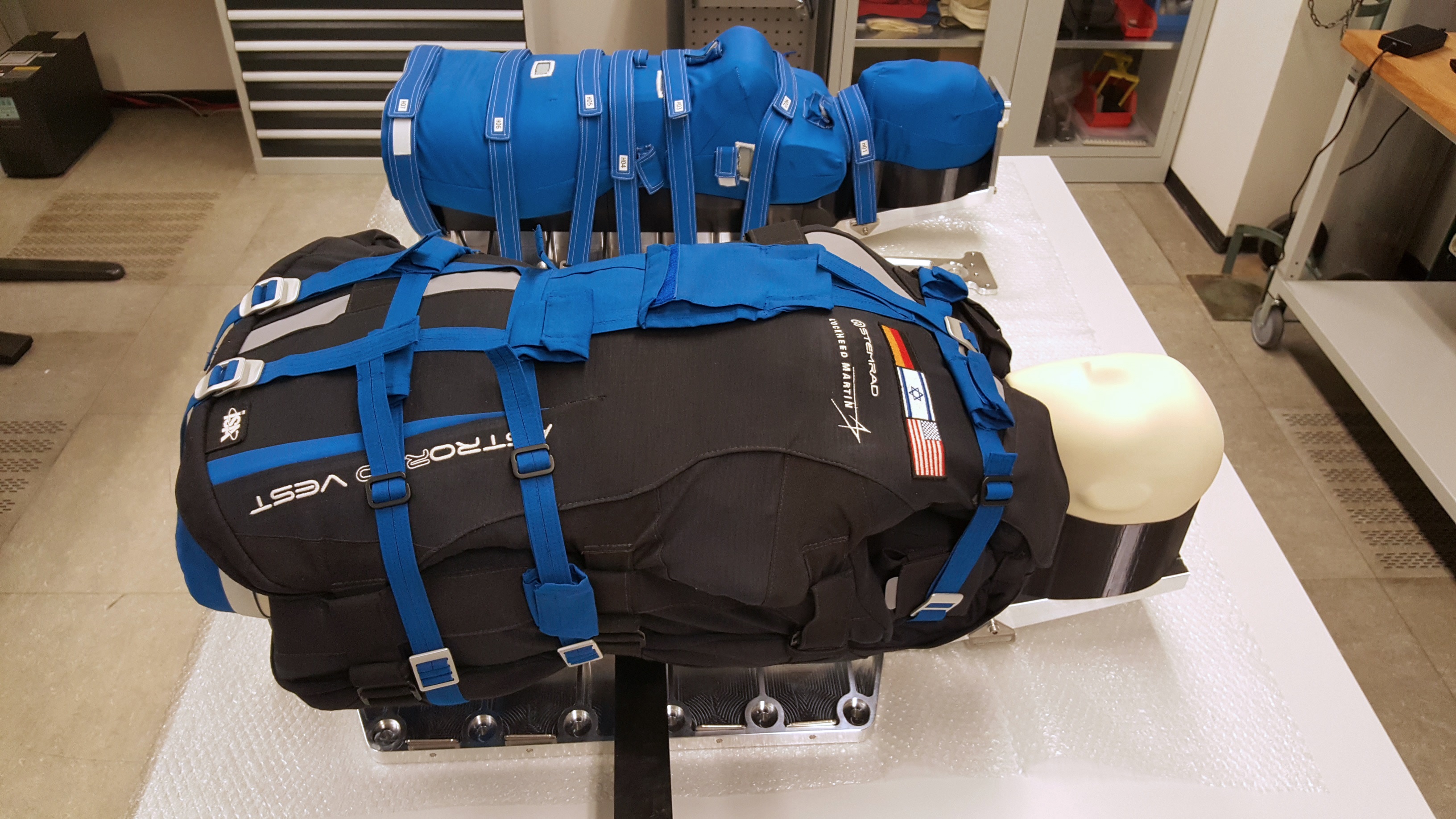
In a Science Advances paper, the researchers simulated measured solar particle events from August 1972 and October 1989 and found that wearing AstroRad would reduce effective dose by around 60% in a 1972-type scenario and by almost 40% for a 1989-type event.
Two human-tissue-equivalent female torso phantoms were seated in the Orion crew capsule during Artemis I; the phantom Zohar wore the AstroRad vest and Helga did not, with numerous dosimeters placed in and on the phantoms allowing received dose to be compared.
Oren Milstein, immunologist and CEO of StemRad Radiation Protection, says a single major solar particle event can deliver more than one third of NASA's 600 millisievert career effective-dose limit.
Milstein says a three-year round trip to Mars would equal or exceed NASA's 600 mSv career limit, which corresponds to a 3% mortality risk from radiation-induced cancer.
Shielding thickness in the vest varies throughout the garment according to the radiation sensitivity of the underlying organs, with concentrated shielding over breasts, colon, lungs, ovaries, stomach and red bone marrow in the test vest.
The experiment used female phantoms because women have a higher predicted risk of radiation-induced cancer than men.
Follow any of these and your For You feed starts watching them — no settings page required.
Evidence-backed comparisons of source perspectives and observed adoption signals. Read the methodology
Which Builder, Operator, and Investor concerns the observed source mix emphasized—not a truth score.
Evidence, demonstrated adoption, hype gap, incentives, and confidence are assessed independently, each on its own current evidence. How these are measured.
Flight-validated model, but the headline numbers are simulated
There is a real physical experiment with a control (vested and unvested phantoms, dosimeters in and on both) and a Monte Carlo digital twin that reproduced the Artemis I detector responses closely, now published in a peer-reviewed journal. But the measured radiation environment was inner Van Allen belt protons, not a solar particle event, so the 60% and almost 40% reductions are model extrapolations to 1972- and 1989-type storms. No absolute mSv values, no vest mass, and no vest-versus-shelter comparison data are reported, and the article's own arithmetic does not fully close.
One uncrewed flight test plus ISS ergonomics runs; no crewed operational use
Adoption evidence is real but early: development with Lockheed Martin since 2015, ergonomics testing on ISS, an uncrewed Artemis I flight experiment in 2022, and a peer-reviewed paper. Nothing in the source shows crewed operational use, a manifest slot on a crewed mission, a procurement decision, or agency adoption of wearable shielding into dose-management procedure; the vest is still being redesigned for mass and comfort.
Simulation presented as demonstration
Modestly overstated. The article opens by saying the vest 'has been shown to significantly reduce' dose, and leads with 60%/40% and 193/131-day figures, when the flight measured belt protons rather than a storm and the storm numbers come from a model. The shelter-equivalence claim is a vendor assertion with no comparative data, and the source's own numbers imply either near-identical 1972 and 1989 event doses or a Mars cruise closer to 680 mSv than the 600 mSv limit it cites. The underlying work is nonetheless a validated, peer-reviewed experiment, so the gap is framing-level rather than fabrication.
Sourcing is entirely from the vendor commercialising the vest
Both named experts are StemRad principals: CEO Oren Milstein and lead scientist for space exploration Jordan Houri, and the company has developed the product commercially with Lockheed Martin since 2015. The threat framing (single-event dose, Mars career-limit exceedance), the benefit numbers, the shelter comparison and the economic rationale of extended astronaut careers all originate with the seller. No independent radiation-protection expert, agency dose-management official, or critic is quoted.
Single credible outlet, single-vendor sourcing, peer-reviewed anchor
Confidence is moderate. The cluster has one publisher and one article, so there is no cross-outlet corroboration, and all substantive claims are vendor-attributed. Offsetting that, the outlet is a specialist physics publication, the underlying result is in a peer-reviewed Science Advances paper, and the experiment's design, materials and modelling method are described in enough detail to audit the internal arithmetic, which is where the weaknesses show.
science
NASA puts survivable lunar microbe refuges at bootprint scale near the south pole1 distinct publisher
product
The Moon's contamination problem now lives in the shade, and it has a hardware bill1 distinct publisher
science
Saarland's metallic-glass team buys five days of weightlessness to measure a melt1 distinct publisher
science
Seventeen spacecraft found the piece of a solar storm Earth could not see1 distinct publisher
Distinct publishers with included, body-backed reporting in this cluster.
1 article · August 26, 2026