Science2 publishers2 min readPublished
An internal latch lets one pufferfish taste receptor accept amino acids of either handedness
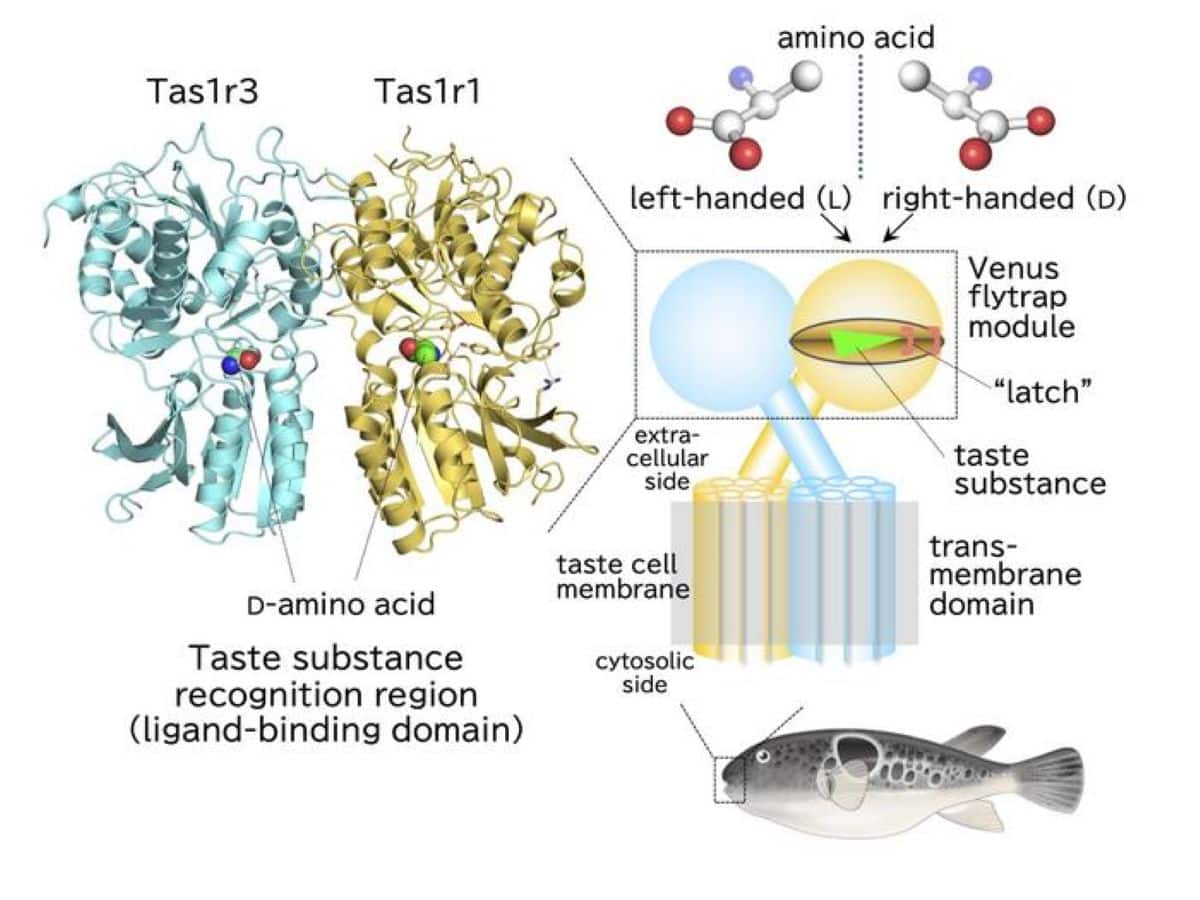
A University of Osaka team solved the first crystal structure of the pufferfish Tas1r1/Tas1r3 binding domain and found bridges between subdomains that keep the clamshell closed on an imperfect fit. Flavor design sits several steps downstream.
The Scientist · Science desk
What happened
- A University of Osaka-led team determined the first 3D crystal structure of the ligand-binding domain of the pufferfish umami-type receptor Tas1r1/Tas1r3, publishing in the Proceedings of the National Academy of Sciences.
- The pufferfish receptor binds and responds to both L-amino acids, usually tasted as savory, and D-amino acids, usually tasted as sweet.
- Senior author Atsuko Yamashita attributes the trait to the fish's diet of mollusks and crustaceans, which carry high concentrations of D-amino acids.
- The team says the work should feed into understanding of taste perception and into the design of new umami flavors for people and feed for livestock and fisheries.
Compiled by The ScientistSomething wrong?How this is made
Why it matters
- capability Atomic coordinates for a promiscuous taste receptor give protein engineers a specific set of contacts to try adding to an L-selective receptor, a test that had no structural starting point before.
- constraint Because the solved region stops at the ligand-binding domain, anyone designing a flavor compound off these coordinates still has to prove signaling in a cell assay rather than reading it off the model.
- decision Aquaculture feed formulators now have a receptor-level reason to screen D-amino acids as palatability additives for marine species, a question no human-receptor assay can settle.
The latch is a set of contacts between subdomains inside the receptor's extracellular binding region. In a class C G protein-coupled receptor, that region is shaped like a clamshell: a matching nutrient drops into the cleft and the clamp closes, and the closed state is what starts intracellular signaling, while a ligand of the wrong shape or the mirror-image chirality leaves the clamp open and the cascade quiet [6]. In the pufferfish receptor, bridges across the subdomains brace the cleft shut even when the fit is imperfect, holding the active conformation across a wide range of amino acids [7]. The team identified them from the crystal structure together with mutational analysis [7].
"Normally, a receptor is unable to bind to a molecule that is the wrong shape," senior author Atsuko Yamashita said [9].
In mammals the L-selective umami receptor is TAS1R1/TAS1R3, and the receptor that reads sugars and D-amino acids is TAS1R2/TAS1R3 [3]. The two pairings share the TAS1R3 subunit, and between them they split ligand classes that the single pufferfish Tas1r1/Tas1r3 pairing covers on its own [13]. The Osaka group describes that as a receptor expanding its range by acquiring intramolecular interactions that shift the conformational equilibrium toward the active state, with no new gene family required [8].
The crystal structure covers the ligand-binding domain, not the transmembrane part of the receptor that couples to a G protein [1]. How much signaling the latch mutants lost relative to wild type is in the paper; neither published summary reports it [14].
The evolutionary account is offered as an inference, and the authors say so. "We believe that the pufferfish's diet drives this molecular evolution," Yamashita said. "They eat a lot of mollusks and crustaceans, which contain high amounts of D-amino acids" [10]. The structure does not date the adaptation, and the sources report no comparison against fish with different diets [15].
The team expects the work to inform new umami flavors for humans and feed for livestock and fisheries [11]. The fisheries end is the nearer of the two: a fish receptor, fish ligands, and an outcome you can measure as feed intake. Designing a compound for human tongues runs through the human umami receptor, whose ligand recognition has stayed structurally obscure because purifying and stabilizing these fragile complexes in vitro has proved difficult [12].
What to watch
- Whether a full-length structure, including the transmembrane domain, shows how cleft closure reaches G protein coupling.
- Whether any group transplants the pufferfish latch contacts into a mammalian TAS1R1/TAS1R3 and gets a D-amino acid response, the direct test of engineerability.
- Whether feeding trials in farmed marine fish show D-amino acid supplementation changes intake.