Science1 publisher2 min readPublished
Platinum electrode lenses molded 10 isolated rabbit corneas to a target focus in about a minute
Chemist Michael Hill and surgeon Brian Wong reshaped 10 isolated rabbit corneas to a target focus using a platinum lens and a small current. The method removes no tissue, and so far the evidence is a conference talk on eyes taken out of the animals.
The Scientist · Science desk
Drafted by a language model from the sources cited here and checked against its claim ledger before publication. How we use AISend a correction
What happened
- The small current lowers the cornea's pH, loosening charge attractions in its collagen so it can conform, and the new shape holds once the original pH returns.
- The 10 corrected eyes came from a test set of 12, so two of the tested eyes fall outside the nearsightedness result.
- According to the American Chemical Society, cells in the treated eyes survived because the team kept careful control of the pH gradient.
- Separate experiments suggested the same technique might reverse some chemically induced clouding of the cornea.
Compiled by The ScientistSomething wrong?How this is made
Why it matters
- capability Because the method changes the chemistry that holds the cornea's shape, a correction made this way would keep the tissue that LASIK's laser removes.
- cost The researchers expect fewer steps and less expensive equipment than LASIK; that is a forecast, and a one-minute bench run does not establish how long a clinical procedure would take.
- constraint Any clinical case turns on how long the new curve lasts and how a living eye reacts, and tests on eyes removed from animals cannot settle either question.
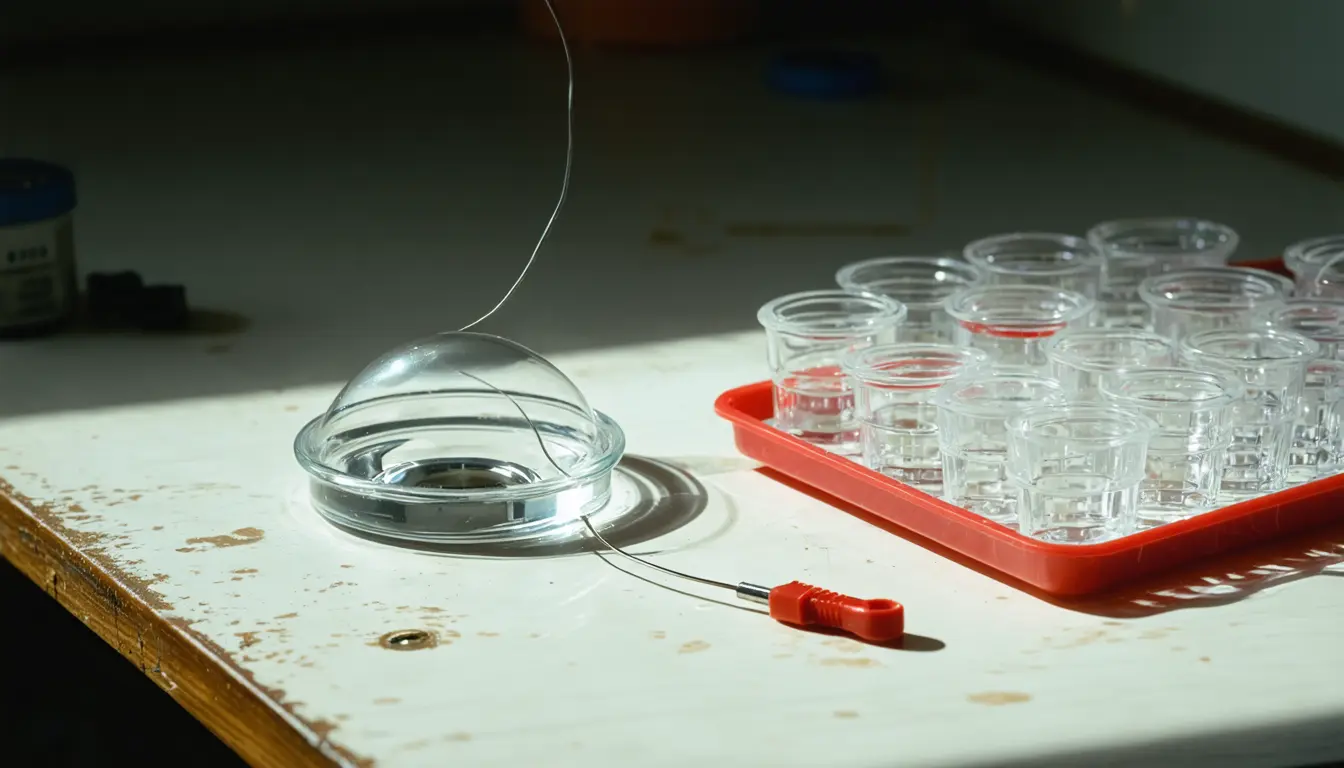
The design is the part I like best. Each platinum lens carries the curvature the team wants the cornea to adopt, and the same lens is the electrode that applies the potential [8]. One piece of metal starts the chemical change and sets the final curve [8].
The team calls the approach electromechanical reshaping, or EMR [17]. For the eye tests, the rabbit eyeballs sat in a saline solution meant to mimic tears. A platinum lens went over each one before the potential was applied [9]. A cross-sectional image released by ACS shows the result as two lines: white for the original corneal profile, yellow for the flatter shape after treatment [16].
Hill is blunt about the comparison. "LASIK is just a fancy way of doing traditional surgery. It's still carving tissue," he said [6]. Wong said the effect turned up while he was working on something broader. "The whole effect was discovered by accident," he said. "I was looking at living tissues as moldable materials and discovered this whole process of chemical modification." [10]
The team came to the cornea from other tissues. They had already applied EMR to rabbit ears and to pig skin and scars [14]. The eye adds a measurable optical target, focusing power, and each of the 10 eyes given the nearsightedness correction reached it [2].
Ten eyes is a feasibility count. It shows the process can move a cornea to a chosen focus on a bench, in about a minute per eye [1]. A sample that size is too small to estimate how often the process would miss its target, or by how much.
Hill presented the work at the American Chemical Society's fall meeting in August 2025 [3]. The announcement describes that presentation and does not identify a peer-reviewed paper [4].
What to watch
- A peer-reviewed paper from Hill and Wong with full methods and the outcomes for all 12 eyes tested.
- Experiments in living rabbits that track how long the reshaped corneal curve holds and how the eye responds over time.