Science1 publisher2 min readPublished
Photon counting pulled a 40-photon quantum reservoir out of ordinary bright light
Physicists at Louisiana State University report a quantum reservoir built from bright classical light and photon-by-photon detection, running at room temperature with 861 measurable components and multiphoton systems as large as 40 photons.
The Scientist · Science desk
What happened
- Louisiana State University physicists report in Advanced Science a multiphoton quantum reservoir that runs at room temperature while tolerating substantial noise and loss.
- The team started from bright, readily available classical light instead of a fragile quantum source, using an optical network and measurements that count photons one by one.
- The same device learned six very different mathematical functions without the reservoir being physically reconfigured between them.
Compiled by The ScientistSomething wrong?How this is made
Why it matters
- capability Multiphoton statistics become reachable for a lab with a bright beam and good photon counting, because the demanding step moves from preparing a quantum state to choosing which detection events to keep.
- constraint A machine that works by selecting particular photon-number events discards the shots that do not match, so its speed is governed by photon statistics and not by how fast the optics can be driven.
- decision Groups budgeting photonic hardware now have a live choice between spending on source quality and spending on photon-number resolution, since this result leans on the detection side.
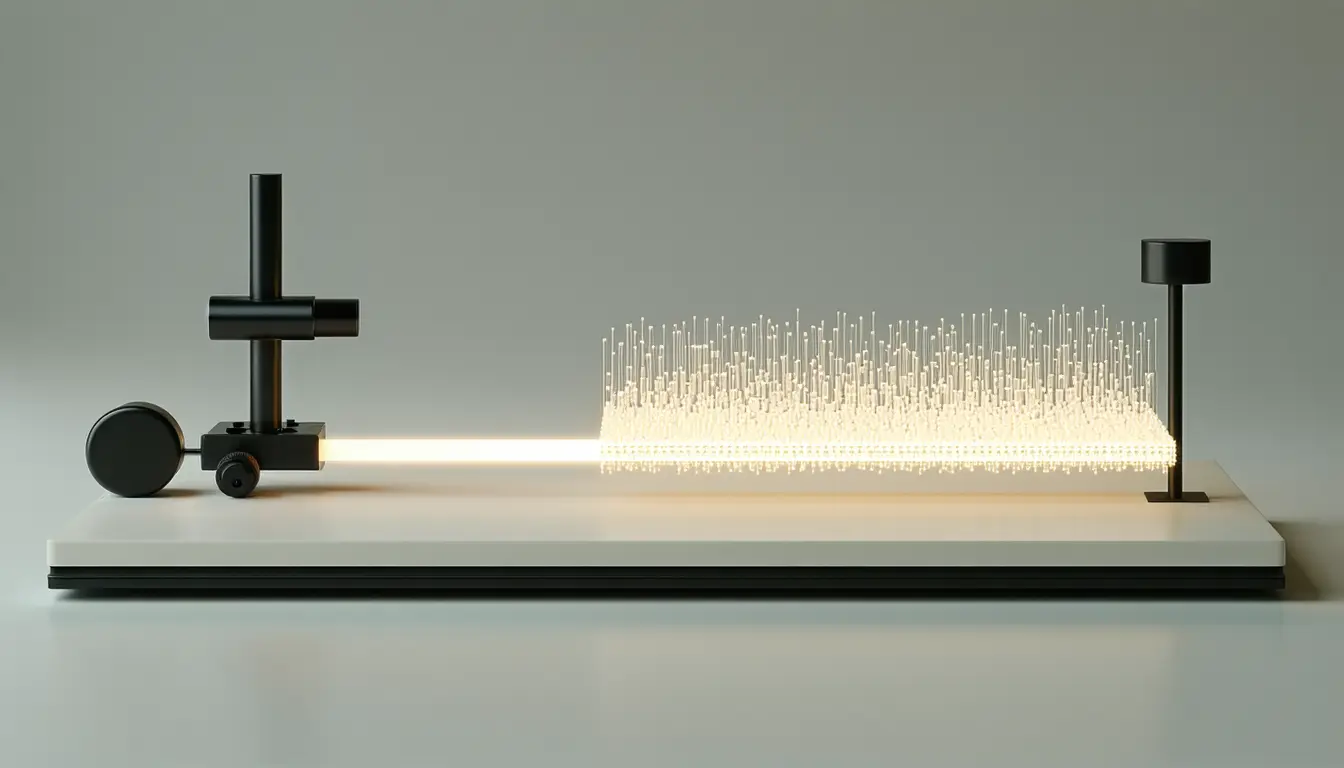
A bright beam delivers a different number of photons on every shot. The count at the detector wanders from shot to shot, and the LSU team used that wandering as the input to the machine [6]. Photon-number-resolving detectors, which distinguish how many photons arrive at once, sorted the events by count, and each selected count picked out a different multiphoton system inside the same classical field [5]. Bright classical light is the easy part to produce, and it can carry large photon numbers [7].
Size came from stacking three properties of the light. Polarization, spatial structure and photon number together gave the reservoir 861 measurable components [4]. That total factors as 41 times 21 [15], and the photon numbers from zero through forty are 41 distinct outcomes [16], which would be consistent with a 21-element mode basis read out at each photon number.
The learning test held the hardware still. The optical network sat in one randomly chosen configuration, inputs were encoded in the polarization of the light, and only the final readout was trained [11]. Six very different mathematical functions came out of that same unchanged configuration [12]. Because the optics were never retuned between tasks, the fit to any one function cannot be credited to adjusting the network for it. In reservoir computing the physical system supplies the complexity and only a simple readout is trained [8].
Omar S. Magaña-Loaiza, the associate professor who leads LSU's Quantum Photonics Laboratory, said: "Rather than requiring perfectly isolated and extremely fragile quantum systems, we show that useful quantum behavior can be extracted from ordinary classical light, even in the presence of substantial noise and loss" [13]. He said the platform "operates at room temperature and gives us access to multiparticle quantum systems containing up to 40 particles" [14]. The group reports it as the first robust multiphoton quantum reservoir of its kind to work at room temperature while tolerating substantial noise and loss [1].
Selection costs shots. Only the events whose photon count matches the chosen number feed the output [5], so how often those events arrive sets the rate at which such a machine can compute. The paper does not give that number.
As physics, the simulation runs carry more weight than the function fitting. Photon-number measurements recovered the spreading of a quantum random walk through a noisy optical network [9], and a synthetic lattice built from different states of light reproduced both thermalization and anti-thermalization, in which fluctuations in a many-particle system grow or shrink as it evolves [10].
What to watch
- A stated rate for the selected photon-number events: the output rate of any machine built this way depends on it.
- Whether the photon-number-resolving detectors themselves run warm; the temperature claim covers the platform, and the detector technology goes unnamed.
- A head-to-head against a classical reservoir with a comparable number of readout features. That would test whether the multiphoton statistics add anything.