Science1 publisher3 min readPublished Updated
Rydberg chain spectra match Ising CFT predictions, turning a simulator into an instrument
Modulation spectroscopy on a neutral atom chain recovered the universal energy ratios of Ising and tricritical Ising CFTs, according to a report in Nature. Boundary conditions were set by local detunings at the edges.
The Scientist · Science desk
Drafted by a language model from the sources cited here and checked against its claim ledger before publication. How we use AISend a correction
What happened
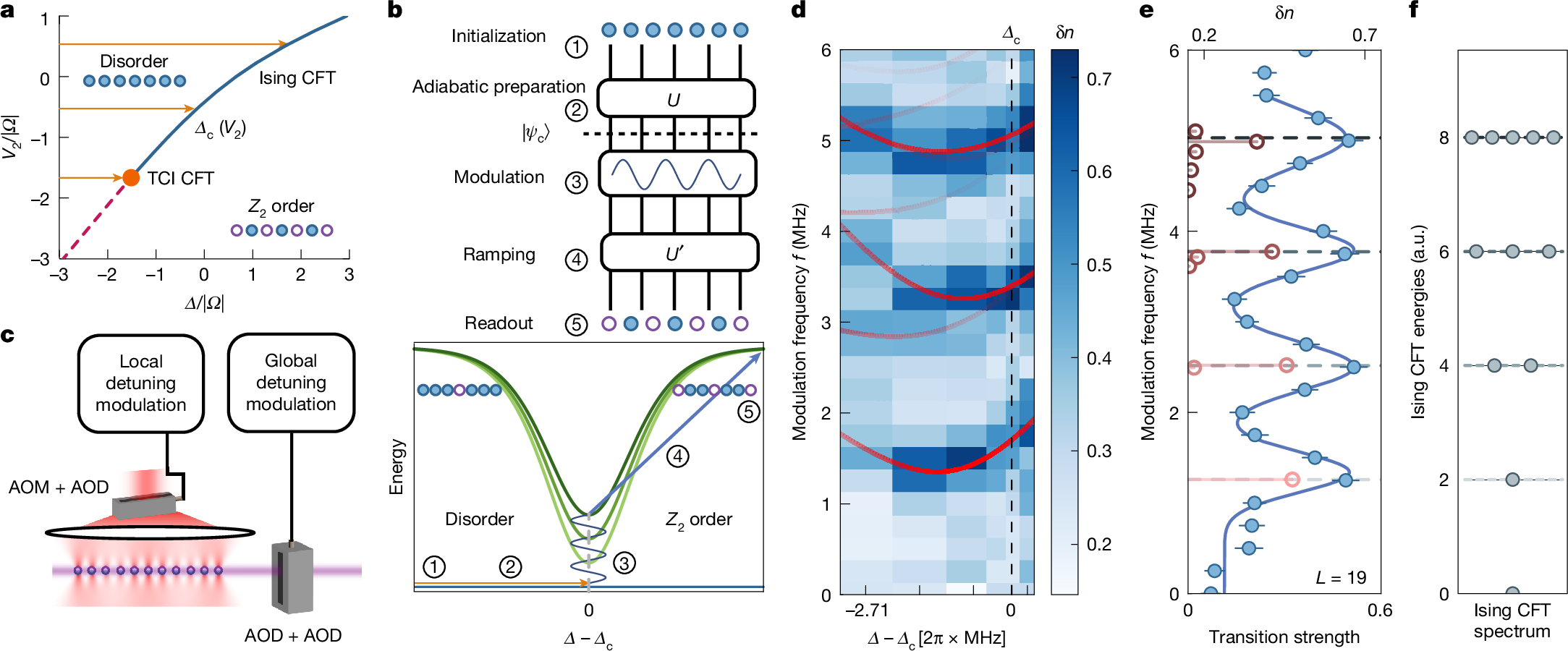
- The authors directly observe the energy excitation spectra of emergent conformal field theories at quantum phase transitions, recovering universal energy ratios characteristic of the underlying field theories.
- The team developed and implemented a modulation technique to resolve the finite-size spectra of a Rydberg chain, variably tuned to quantum phase transitions described by either Ising or tricritical Ising CFTs.
- Local control was used to distinguish parities of excitations under reflection.
- In the tricritical Ising chain, local control was used to induce transitions between distinct CFT spectra associated with changing boundary conditions.
- Using a variant of the modulation technique, the authors studied the dynamical structure factor of the critical system, which is closely related to the correlation of an underlying Ising conformal field.
Compiled by The ScientistSomething wrong?How this is made
Why it matters
Researchers reporting in Nature have measured the finite-size many-body excitation spectrum of a programmable neutral atom simulator tuned to one-dimensional quantum phase transitions, and recovered the universal energy ratios of the Ising and tricritical Ising conformal field theories that govern them [1][2][10][20]. The consequence is a change of role: the machine is not demonstrating that it can sit near a critical point, it is returning the numbers that identify which field theory the critical point belongs to [8][16].
Why the spectrum is the useful observable goes back to Cardy in the 1980s. In a finite system, the pattern of low-lying energy levels reveals the operator content of the underlying CFT, meaning which fields are present and what their scaling dimensions are [8]. Conformal symmetry is not a microscopic property of the atoms; it emerges at long distances and low energies near a zero-temperature critical point separating phases [17][19]. The technique here is modulation spectroscopy, coherent control between many-body states in targeted symmetry sectors, applied to a Rydberg chain variably tuned to either Ising or tricritical Ising criticality [2][21]. In the Ising case the authors report that measured excitation energies match universal Ising CFT predictions for open chains in both their ratios and their scaling with system size [11].
The ratio part matters for instrument credibility. Ratios of energies are dimensionless, so agreement of a ratio does not depend on absolute calibration of the energy scale [22].
Two further controls push past a single spectrum. Local detuning at the chain edges changes the boundary condition, which in CFT filters which operators are allowed and therefore reshapes the observable low-energy spectrum [9]; at the tricritical point the group reports signatures consistent with three distinct tricritical Ising fixed-point boundary conditions [12], and describes inducing transitions between the distinct spectra those boundary conditions produce [4]. Local control was also used to separate excitations by their parity under reflection [3]. A variant of the same modulation method yielded the dynamical structure factor, which is closely related to the correlation of an underlying Ising conformal field [5].
Context for how thin the prior record is. In quantum materials, CFT properties have been approached with inelastic neutron scattering on magnetic insulators and quantum Hall systems, and with electrical and thermal transport, which reveal selected properties [13]. Simulator work has shown power-law correlations while accounting for open-system effects that suppress long-range signatures of critical ground states, and has probed dynamics including Kibble-Zurek scaling and late-time quantum coarsening on ramps through transitions [14][15]. A direct measurement of CFT excitation spectra, the authors write, had remained outstanding in solid-state systems and quantum simulators alike [16], and much of the structure CFTs predict is still unobserved [7].
Caveats worth stating: the material available here is the abstract and opening of the paper, which do not give chain lengths, atom counts or measurement uncertainties, and "agree well" is the authors' own characterization of the Ising comparison [11][23].
What to watch is the claim with the longest reach: that the method can diagnose a priori unknown universality classes in future experiments [6]. The test of that is a critical point whose field theory is not already fixed by theory or numerics, since the Ising and tricritical Ising answers were known in advance [1][11]. Also worth tracking is whether boundary-condition switching at the tricritical point resolves further levels [12], and whether other groups reproduce the ratios on their own hardware.