Science1 publisher3 min readPublished
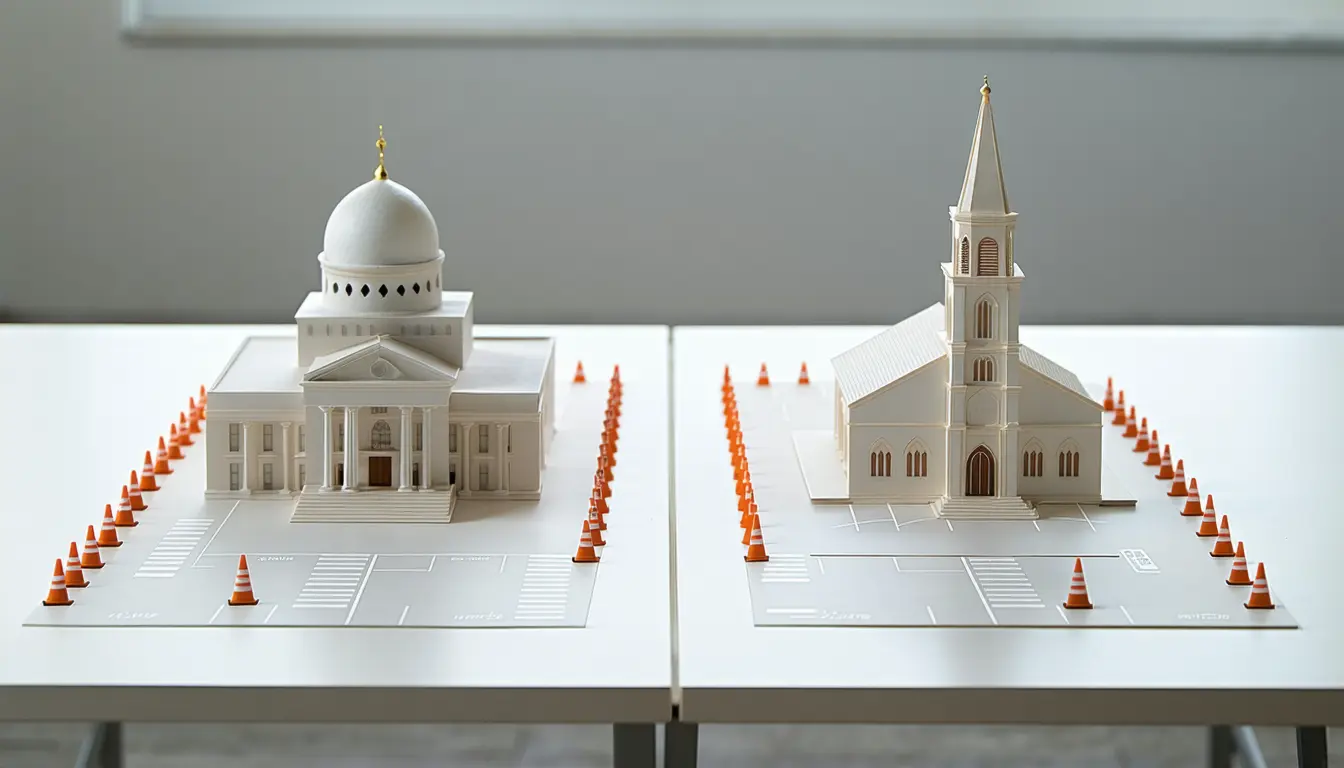
New US mosques drew more opposition than paired churches even with surplus parking
UC Santa Cruz and UCLA researchers found that new US mosques were 16% to 18% more likely than nearby new churches to face opposition, in a study of 107 pairs. The authors say parking complaints often mask anti-Muslim prejudice, an inference the paired design supports but cannot prove on its own.
The Scientist · Science desk
What happened
- Only 5 of the 107 comparison churches drew any opposition reported in local news coverage.
- Most projects of both faiths built more parking than required, with the median mosque at 113% of its code requirement and the median church at 107%.
- In Goleta, the Islamic Society of Santa Barbara's mosque went through 16 hearings and 10 years of permitting, opening in 2019 nearly 19 years after the land purchase.
Compiled by The ScientistSomething wrong?How this is made
Why it matters
- constraint Building above the parking minimum did not keep mosque projects out of disputes, so congregations cannot count on code compliance to shorten a contested approval.
- contradiction Quoted as 16 to 18 percent, the gap looks modest; on the raw counts mosques drew opposition about four times as often, so anyone citing the study needs to name the scale.
- capability Pairing each minority-faith project with a nearby majority-faith one gives planning departments and researchers a repeatable test for bias in public hearings.
Each of the 107 mosques was matched with a newly built church nearby [3]. That pairing is the control. It holds location roughly constant, so if parking objections were simply what neighbours say about any new house of worship, the churches should have drawn them at a similar rate. Five of the 107 churches drew reported opposition of any kind [5].
The parking figures make the complaints harder to take at face value. Most projects of both faiths built more parking than their local government required, with the median mosque at 113 percent of its requirement and the median church at 107 percent [6]. By the standard a planning code enforces, the mosques were the better-supplied group [6]. A code minimum is a legal floor fixed in advance, and meeting it is a separate question from how full the lot gets at the busiest service. Even so, I think the pairing and the surplus together rule out the simplest explanation: that mosques drew parking complaints because they built too little parking [14].
The phys.org summary gives the gap as 16 to 18 percent [2]. Its own counts imply a larger contrast. About 20 percent of 107 is roughly 21 mosques facing opposition [2], against five churches, or 4.7 percent [1]. That is a difference of about 15 percentage points and a ratio of about four to one [3]. The article does not say whether the 16-to-18 figure is in percentage points or relative terms, or what the model behind it adjusts for. Percentage points fits the raw counts; read as a relative increase, the figure would badly understate them [3]. Parking came up in more than half of the mosque disputes, so roughly 11 or more of the 107 mosques, about one in ten, met a parking objection that made the local news [4].
Moving from that gap to prejudice is the researchers' inference [11], and the design supports it without proving motive. Opposition was counted from local news coverage [3]. If a paper treats a contested mosque hearing as a story and a contested church hearing as routine, the measured gap widens with no change in what residents said. The team's other evidence is the check on that: public records of city council hearings on mosque construction nationwide, and interviews with planners, elected officials and religious leaders in case studies in four regions [8].
Huzaifa Shahbaz, a UC Santa Cruz doctoral student on the team, was formerly a senior researcher at the Council on American-Islamic Relations, and CAIR's San Francisco Bay Area chapter was a community partner on the research [12].
Adam Millard-Ball, a UCLA urban planning professor and study author, places the result in a longer record of procedural objections to affordable housing [13]. "It's attractive as a disguise because parking is also a genuine concern for many people, and so separating the parking from the prejudice is a challenge," he said [10]. Mark Fathi Massoud, the UC Santa Cruz politics and legal studies professor who is the senior author, named both fears. "A fear of religion and religious minorities exists in many areas of America, as much as we care about religious freedom. But there's also the fear of not enough parking," he said [9].
What to watch
- Whether the full Journal of the American Planning Association paper states the 16-18% gap in percentage points or relative terms, and what its model adjusts for.
- Whether the city council hearing records, counted independently of news coverage, show the same mosque-church gap.