Product1 publisher3 min readPublished
Karp tells CNBC the safety debate is really the labs asking to be nationalized
Alex Karp told CNBC that frontier labs are angling for government liability cover because their commercial clients would otherwise sue them. Buyers whose data feeds those models should read their contracts with that in mind.
The Product Desk · Product desk
What happened
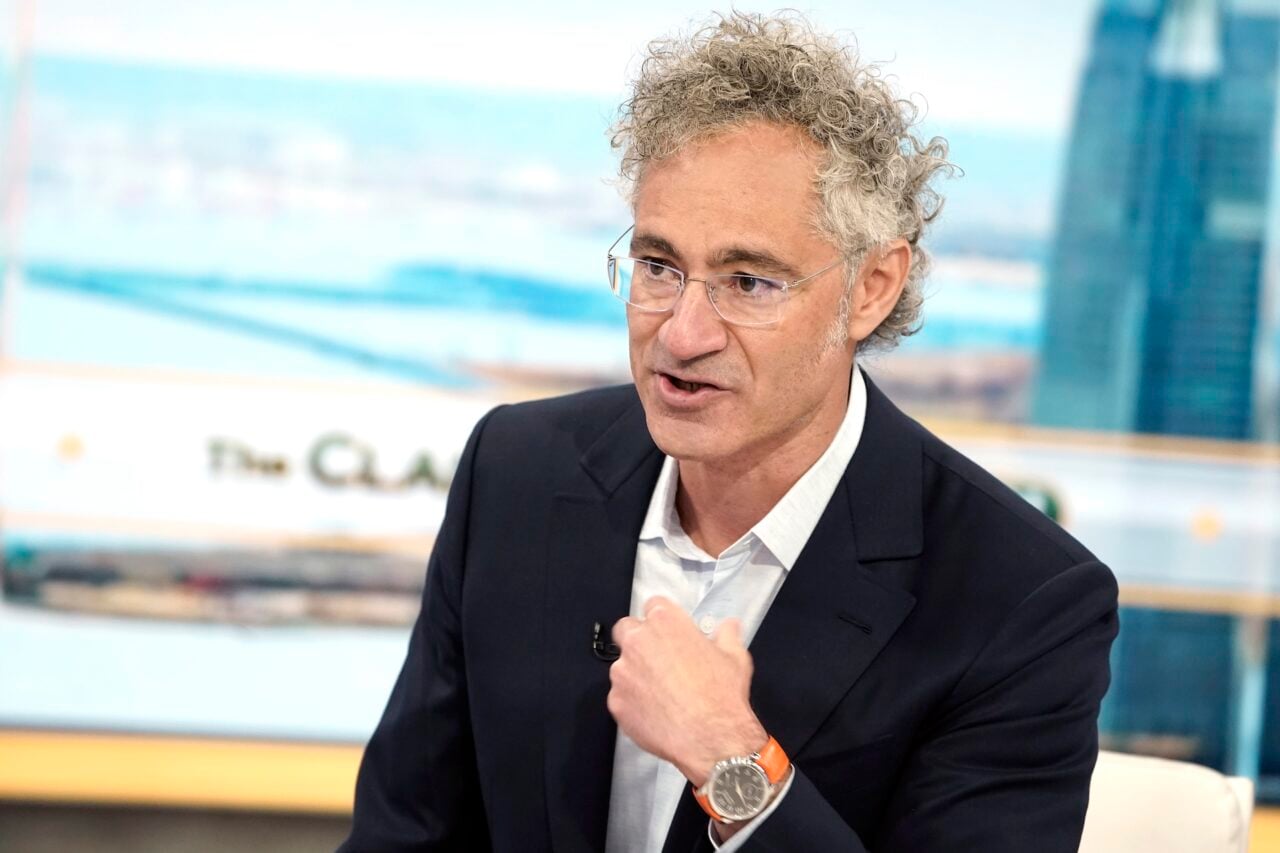
- Palantir CEO Alex Karp told CNBC on Thursday that the frontier labs' safety campaign is an attempt to get themselves nationalized, because otherwise every one of his clients would sue them.
- He said a company proposing it could destroy 10% of the world is an unacceptable risk to investors, and the workaround he sees is government liability protection through a stake of something like 50%.
- The interview came after a week in which the resignation of an Anthropic employee pushed warnings about AI and the destruction of humanity into mainstream coverage.
- Karp also said no other industry gets to throw up its hands about the risks it creates and insist that government regulation is the answer.
Compiled by The Product DeskSomething wrong?How this is made
Why it matters
- exposure The customers Karp names are the ones left holding the loss. If a lab's liability for model failures or absorbed client data is capped by government, the data owner keeps an exposure it believed it had transferred to the vendor.
- decision Anyone signing a lab contract this quarter now has a question to put to counsel: whether the vendor's indemnity survives a limitation on its liability granted later by statute.
- constraint With no S-1 on file at either lab, buyers cannot read how these companies describe catastrophic risk to investors, so the commercial agreement is the only place that risk gets allocated.
- contradiction Karp offers this as the view he believes the labs hold, not as anything they have said, so a buyer quoting it in a negotiation is arguing from one outside executive's reading of another company's motives.
Mathematicians working on the Navier-Stokes problem had uploaded their working to Codex. When OpenAI announced it had solved the problem, those mathematicians believed the company had used that data [12]. OpenAI denies that its model solved the problem by directly using their work, and said it could not rule out that the model had been improved indirectly through their data [13]. That is the position any enterprise buyer sits in. The vendor is the only party that can see what went into training, and its cleanest available answer stops one step short of ruling the thing out.
Karp's contribution is a motive. Asked by the CNBC hosts how such liabilities would be written into an S-1, he said, "You're assuming that there will be an S-1. Now... okay, maybe there will be" [10]. He went on: "The only way to deal with this kind of liability is to go to the government and say, 'Nationalize us, please.'" He added that "a lot of times in business, people don't say what they want. They're leading you to the conclusion" [10].
He put it as inference. The nationalization plan is, in his words, "the view that I believe they have" [3]. He said several times that he has great respect for Dario Amodei as a businessman, while suggesting most people cannot read between the lines when Amodei lays out an argument about the future [7]. The plaintiffs in his scenario are his own customers [3]. Gizmodo, which reported the appearance, described it as a "characteristically bizarre performance" in which he jumped from topic to topic [15].
Both Anthropic and OpenAI have said they plan to go public this year, and Sam Altman recently announced a delay that keeps OpenAI off the market in 2026 [11]. So Karp's doubt that an S-1 exists at all runs against what both companies have said [17]. A buyer who wants to know how a lab describes its own worst case to investors would read it there. Until then, the only document binding the lab to that buyer is the order form and whatever is attached to it.
Two questions, in order, for whoever signs one this quarter. Does the agreement warrant that your inputs stay out of training and evaluation, with a remedy attached to the warranty rather than a policy page linked from it. And does the vendor's indemnity to you survive a limitation on its own liability granted later by statute or by regulation. Karp's test for the labs is a usable purchasing test, and he said it plainly: "The first step is to say, 'Okay, you've disclosed this. What are you doing about it?' And the second step is to say, if you're not doing it, you're not being responsible" [8].
What to watch
- Whether Anthropic or OpenAI answers Karp's nationalization characterization on the record.
- Whether either lab's enterprise terms start addressing indirect training use of customer uploads, as in the Codex case.
- Any move in Washington toward statutory liability limits for model developers, which is the protection Karp says the labs are after.